
What you are trying to prove
The aim is simple to say and easy to miss: the equipment must not be able to start, move, or release energy while someone is exposed. Electrical energy is only one source. You also have to think about pressure, gravity, hydraulics, pneumatics, steam, chemicals, and stored mechanical energy such as a raised load or a compressed spring.
OSHA’s control of hazardous energy standard, 29 CFR 1910.147, is the reference many client procedures are built from. Follow the written procedure for your site first; the OSHA steps below are the backbone that should still be recognisable in that procedure.
A working sequence
- Prepare. Identify every energy source, the correct isolation points, and who will be affected. Walk the equipment, do not rely only on a drawing from another unit.
- Notify affected people, then shut down the equipment in the normal way, so you do not create a new hazard during the stop.
- Isolate each energy source at the point that actually cuts the energy, not at a local switch that can be overridden if the procedure requires a higher isolator.
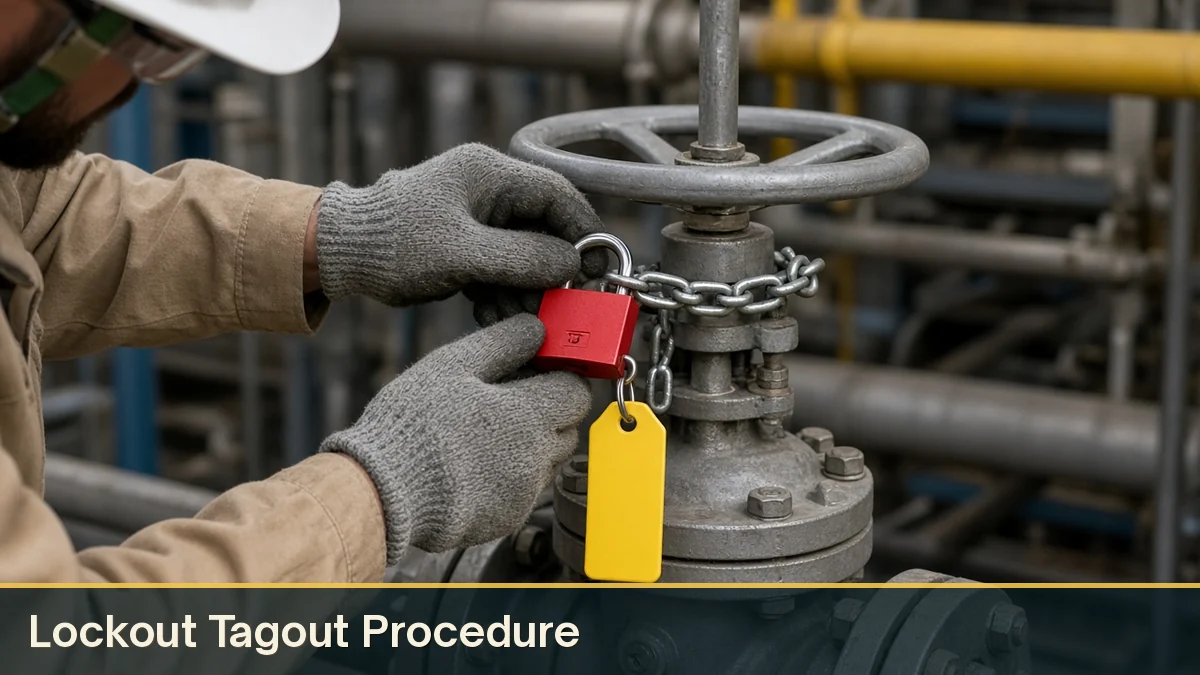
- Apply the lockout device and a clear tag. Each person exposed should have a personal lock, or work under a group-lock procedure that still gives them an equivalent personal hold.
- Release or restrain stored energy: drain, vent, discharge, block, or lower, as the procedure requires.
- Verify. Try to start, watch the gauge, use a test method that is allowed on that system, and prove zero energy before tools go on the job.
- When the work is done, inspect the area, remove tools, confirm people are clear, remove locks in the agreed order, and only then re-energise.
Sites sometimes teach this as six or seven steps, depending on whether notification and return-to-service are counted separately. Do not argue about the numbering. Do not skip verification.
Record the isolations on the site register. The LOTO isolation register is the running evidence of what is locked, who owns the lock, and what has been removed. A permit that says “isolated” with no register entry and no lock number is a claim, not a proof.
A field situation that goes wrong
A pump is tagged out for a seal change. The electrical isolator has a tag on it, but no lock, because “the switch room is controlled.” A second crew, looking for the cause of a low-flow alarm, finds the switch in the off position, assumes it was bumped, and closes it. The person working on the seal is then exposed to rotation and residual product.
The failure was not a lack of a form. It was an isolation that any other person could undo, and a verification that was never tried. A personal lock, a register entry, and a start-attempt or equivalent proof would have stood in the way.
Common failures to brief
- A tag only, where the site procedure requires a lock, or a lock that is not unique to the person.
- Keys left in locks, or one person holding everyone else’s keys “for convenience.”
- Locking a local control while a remote start, a second feed, or a stored-energy source is still live.
- Forgetting residual pressure in a line, a raised ram, or a capacitor.
- Removing someone else’s lock, or cutting a lock, without the formal emergency procedure.
- Handing the job to the next shift without a handover of locks and permit status. Use a proper permit handover.
Electrical work also needs the right test equipment and competence; a general LOTO talk does not turn a helper into an authorised electrical person. For electrical devices and residual shock risk, site electrical rules sit on top of this procedure, alongside practical guidance such as the site’s rules on protective devices where those apply to the installation.
If you cannot prove isolation, you do not start. That sentence belongs in the JSA and in the permit briefing, not only in a training slide.
1. What is the purpose of a lockout-tagout procedure?
LOTO is a verified isolation process. Labels after the fact, or a shared company lock that anyone can open, miss the point.
2. Which step is most often skipped, and should not be?
Applying a lock without proving that the energy is gone is a common failure. Verification is part of the procedure, not an optional extra.
3. A switch has a tag but no lock, and another crew can operate it. What is the problem?
Where a lock is required, a tag alone can be ignored or removed. The isolation must not be reversible by a person who is not part of the procedure.
4. Why is residual pressure or a raised load part of LOTO?
Hazardous energy includes pressure, gravity, hydraulics and stored mechanical energy. Isolating a motor starter does not empty a charged line.
5. What should happen at shift change on a locked-out job?
Shift change is a known failure point. Isolation ownership must stay continuous. Cutting or clearing locks without the formal process is dangerous.
Frequently asked questions
What is a lockout-tagout procedure?
It is the written process for shutting down equipment, isolating its energy sources, applying locks and tags, releasing stored energy, verifying zero energy, doing the work, and then restoring the equipment in a controlled way.
What are the main steps?
Prepare and notify, shut down, isolate, apply lockout and tagout devices, release stored energy, verify isolation, carry out the work, then clear the area and restore energy under the procedure. Your site may split notification or restoration as separate steps.
Is a tag without a lock acceptable?
Only if the written procedure and the legal standard that applies to that workplace allow a tagout-only method, with the extra measures those rules require. On most industrial sites a lockable isolator must be locked. Do not invent a tag-only practice because it is quicker.
Who may apply and remove a lock?
The authorised person who applied a personal lock normally removes it. Removal of another person’s lock is an emergency process with formal authorisation, not a courtesy at the end of a shift.
How does LOTO relate to the permit?
The permit authorises the work. The isolation register and the locks prove the energy is controlled. One is not a substitute for the other.