
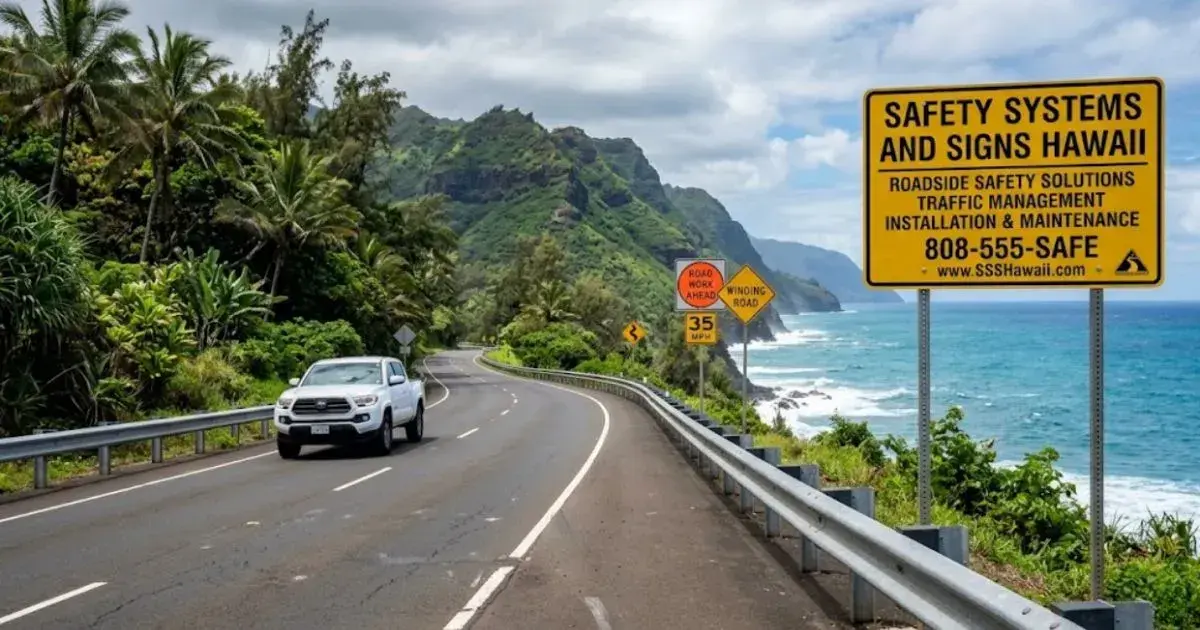
Safety signs are not decorative. When it comes to safety systems and signs Hawaii workplaces rely on, they are legally enforceable communication tools — and failure to post the correct sign in the correct format can result in HIOSH citations, fines, and, more critically, worker fatalities.
Hawaii enforces its own occupational safety and health regulations through the Hawaii Occupational Safety and Health Division (HIOSH), which operates as a federally approved OSHA State Plan under 29 CFR Part 1902.
Understanding safety systems and signs Hawaii regulations require is not optional for any employer operating across the islands. This guide covers the sign categories, color codes, ANSI Z535 standards, and HIOSH-specific requirements your site must meet — whether you manage a construction site in Honolulu, a facility on Maui, or a warehouse on the Big Island.
What Are Safety Systems and Signs?
Safety systems are structured programs that combine physical controls, administrative procedures, and visual communication to eliminate or reduce workplace hazards. Safety signs are the visible layer of that system — they communicate hazards, required PPE (Personal Protective Equipment), prohibited actions, and emergency instructions at the point of risk.
OSHA defines safety signs under 29 CFR 1910.145 (general industry) and 29 CFR 1926.200 (construction). Both standards require that signs be legible, durable, and positioned where workers will encounter them before exposure to the hazard — not after.
In Hawaii, HIOSH adopts these federal standards and enforces them independently. Your signs must comply with both the federal CFR baseline and any HIOSH-specific amendments published in the Hawaii Administrative Rules (HAR) Title 12, Subtitle 8.
Who does this apply to? Every employer in Hawaii with one or more employees, including construction contractors, hospitality facilities with back-of-house operations, agricultural operations, and marine industry employers.
HIOSH and Federal Legal Requirements
Hawaii is one of 22 states operating an OSHA-approved State Plan for private-sector employers. HIOSH must maintain standards that are “at least as effective” as federal OSHA — and in some areas, HIOSH exceeds the federal baseline.
Governing Standards for Safety Signs in Hawaii
| Standard | Scope | Enforced By |
|---|---|---|
| 29 CFR 1910.145 | General industry signs and tags | HIOSH (via State Plan) |
| 29 CFR 1926.200 | Construction site signs and signals | HIOSH |
| ANSI Z535.1–Z535.6 | Color, format, and symbol requirements | Referenced by HIOSH |
| ISO 7010 | Internationally harmonized safety symbols | Increasingly referenced |
| HAR Title 12, Subtitle 8 | Hawaii-specific OSH rules | HIOSH exclusively |
29 CFR 1910.145(c)(1) requires danger signs to use red, black, and white only. 29 CFR 1910.145(c)(2) requires caution signs to be yellow with black lettering. These are not suggestions — they are enforceable color requirements.
ANSI Z535 is the primary American standard governing the full sign system: Z535.1 covers safety colors, Z535.2 covers environmental and facility signs, Z535.4 covers product safety signs, and Z535.5 covers tags and labels.
Regulatory note: Regulations may vary by jurisdiction and industry sector. Always verify current HIOSH requirements directly with the Hawaii Department of Labor and Industrial Relations (DLIR) or your HIOSH compliance officer.
Types of Safety Signs and Color Codes
Understanding sign hierarchy is the foundation of any compliant safety system. The five signal words — each tied to a specific color and hazard severity — are defined under ANSI Z535.
The Five ANSI Z535 Sign Categories
1. DANGER (Red/White/Black) I: indicates an imminently hazardous situation that will result in death or serious injury if not avoided. Use only for the highest-severity hazards. Example: “DANGER — HIGH VOLTAGE — DO NOT ENTER.”
2. WARNING (Orange/Black) A potentially hazardous situation that could result in death or serious injury. Example: “WARNING — ROTATING MACHINERY — KEEP GUARDS IN PLACE.”
3. CAUTION (Yellow/Black) A potentially hazardous situation that may result in minor or moderate injury. Also used for property damage hazards. Example: “CAUTION — WET FLOOR.”
4. NOTICE (Blue/White) Non-hazard information — procedural, housekeeping, or equipment instructions. Example: “NOTICE — AUTHORIZED PERSONNEL ONLY.”
5. SAFETY INSTRUCTION (Green/White) Positive safety messages, first aid locations, and emergency procedures. Example: “SAFETY FIRST — WEAR YOUR PPE BEYOND THIS POINT.”
Mandatory Sign Locations in Hawaii Workplaces
- All entrances to restricted or hazardous areas
- Adjacent to LOTO (Lockout/Tagout) energy isolation points
- At chemical storage and SDS (Safety Data Sheet) stations
- Emergency exit routes and muster points
- Crane, forklift, and overhead load travel paths
- Electrical panels and switchgear rooms
- Any area requiring respiratory protection or hearing protection
How to Select and Install Safety Signs
Choosing the wrong sign — or placing the right sign in the wrong location — creates false assurance. Follow this process:
Also read: How Many Categories Of Struck-By Hazards Are There Really? (2026 Update)
Step 1: Conduct a Hazard Identification Walk
Walk every area of your facility with a JSA (Job Safety Analysis) worksheet. Identify every hazard by type: chemical, physical, electrical, biological, or ergonomic. Map hazard locations on a site plan.
Step 2: Assign Signal Words Using ANSI Z535 Severity Matrix
Match each identified hazard to the correct signal word using the probability × severity matrix. If the hazard can cause death under any foreseeable circumstance, it requires DANGER classification — not WARNING.
Step 3: Select Sign Format and Symbols
Under ANSI Z535.2 and Z535.3, signs must include:
- The signal word panel (color-coded header)
- A safety symbol or pictogram (ISO 7010 symbols are preferred)
- A message panel in English — and in Hawaii, bilingual posting in Tagalog, Ilocano, Japanese, or Spanish is strongly recommended, given the workforce demographics
Step 4: Verify Material and Durability Requirements
29 CFR 1910.145(d)(1) requires signs to be of substantial construction. In Hawaii’s coastal and high-humidity environments, aluminum or UV-stabilized plastic signs outperform paper and cardboard-backed materials. Salt air corrosion is a real failure point on Oahu and neighbor island industrial sites.
Step 5: Mount at Correct Height and Visibility Distance
ANSI Z535.2 recommends sign placement so the message panel is at eye level (approximately 1.5m / 5 feet) for stationary viewing. For moving vehicle paths, mount at a height and distance that allows a loaded forklift operator to read the sign before reaching the hazard zone — typically 3–5 seconds of travel time at operating speed.
Step 6: Document, Inspect, and Replace
Log all signs in your facility safety register. Inspect quarterly. Replace any sign with fading, damage, or illegible text. Under 29 CFR 1910.145(d)(4), signs with safety instructions or warnings must be maintained in legible condition at all times.
Common Violations and Mistakes
During HIOSH inspections and internal audits, the same failures appear repeatedly. Here are the seven most cited errors — and how to correct them.
1. Using the Wrong Signal Word for Hazard Severi.ty. Site managers use “CAUTION” for electrical hazards that qualify as “DANGER.” This is a direct violation of 29 CFR 1910.145(c). Fix: Re-evaluate every sign against the ANSI severity matrix annually.
2. Missing Signs at LOTO Points Lockout/Tagout procedures require both a lock and a tag. Many sites have the loc, but no durable “DANGER — DO NOT OPERATE” tag attached. 29 CFR 1910.147 requires the tag to state the reason for the lockout and identify the authorized employee.
3. Signs Posted Behind Other Equipment or Obstructed. A sign blocked by a pallet rack, a machine guard, or a door swing provides zero protection. HIOSH inspectors will cite this as a recordable condition. Fix: Include sign visibility in every quarterly inspection checklist.
4. No Bilingual Signage in Mixed-Language Workforces HIOSH does not mandate bilingual signs by CFR citation — but under the General Duty Clause (Section 5(a)(1)), employers must provide a workplace free from recognized hazards. If your workforce does not read English as a primary language and your signs are English-only, a General Duty citation is defensible against you. In Hawaii, this applies directly to Filipino, Japanese, and Spanish-speaking workers.
5. SDS Signs and Chemical Identification Missing Under 29 CFR 1910.1200 (HAZCOM), containers must be labeled with the product identifier and GHS hazard pictograms. Many facilities label primary containers but fail to label secondary containers (transfer containers, spray bottles, decanted materials). Each is a separate citation.
6. Exit Signs Not Maintained or Illuminated 29 CFR 1910.37(b)(6) requires exit signs to be illuminated to a surface value of at least 5 foot-candles. Battery backup failure in exit signs is one of the most common findings in HIOSH general industry inspections statewide.
7. Temporary Construction Signs Left Permanently. Construction sites in Hawaii frequently use temporary paper or adhesive signs during project phases, then never remove or replace them with permanent compliant signs after work is complete. Faded, peeling, or incomplete signs are not compliant signs.
Safety Sign Compliance Checklist
Use this checklist during your quarterly sign inspection. Check each item against your facility floor plan.
Sign Inventory and Classification
- All hazardous areas were identified and mapped in the risk assessment
- Each hazard is assigned a signal word (DANGER / WARNING / CAUTION / NOTICE / SAFETY)
- ANSI Z535 color code verified for each sign category
- ISO 7010 symbols used where applicable
Physical Condition
- All signs legible — no fading, peeling, or discoloration
- Signs made of durable material appropriate for Hawaii’s humidity and salt air
- No signs obstructed by equipment, storage, or structural elements
Placement and Coverage
- Signs are posted at all hazardous area entry points
- LOTO danger tags are attached to every energy isolation point in use
- Chemical containers (primary and secondary) labeled per GHS/HAZCOM
- Exit signs are illuminated, and battery backup is tested within the last 12 months
- Emergency egress route signs are posted and unobstructed
Language and Accessibility
- Bilingual signs are posted where non-English-speaking workers are present
- Signs visible and readable from approach distance for vehicle traffic zones
Documentation
- Sign inventory log updated
- Inspection date, inspector name, and findings recorded
- Replacement signs are ordered for any failed items
Download the full Safety Sign Inspection Template from the [HSE Documentation library on hse-documents.com — safety signage templates].
Hawaii-Specific Workplace Considerations
Hawaii’s geography, workforce composition, and industry mix create compliance challenges that mainland-focused safety programs often miss.
HIOSH Enforcement and Inspection Rates
HIOSH conducts programmed (planned) and unprogrammed (complaint-driven) inspections. Hawaii’s construction sector — particularly residential and resort construction on Maui and the Big Island — is a priority target for programmed inspections under the HIOSH Site-Specific Targeting (SST) program. If your DART rate (Days Away, Restricted, or Transferred) exceeds your industry average, expect a programmed inspection.
Marine and Port Industry
Hawaii’s significant maritime and port workforce is subject to 29 CFR Part 1917 (marine terminals) and 29 CFR Part 1918 (longshoring) in addition to standard HIOSH sign requirements. Marine terminal signs must additionally address vessel boarding hazards, crane load zones, and tidal/wave exposure areas.
Agriculture
Hawaii’s agricultural sector — including pineapple operations, coffee farming, and macadamia nut processing — falls under 29 CFR Part 1928 (agricultural operations). Chemical signs and SDS compliance are especially critical given pesticide use. HIOSH has issued targeted enforcement guidance for agricultural chemical sign compliance in recent years.
Multilingual Workforce Requirements
Hawaii’s workforce includes significant populations of workers whose primary languages include Tagalog, Ilocano, Marshallese, Japanese, Korean, and Spanish. While the CFR does not mandate translated signs in all cases, HIOSH’s application of the General Duty Clause in Hawaii has supported citations where language barriers contributed to hazard exposure. Post bilingual signs anywhere your workforce demographic indicates a language gap.
Volcanic and Environmental Hazard Signage
Worksites on Hawaii Island (Big Island) near active volcanic zones must include signage addressing volcanic gas (SO₂/H₂S) hazards, laze exposure (hydrochloric acid steam from lava meeting ocean), and air quality alerts. OSHA’s General Duty Clause requires employers to address recognized hazards — and vog (volcanic smog) exposure is a recognized Hawaii-specific industrial hazard for outdoor workers.
FAQS: Safety Systems And Signs Hawaii
Hawaii follows federal OSHA standards under its HIOSH State Plan, including 29 CFR 1910.145 for general industry and 29 CFR 1926.200 for construction. ANSI Z535.1 through Z535.6 provide the color, format, and symbol specifications that HIOSH inspectors use as the compliance benchmark.
The five signal words are: DANGER (red/white/black), WARNING (orange/black), CAUTION (yellow/black), NOTICE (blue/white), and SAFETY INSTRUCTION (green/white). Each corresponds to a specific hazard severity level defined in ANSI Z535.
There is no specific CFR requirement mandating bilingual signs in all cases. However, HIOSH can issue a General Duty Clause citation if an employer’s English-only signs create a recognized hazard for non-English-speaking workers. In Hawaii’s multilingual workplaces, bilingual signage in Tagalog, Spanish, or other relevant languages is a best-practice standard.
OSHA requires signs to be maintained in legible condition at all times under 29 CFR 1910.145(d)(4). Best practice — and the HIOSH-recommended interval — is a formal, documented inspection at least quarterly, with immediate replacement of any damaged or illegible sign.
HIOSH can issue an other-than-serious, serious, or willful citation depending on the severity and nature of the violation. As of the most recent federal OSHA penalty schedule (adjusted annually), serious violations carry penalties up to $16,131 per violation, and willful or repeat violations can reach $161,323 per violation.
The hse-documents.com HSE Documentation library includes a ready-to-use Safety Sign Inspection Template aligned with ANSI Z535 and HIOSH requirements.
Conclusion
Compliant safety signs and systems in Hawaii mean understanding three layers: federal CFR requirements, ANSI Z535 format standards, and HIOSH’s state-level enforcement priorities. Get the signal words wrong, post signs in the wrong location, or ignore your multilingual workforce — and you face both HIOSH citations and, more seriously, preventable injuries.
Conduct your hazard identification walk, audit your current sign inventory against the checklist above, and replace anything that fails the legibility or placement test before your next inspection cycle.
For the complete safety sign inspection template and a full library of HIOSH-compliant HSE documentation.