
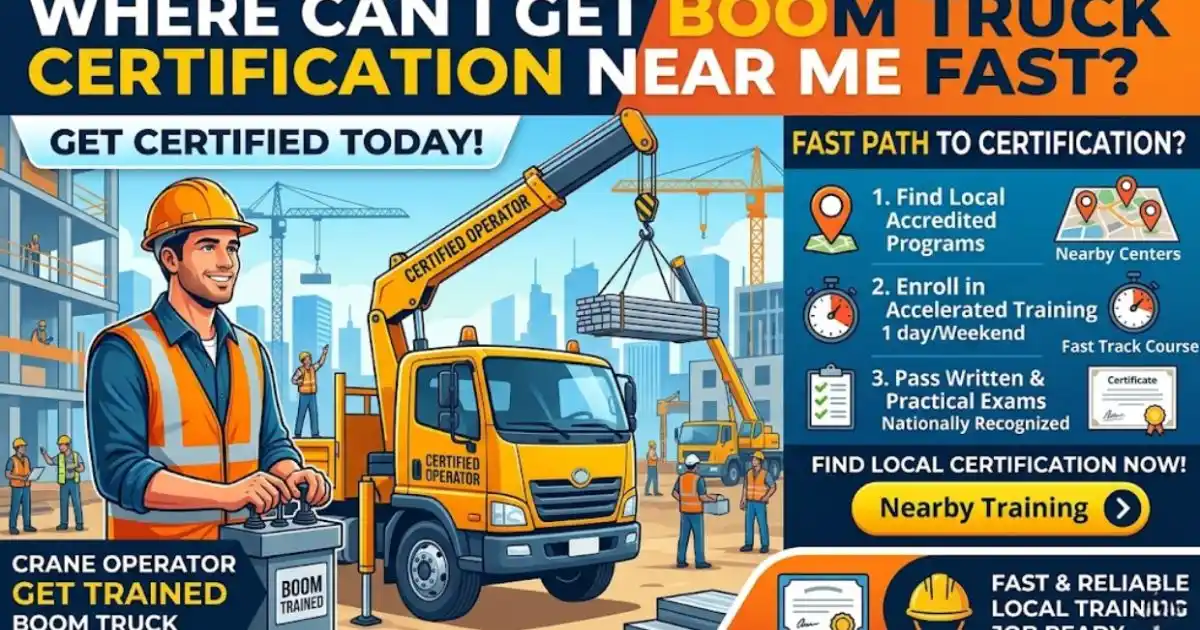
Federal OSHA’s crane rule — 29 CFR 1926 Subpart CC — requires operators to be certified when using cranes with capacities exceeding 2,000 lb. in construction applications. If you operate a boom truck on a construction site and you’re not yet certified, you’re in violation every shift you work.
The guide tells you exactly what boom truck certification requires, which accredited body issues it, how to find a qualified training provider close to you, and what the most common compliance gaps look like in the field. Whether you’re a first-time candidate or an operator chasing renewal, the steps are the same — and they’re straightforward once you know where to look.
What Is Boom Truck Certification? {#what-is-boom-truck-certification}
A boom truck is a crane mounted on a commercial truck chassis, equipped with a rotating superstructure, a fixed or telescopic boom, and its own power source. Its function is to lift, lower, and swing loads at various radii, requiring the use of outriggers/stabilizers. Because it combines road transport with lifting capability, boom trucks appear across building supply, HVAC, sign installation, tree maintenance, and general construction.
Boom truck certification is the formal, third-party verification that an operator has demonstrated sufficient knowledge and hands-on skill to operate this equipment safely. It is distinct from the employer’s “qualification.”
Being “certified” means you’ve successfully passed a formal test — usually involving written and practical exams — given by an accredited, independent organization. Being “qualified,” on the other hand, is a broader employer-determined judgment that you have the necessary knowledge, training, and experience to safely operate specific equipment for a specific task.
Both are required under federal OSHA. Certification proves you passed an independent standard; qualification proves your employer has assessed your competence for their specific site.
OSHA Legal Requirements {#osha-legal-requirements}
OSHA recognizes the boom truck as a crane in both General Industry and Construction. You first need to know whether you are covered under OSHA’s General Industry Standard (29 CFR 1910) or Construction Standard (29 CFR 1926). If the majority of your daily operations fall under General Industry, but your organization performs any construction, alteration, or repair, you may need to follow the more stringent regulations under the Construction Standard.
Construction Applications — 29 CFR 1926 Subpart CC
Under 29 CFR 1926 Subpart CC, if you’re operating a boom truck with a capacity over 2,000 pounds on a construction site, certification is not optional — it’s the law.
The acceptable ways of obtaining certification include: an accredited testing service, an independently audited employer program, military training, or by complying with qualifying state or local licensing requirements.
Equipment-Type Variations
Different boom truck configurations sit under different regulatory expectations:
Telescopic boom trucks generally fall under the 2,000 lb. rule and require certification for construction lifting. Knuckle boom cranes often require certification for capacities between 5 and 65 tons, especially when used to place materials rather than just for delivery. Digger derricks are exempt when used only for digging holes — but if used to lift suspended loads, they are subject to crane certification rules.
General Industry — 29 CFR 1910.180
OSHA regulations require that only qualified and authorized boom truck operators, or operator trainees under the direct supervision of a qualified operator, shall be permitted to operate boom trucks. Operators must complete a crane operator qualification process.
Disclaimer: Regulations may vary by jurisdiction. Always verify current requirements with your local OSHA Area Office or state-plan authority. Some states have adopted standards that go beyond federal minimums.
NCCCO CCO BTF: The Industry Standard {#nccco-cco-btf-the-industry-standard}
When operators search for boom truck certification near me, the credential they need in most cases is the CCO Boom Truck — Fixed Cab (BTF) from the National Commission for the Certification of Crane Operators (NCCCO).
Founded in 1995, NCCCO programs are ANSI-accredited and recognized by federal OSHA as meeting compliance requirements. NCCCO has administered over 800,000 exams to more than 130,000 operators across all 50 states.
NCCCO is what’s called a “third-party certifier” — they stay completely neutral. They don’t train you, but they test your knowledge and skills to make sure you’re ready for the real world. NCCCO certification is accredited to ISO 17024 standards, meaning it’s internationally recognized.
What the BTF Exam Covers
Candidates must take the Mobile Crane Operator Core written exam as well as a Boom Truck Specialty written exam, which features a Manitex boom truck load chart. The practical exam remains unchanged from the TSS program, but BTF candidates are required to take their tests on boom trucks.
Key exam topic areas include:
- Load Chart Knowledge — interpreting rated capacity at various radii
- Site Operations — outrigger setup, ground bearing pressure, pick-and-carry rules
- Technical Knowledge — boom truck components, safety systems, pre-use inspection
- Signals and Rigging — hand signals, rigging hardware, sling angles
The core examination has 90 multiple-choice questions. Candidates are allowed 90 minutes to complete the core examination. The practical examination comprises six main tasks that increase progressively in skill level: inspecting the equipment, hoisting, booming, swinging, following hand signals, and combination (multifunction) operations. Crane operation with and without a load is required.
TSS Holders — You’re Already Covered
Since CCO Telescopic Boom — Fixed Cab (TSS) operator certification already covers fixed-cab boom truck cranes, operators who currently hold a TSS certification do not need to take the new BTF certification exams. They will be automatically granted the new BTF certification.
Certification Validity
Most nationally accredited certifications, including those from NCCCO, are valid for five years. The recertification process typically requires passing written exams and providing proof of relevant work experience during your certification period.
NCCER is a second accredited provider. NCCER certifications meet or exceed OSHA regulations and ASME standards, are accredited by the ANSI National Accreditation Board (ANAB), are valid for 5 years, and are recognized in all states.
How to Find Boom Truck Certification Near You {#how-to-find-boom-truck-certification-near-you}
This is where the “near me” search intent gets practical. Here are the four most reliable methods:
1. Use the NCCCO Training Provider Directory
NCCCO maintains a publicly searchable directory of approved training providers at nccco.org/training. NCCCO does not offer training itself, but you can access a directory of training providers at nccco.org/training. Other options include self-study using the exam outlines and load charts at nccco.org/references, or employer-provided training.
Filter by state, certification type (BTF), and whether the provider offers on-site testing.
2. Use the NCCCO Exam Locator
Beyond training, NCCCO provides a separate exam locator at nccco.org/find-cco-test-locations that lists upcoming written and practical exam administrations by region. Check both — a training provider near you may not host exams, while a testing site may refer you to prep courses.
3. Request On-Site Training
Several national providers travel to your site. Training for NCCCO written examinations is available at your site, the provider’s facility, or via online proctored testing. Practical hands-on testing for mobile cranes, boom trucks, and articulating cranes can also be conducted at the operator’s location using mobile test courses.
On-site training minimizes downtime and lets operators train on the exact equipment they use daily — which directly improves practical exam performance.
4. Check Your Equipment Dealer or Manufacturer
Boom truck manufacturers and dealers often partner with NCCCO-approved training bodies. Altec, for example, administers NCCCO certification programs for operators of mobile cranes and digger derricks, covering OSHA and ASME topics including crane setup, rigging, crane inspections, safety devices, maintenance, and load chart interpretation. Contact your equipment supplier to ask whether they offer or can refer you to a certification program.
Step-by-Step: Getting Certified {#step-by-step-getting-certified}
Follow these steps from the first search to the certification card in hand.
Step 1 — Confirm Your Equipment Type and OSHA Coverage: Determine whether your operations fall under 29 CFR 1910 (General Industry) or 29 CFR 1926 (Construction). This decides the standard you’re being tested against. If your boom truck capacity is over 2,000 lb. and you work on construction sites, you need the NCCCO BTF or equivalent accredited credential.
Step 2 — Check State-Plan Requirements: Twenty-six U.S. states and territories operate OSHA-approved state plans. Some go further than federal minimums. California’s Cal/OSHA, for example, has its own crane operator licensing regime. Verify local requirements before enrolling.
Step 3 — Enroll in an Accredited Prep Course. Use the NCCCO provider directory to find a course near you. Certification courses typically run two to five days, depending on the certification type. Each class day is typically 8 hours and covers classroom material and hands-on practical training with instructors. The final day is designated for written exams and remaining practicals.
Step 4 — Pass the Written and Practical Exams
To earn NCCCO certification valid for five years, candidates must pass the written exam and one practical exam. The written Boom Truck — Fixed Cab (BTF) exam is a modified version of the TSS written exam, with boom-truck-specific questions replacing irrelevant material.
Both exams must be completed within 12 months of each other.
Step 5 — Carry Your Credentials on Site
OSHA and state inspectors require immediate access to specific documents on the job site. You must have your certification card with you at all times while working, proof of training for specific equipment or safety protocols, and a current medical evaluation if required by your certification or state.
Common Mistakes and Compliance Failures {#common-mistakes-and-compliance-failures}
On construction sites, the same boom truck compliance errors appear in audit after audit. Here are the six most common — and how to fix each one.
Mistake 1 — Assuming Equipment Type Exemption Operators and supervisors sometimes believe their boom truck is exempt because it “isn’t used for construction.” OSHA’s trigger is the capacity (2,000 lb.) and the application, not the job title printed on the work order. If a boom truck delivers materials to a construction site and places them, certification requirements apply. Verify the application before assuming exemption.
Mistake 2 — Confusing Employer Qualification with Third-Party Certification An employer can internally “qualify” an operator, but this does not satisfy the OSHA requirement for third-party certification under 29 CFR 1926.1427. These are two separate, parallel obligations. Operators need both. During audits, this is the most frequently cited paperwork gap.
Mistake 3 — Expired Certification Cards on Site. The recertification process typically requires passing written exams and providing proof of relevant work experience. Some states or employers also require continuing education. Operators who let their five-year card lapse and continue working are in direct violation. Start renewal at least 90 days before expiration — NCCCO processing delays can be significant during peak testing periods.
Mistake 4 — Operating Without a Medical Evaluation NCCCO requires a medical evaluation for initial certification and may require an updated evaluation at renewal. Operators who obtain their card without a valid medical evaluation can have their certification challenged. Keep the medical evaluation documentation with your certification records.
Mistake 5 — No Operator-in-Training Documentation. If an operator is not certified, they may only operate covered cranes if they meet OSHA’s definition of an “operator-in-training,” which includes having received sufficient training from the employer to operate the crane safely and being continuously monitored by an operator’s trainer. “Continuously monitored” is not optional — the trainer must be physically present, and the employer must document this arrangement. Verbal agreements do not satisfy the regulation.
Mistake 6 — Wrong Certification Type for Equipment: NCCCO certifications are equipment-specific. A TSS (Telescopic Boom — Fixed Cab) automatically grants BTF. But an operator with a Lattice Boom Truck (LBT) certification cannot legally operate a telescopic boom truck without the appropriate BTF or TSS credential. Always match the certification designation to the exact machine class.
Boom Truck Operator Certification Checklist {#boom-truck-operator-certification-checklist}
Use this checklist before your first exam attempt and before each shift on a certified site:
Pre-Certification
- Confirmed equipment type (BTF, TSS, LBT, or STC)
- Verified state-plan requirements beyond federal OSHA minimums
- Enrolled in NCCCO-accredited training with the BTF curriculum
- Completed medical evaluation (NCCCO standard)
- Reviewed NCCCO Mobile Crane Operator Candidate Handbook
- Practiced load chart problems specific to boom truck configurations
- Completed pre-exam practical familiarization on actual boom truck equipment
On the Job Site
- NCCCO BTF certification card physically present (not stored in vehicle)
- Card not expired — validity date checked
- Employer qualification documentation on file (separate from NCCCO card)
- Pre-use inspection completed and documented (29 CFR 1926.1412)
- Outrigger deployment verified and documented
- JSA (Job Safety Analysis) for the lift was completed and signed
- Load chart consulted and radius/capacity verified before lift
- Rigger and signal person certifications verified (if applicable)
Gulf Region and Saudi Aramco Context {#gulf-region-and-saudi-aramco-context}
For HSE professionals and contractors in Saudi Arabia, the UAE, Qatar, and Kuwait, boom truck certification requirements carry an additional layer beyond federal U.S. standards.
Saudi Aramco Requirements
Saudi Aramco’s crane and lifting operations fall under GI-0002.102 (Lifting and Hoisting Safety) and related SAES standards. Aramco does not accept self-certification or informal training records for heavy lifting equipment. Operators working on Aramco projects must demonstrate:
- A valid third-party certification (NCCCO, CPCS, or equivalent recognized by Aramco’s asset owner)
- Completion of Aramco’s Safety Passport program
- Familiarity with the PTW (Permit to Work) system for lifting operations
- Evidence that pre-lift risk assessments have been completed and approved
Contractors consistently report that Aramco PTW-issuing authorities require the operator’s certification card to be physically attached to or referenced within the relevant work permit. A photocopy or verbal confirmation is not acceptable on an active Aramco worksite.
UAE and GCC Context
The UAE follows Federal Law No. 8 of 1980 on labor regulations and references OSHA standards for contractor compliance on international projects. Many major project owners — including ADNOC and SABIC — align with OSHA 29 CFR 1926 Subpart CC requirements and recognize NCCCO credentials. CPCS (Construction Plant Competence Scheme) from the UK is also widely accepted across the GCC for crane operators.
Pakistan and India
For operators in Pakistan and India seeking Gulf employment, NCCCO BTF certification is the most internationally portable credential. Gulf employers and Aramco-approved contractors specifically request it in job postings. Pairing NCCCO certification with a NEBOSH general certificate significantly strengthens a candidate’s profile for senior operator or HSE-adjacent roles.
Requirements described are based on publicly available Saudi Aramco standards. Contractor-specific requirements may vary. Always verify with the relevant Aramco asset owner or project HSE representative.
FAQS: Boom Truck Certification Near Me
Use the NCCCO Training Provider Directory at nccco.org/training and filter by your state and the BTF (Boom Truck — Fixed Cab) certification type. You can also search the NCCCO exam locator for upcoming written and practical test administrations in your region. Many providers also offer mobile on-site training if no fixed facility is nearby.
Most NCCCO certification prep courses run 3 to 5 days for first-time candidates, combining classroom instruction with practical equipment time. Each class day is typically 8 hours. The last day is designated for written exams and any practicals not yet completed. After passing, NCCCO issues your certification card, which takes approximately 2 to 4 weeks to arrive.
29 CFR 1926 governs boom truck operators performing construction work, while 29 CFR 1910.180 applies to general industry operations. If you perform any construction-related lifting — even occasionally — the stricter 29 CFR 1926 Subpart CC applies. The 2,000 lb. capacity threshold is the trigger for third-party certification.
Yes. NCCCO boom truck operator certification is valid for five years. The recertification process requires passing written exams and providing proof of relevant work experience during your certification period. Start the renewal process at least 90 days before your expiration date.
Acceptable methods of obtaining certification include an accredited testing service, an independently audited employer program, military training, or qualifying state or local licensing requirements.
An employer-based program is allowed, but it must be independently audited — not simply the employer signing off internally. NCCCO is the simplest and most universally recognized route.
A five-day first-time NCCCO Crane Prep & Test program at one major provider costs $2,000, which includes the NCCCO exam fees. Recertification programs run approximately $1,000. Prices vary by provider, region, and whether training is on-site at your facility. Always confirm what’s included — exam fees, study materials, and practical equipment access are sometimes billed separately.
You can access a ready-to-use boom truck lift planning checklist and related crane safety documentation templates from our. These templates are formatted for OSHA compliance and Saudi Aramco PTW compatibility.
Conclusion
Boom truck certification is not a bureaucratic hurdle — it is the minimum proof that an operator can read a load chart, set up outriggers correctly, and make safe lifts without endangering a crew. Under 29 CFR 1926 Subpart CC, certification for cranes over 2,000 lb.
In construction applications is a legal requirement, not a recommendation. NCCCO’s CCO BTF credential remains the industry standard: ANSI-accredited, OSHA-recognized, and valid for five years across all 50 states.
To get started, use the NCCCO training provider directory to find an accredited course near you, confirm your state-plan requirements, and schedule both your written and practical exams within the 12-month window NCCCO requires.
For crane safety documentation — including lift plans, rigging inspection forms, and PTW templates formatted for Aramco contractor use.