
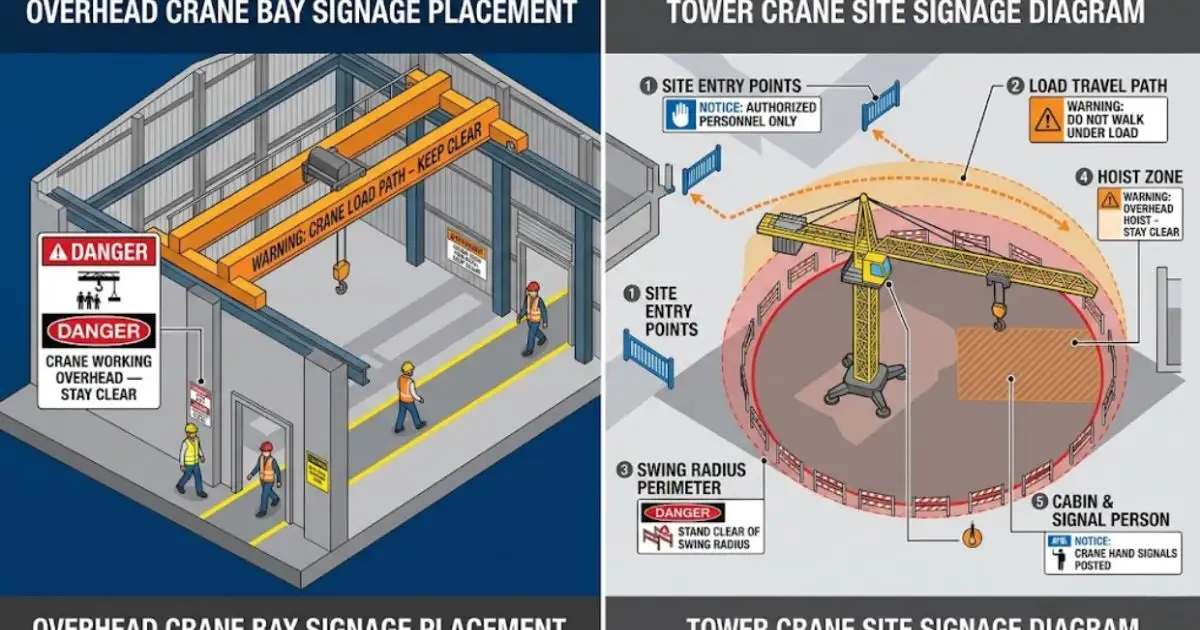
This guide covers crane signage for construction sites and fixed industrial facilities operating under OSHA 29 CFR 1926 Subpart CC and 1910 general industry standards. It does NOT address marine crane operations, offshore rigs, or jurisdictions outside U.S. federal OSHA authority.
Crane safety signs are posted warnings, hazard alerts, and instructional markers placed on or around cranes, load paths, and exclusion zones to communicate lifting hazards to workers, riggers, and bystanders. They reduce struck-by and crush incidents by making hazard zones visible before a load moves.
That definition sounds simple. The compliance reality is messier.
OSHA’s crane standard — Subpart CC (1926.1400) — is 60+ pages of operator certification, ground conditions, and rigging requirements. Signage gets maybe three sentences. So site managers are left piecing together requirements from ANSI Z535, manufacturer decal mandates, and general duty clause logic.
This guide closes that gap.
Why Crane Signage Isn’t Optional — Even When OSHA Doesn’t Name Every Sign
A review of 249 overhead crane incidents documented 838 OSHA violations, resulting in 133 injuries and 133 fatalities — with 37% of cases involving workers crushed by a load (Crane Training Universities / CICB, 2024). The Crane Inspection & Certification Bureau estimates roughly 90% of crane accidents are caused by human error.
Signs don’t prevent mechanical failure. But they’re the last passive barrier between a distracted worker and a load path.
Here’s the thing: OSHA’s General Duty Clause (Section 5(a)(1)) requires employers to protect workers from recognized hazards even when no specific regulation names a particular control. If a crane is operating overhead and there’s no visible indication of that hazard, that’s a citable condition — with or without a sign-specific rule attached to it.
The legal exposure is real. In FY2024, OSHA’s crane and rigging citations remained among its most serious categories, with per-instance penalties reaching $16,131 for serious violations.
The ANSI Z535 System: Why Sign Color and Header Word Actually Matter
Most people assume any yellow sign with bold text will satisfy safety requirements. The data — and OSHA enforcement — says otherwise.
ANSI Z535 is the standard that governs safety sign design in the U.S. It defines a hierarchy that OSHA references and that courts use when evaluating negligence. Getting the header word wrong isn’t a cosmetic issue. It’s a liability issue.
Also read: Crane Safety: OSHA Rules, Hazards & Site Best Practices
ANSI Z535 Signal Word Hierarchy:
| Signal Word | Color | Hazard Level | Crane Application Example |
|---|---|---|---|
| DANGER | Red | Imminent — death or serious injury likely | “Crane Working Overhead — Stay Clear” |
| WARNING | Orange | Potential — death or serious injury possible | “Do Not Operate Without Signal Person” |
| CAUTION | Yellow | Minor injury possible | “Stand Clear of Swing Radius” |
| NOTICE | Blue | Non-injury / property / procedural | “Authorized Crane Operators Only” |
Quick Comparison — DANGER vs. CAUTION for crane zones: DANGER signs are better suited for active load paths and electrocution zones because the injury risk is immediate and severe. CAUTION works when the hazard is conditional — like a swing radius that’s only active during specific operations. The key difference is the probability and severity of the injury outcome.
Quick note: Some manufacturers ship signs labeled “Warning” for hazards that meet the ANSI threshold for “Danger.” That’s not compliant. Verify signal words against ANSI Z535.2 before posting.
The 7 Core Types of Crane Safety Signs and Where Each One Goes
This is where most guides stop at a product list. That’s not enough. Placement is half the compliance equation.
1. Overhead Crane / Crane Working Overhead Signs
Signal word: DANGER or WARNING Where: Entry doors to any bay or work area with an overhead bridge crane; posted at eye level at all pedestrian access points. Also, on the bridge beam itself, if workers pass underneath. Why it matters: Workers entering a bay from a side entrance often can’t see the crane position. A posted sign at every entry point ensures awareness before they step under the load path.
2. Suspended Load / Do Not Walk Under Load Signs
Signal word: DANGER Where: Posted on columns, barriers, and fencing along the load travel path. On the hoist or trolley assembly if the crane is mobile. Common mistake: Posting only at the lift point. The hazard travels with the load — signs need to reflect the full travel path, not just the origin.
3. Crane Swing Radius Signs
Signal word: DANGER or CAUTION (use DANGER if workers routinely access the swing area during operations). Where: Perimeter of the crane’s maximum swing arc, on barriers or fencing. On the crane body itself, facing outward.
A 37-year-old aerial lift operator was killed in Florida in 2023 when a 110-ton Liebherr crane tipped and its boom struck him — he was working in the swing radius with no exclusion zone enforced. Signs are one layer. Barriers are another. Both are needed.
4. Overhead Hoist Signs
Signal word: DANGER Where: On the hoist body. On any structural support column within the lift zone. At floor-level entry points directly beneath the hoist travel path.
5. Crane Hand Signal Charts
Signal word: N/A (instructional, not warning). Where: Posted in the cab. Posted at the signal person’s designated station. OSHA 1926.1419 requires that crane hand signals be posted — this is one of the few explicit signage mandates in Subpart CC.
Or maybe I should say it this way — this is the one sign type where OSHA does name the requirement directly. Every other crane sign draws authority from the General Duty Clause, ANSI Z535, or manufacturer requirements.
6. Electrocution Hazard / Power Line Signs
Signal word: DANGER Where: On cranes operating near energized lines. Posted along the approach path to the work zone. OSHA 1926.1407 requires specific minimum clearances from power lines (10 feet for lines under 50kV) — signs reinforce those boundaries visually.
Approximately 100 crane-power line contacts occur annually in the U.S., making up roughly 20% of all construction-related crane fatalities (CICB / OSHA data, 2024).
7. Authorized Personnel / Restricted Area Signs
Signal word: NOTICE or DANGER (depending on proximity to active lift zones). Where: At the perimeter of the crane operating area. On access gates to the lift zone. These signs support the exclusion zone requirements under OSHA 1926.1425.
Material Selection: What Survives a Construction Site
Look — if you’re posting signs outdoors on an active construction site, here’s what actually works.
Rigid aluminum is the standard for permanent or semi-permanent outdoor placement. It holds up against UV, moisture, and vibration. Brady Corporation’s BradyGlo line adds photoluminescent properties for low-light areas like confined crane bays.
Adhesive vinyl decals (with UV lamination) are what go directly on crane bodies, hoist housings, and equipment panels. SafetyKore rates their laminated decals at up to 10 years of outdoor life. That’s not a marketing claim to ignore — replacing decals annually on a large fleet is a real cost.
Polystyrene or corrugated plastic works for temporary barriers and perimeter fencing during a specific lift operation — not for permanent hazard zones.
Fiberglass is the choice for chemical or high-moisture environments like ports or treatment plants where aluminum can corrode.
I’ve seen conflicting data on whether aluminum or fiberglass outlasts the other in coastal environments — some site managers report aluminum pitting within 3 years near salt water, others say properly coated aluminum is fine. My read is: go fiberglass within a quarter mile of tidal water.
How to Build a Crane Signage Plan in 5 Steps
To meet OSHA and ANSI requirements for crane signage, follow these steps:
- Map every crane hazard zone — load path, swing radius, hoist area, and power line proximity.
- Assign the correct ANSI Z535 signal word to each zone based on injury probability and severity.
- Select sign type and material based on indoor/outdoor, permanent/temporary, and surface type.
- Post hand signal charts in the cab and at the signal person’s station — this is the one mandatory placement per OSHA 1926.1419.
- Document placement with photos in your site safety plan for inspection readiness.
This process applies to both new site setups and compliance audits of existing operations.
Where to Source OSHA-Compliant Crane Safety Signs
Three suppliers cover most site needs without requiring custom fabrication:
SafetyKore stocks the most crane-specific SKUs of any dedicated safety sign supplier, including swing radius, overhead hoist, electrocution hazard, and mobile crane hand signal charts — with same-day shipping and both rigid and decal formats.
Brady Corporation is the right call for facilities that need custom messaging, large-format signs, or integration with a broader lockout/tagout and hazard communication program. Their OSHA-compliant headers align with ANSI Z535.
ComplianceSigns.com offers a downloadable crane resource bulletin that cross-references ANSI Z535 headers with specific crane hazard applications — useful for compliance documentation.
Some experts argue that generic safety supply distributors (Grainger, Uline) are equally adequate. That’s valid for standard PPE and general warning signs. But for crane-specific applications — swing radius dimensions, mobile vs. overhead hoist distinctions, hand signal chart formats — purpose-built suppliers have more accurate SKU mapping and fewer mislabeled signal word classifications.
FAQS: Crane Safety Signs
Rigid aluminum with UV-resistant printing lasts longest in most outdoor environments. Use UV-laminated vinyl decals directly on crane bodies. Opt for fiberglass in coastal or high-moisture settings.
Construction cranes fall under 29 CFR 1926 Subpart CC. General industry overhead cranes fall under 1910.179. Both reference ANSI Z535 for sign design. Hand signal posting is explicitly required in both.
Use DANGER if workers are regularly present in or near the swing area during operations. CAUTION applies when the hazard is intermittent, and the area is otherwise safely accessible.
Replace any sign that’s faded, torn, or no longer legible — regardless of age. Quality UV-laminated decals can last 5–10 years. Inspect signs during regular crane pre-shift inspections.
Always — OSHA 1926.1419 explicitly requires hand signal charts to be posted in the cab and available to the signal person. This applies any time a signal person is required or used.
This guide covers signage requirements under U.S. federal OSHA authority. State-plan states (California, Washington, Michigan, and others) may have additional or stricter requirements. Always verify with your state’s occupational safety agency.