
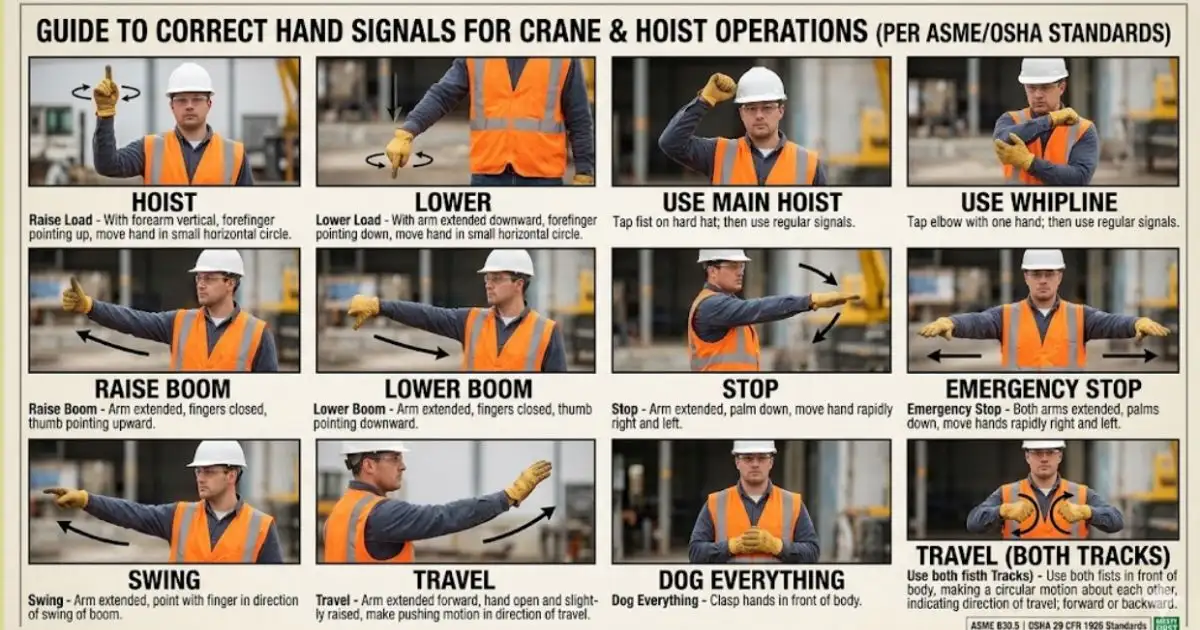
This guide covers mobile and overhead crane safety in construction and industrial settings. It does NOT address marine crane operations, offshore rigs, or aerial lift regulations under 29 CFR 1926.453.
Crane safety refers to the set of operational procedures, equipment inspections, training requirements, and regulatory compliance measures designed to prevent accidents during crane use on construction and industrial sites. It covers everything from pre-lift checks to power line clearance distances.
That one-sentence definition doesn’t do justice to what’s at stake.
According to the U.S. Bureau of Labor Statistics’ Census of Fatal Occupational Injuries, an average of 44 workers die in crane-related accidents every year in the United States. The Crane Inspection & Certification Bureau estimates that roughly 90% of those deaths are caused by human error — not equipment failure. That’s the uncomfortable truth most job site briefings skip.
What Does OSHA Actually Require for Crane Operations?
This is where most safety managers hit a wall. OSHA’s official crane standards live across multiple subparts, and reading the raw regulation feels like decoding tax law.
Here’s the practical breakdown.
The primary standard governing cranes on construction sites is 29 CFR 1926 Subpart CC, which took effect in 2010 and was refined through subsequent enforcement guidance. It covers mobile cranes, tower cranes, derricks, and floating cranes. General industry overhead cranes fall under 29 CFR 1910.179.
The four non-negotiable OSHA requirements every site must meet:
According to OSHA’s Subpart CC standards, compliance requires these core actions:
- Verify ground conditions are adequate to support the crane before each lift (1926.1402)
- Maintain a minimum 20-foot clearance from energized power lines — or de-energize lines before work begins (1926.1407–1409)
- Conduct a pre-shift inspection of all crane components before each use (1926.1412)
- Use only qualified riggers and trained signal persons during all lifts (Subpart CC Fact Sheets, OSHA 2010)
Quick note: “qualified” and “certified” are not the same thing under OSHA’s language. A qualified rigger has demonstrated — through experience or testing — that they can safely rig loads. Certification through a body like the CICB (Crane Inspection & Certification Bureau) goes a step further and is increasingly required by general contractors even when OSHA doesn’t mandate it outright.
Some experts argue that OSHA’s Subpart CC requirements are sufficient on their own. That’s valid for projects where a knowledgeable safety officer is actively present. But if you’re managing multiple subcontractors across a large site, those minimum standards leave real gaps — particularly around communication protocols and shift handoffs.
The 5 Hazards That Actually Kill People on Crane Sites
OSHA’s hazard page lists references. What it doesn’t give you is a ranked, real-world context.
Here’s what the data actually shows.
1. Power Line Contact OSHA has confirmed that 45% of crane accidents involve the boom or load line making contact with energized power lines. This is the single largest killer. It doesn’t always happen because someone was careless — it often happens because a site layout changed, a swing radius wasn’t recalculated, or a signal person was out of position.
2. Overloading / Structural Collapse Every crane has a rated load chart. When supervisors — under schedule pressure — ignore or misread it, the crane tips or the boom buckles. A 2024 OSHA fatality investigation in Florida found that a 110-ton Liebherr crane tipped after an outrigger gave way on inadequate ground, killing a 37-year-old aerial lift operator working in the swing radius.
3. Load Drop from Rigging Failure A review of 249 overhead crane incidents found that 27% involved load drops — primarily from rigging failure. Worn slings, improper choker hitches, and overloaded shackles are the typical culprits. Wire rope condition is especially under-inspected.
4. Workers Struck by Swinging or Falling Loads Just over half of all fatal crane injuries involve workers being struck by an object or equipment, according to BLS CFOI data from 2011–2017. In 79 of those cases, the worker was struck by an object falling from or set in motion by a crane. Most of those workers were not the operators.
5. Falls from Height About 12% of crane fatalities involve falls from the cab, during rigging, or while performing maintenance at elevation. Fall arrest systems are required but inconsistently used, particularly during climb-and-inspect routines.
One counter-intuitive finding: most crane fatalities do NOT involve the crane operator. Bystanders, riggers, and ground workers are the most common victims. If your safety training focuses exclusively on the operator, you’re protecting the wrong person.
Also read: What Is Working Load Limit (WLL)? Definition & Safety Guide
Pre-Operational Inspection: What a Real Checklist Looks Like
Most guides say “inspect your crane.” That’s useless advice without specifics.
To complete a compliant pre-shift crane inspection, follow these steps:
- Check the wire rope for broken wires, kinking, crushing, or corrosion along the full length
- Inspect all hooks for cracks, deformation, or throat opening exceeding 15% of normal
- Test all limit switches, load indicators, and emergency stop functions
- Verify outrigger pads are set on firm, level ground — not fill, not recently disturbed soil
- Confirm the load chart is physically present in the operator cab and legible
- Check all safety warning labels are intact and readable (per ASME B30 standards)
- Document findings on a written form — verbal checks don’t satisfy OSHA 1926.1412
ASME B30 standards are the engineering backbone behind most of OSHA’s crane-specific rules. The B30 series (published by the American Society of Mechanical Engineers) covers everything from mobile cranes (B30.5) to overhead cranes (B30.2) to wire rope (B30.9). If you’re managing a crane program, those documents are the technical reference — OSHA points back to them regularly.
Or maybe I should say it this way: OSHA sets the legal floor. ASME B30 tells you what good actually looks like.
Qualified Rigger vs. Signal Person: A Distinction Most Sites Get Wrong
Quick Comparison
| Role | Best For | Key Benefit | Limitation |
|---|---|---|---|
| Qualified Rigger | Attaching and detaching loads | Ensures load is secured per weight/geometry | Does not direct crane movement |
| Signal Person | Directing crane travel and lift | Reduces miscommunication during movement | Must have clear line of sight at all times |
| Crane Operator | Operating machinery | Controls lift execution | Cannot monitor ground conditions and controls simultaneously |
| Safety Supervisor | Site-wide compliance | Catches cross-role failures | Not always required by OSHA on smaller sites |
A signal person is required whenever the operator’s view of the load or path of travel is obstructed. That’s the trigger condition — not site size, not load weight.
Look — if you’re on a site where the operator and rigger are the same person trying to handle both jobs, that’s not just an OSHA violation. It’s the exact scenario that precedes a dropped load incident. One role. One person. No exceptions.
Crane Safety Regulations vs. Best Practices: Know the Difference
I’ve seen conflicting data on this — some sources frame every safety recommendation as an OSHA “requirement,” while others present mandatory rules as optional tips. My read is that conflating the two actually makes sites less safe, not more.
Here’s the structural difference:
OSHA regulations carry legal weight. Violations result in citations. In FY2024, cranes and rigging violations remained among OSHA’s most serious citation categories. Penalties for serious violations can reach $16,131 per instance — the Adcock Cranes case in 2024 shows this isn’t theoretical.
Best practices — like pre-task planning meetings, daily lift plans, and exclusion zone markers — aren’t always mandated but dramatically reduce incident rates. The sites with the lowest crane incident rates tend to treat best practices as if they were regulations.
This guide covers OSHA-mandated requirements for construction and general industry. It does NOT substitute for a site-specific crane safety plan, which should be developed with a qualified engineer or certified safety professional for your specific equipment and conditions.
FAQS: Crane Safety
Human error accounts for approximately 90% of crane accidents, according to the Crane Inspection & Certification Bureau. The most common specific cause is contact with energized power lines, responsible for roughly 45% of crane fatalities.
Yes — most crane manufacturers specify maximum wind speed limits in the load chart, typically 25–30 mph. Operations should stop when the wind exceeds the manufacturer’s rated limit or when gusts create an unpredictable load swing.
OSHA 1926.1412 requires a pre-shift inspection because crane components — particularly wire rope, hooks, and limit switches — can degrade or fail between uses. A missed defect during a brief morning check is far cheaper than a dropped load.
A signal person is required at any time the operator cannot clearly see the load, the path of travel, or workers in the area. This is not discretionary — it’s a direct OSHA requirement under Subpart CC.