
This guide covers crane safety developments in the U.S. and global markets from 2024–2026. It does NOT address maritime crane regulations, offshore lifting operations, or jurisdiction-specific state OSHA plans in detail.
Crane safety news has never been more urgent. Incidents keep happening — tower jib collapses in London, crane overturns in Switzerland, fatalities in Bangkok and Houston — and they keep happening for the same preventable reasons. Human error. Rigging failures. Skipped inspections.
According to the Crane Inspection & Certification Bureau (CICB), over 90% of crane accidents are caused by human error. That number hasn’t meaningfully moved in decades, despite better equipment and tighter regulation.
That should bother everyone in this industry.
What “Crane Safety News” Actually Covers — And Why It Matters Now
Crane safety news refers to ongoing reporting on crane-related incidents, OSHA enforcement actions, equipment recalls, regulatory updates, and industry best practices designed to prevent fatal lifting accidents. It spans mobile cranes, tower cranes, overhead cranes, crawler cranes, and related rigging systems across construction, manufacturing, energy, and ports.
This isn’t just reading about other people’s problems. When a tower crane jib collapses in Kensington or a rough-terrain crane overturns during setup at a bridge demolition site in India, those incidents carry specific root causes — and those causes are almost always present on other active job sites right now.
Crane operators and safety managers who track incidents in real time catch patterns before those patterns catch them.
2024–2025 Crane Accident Reports: What the Incidents Are Telling Us
The volume of recent incidents is striking. Here’s what actually happened — not a generic list, but real events with real lessons.
Tower crane jib collapse, Kensington, London (March 2025). A jib failure during an active lift injured workers and triggered an HSE investigation. Structural integrity during lifting operations — not just setup — was implicated.
Crane overturn, Stallikon, Switzerland (February 2025). A tower crane being dismantled overturned, critically injuring the operator. Dismantling and erection phases remain the most dangerous moments in a crane’s lifecycle, yet they often get less safety attention than active lifting.
Tower crane jib collapse near Terminal 21, Bangkok (February 2025). Two workers were critically injured. This came just months after a separate Thai fatality involving a boom lift falling through a concrete floor — a different machine, same underlying issue: ground bearing capacity wasn’t properly assessed.
Rough terrain crane overturn, Pamban Bridge, India (January 2025). Setup phase failure, again.
Look — if you’re running a site where a crane is being erected, climbed, or struck, that’s your highest-risk window. Not day-to-day picks.
According to data compiled by 360osha30.com (2026), OSHA reported 7 fatal overhead crane incidents in industrial settings in just the first seven months of 2024. The U.S. Bureau of Labor Statistics puts the annual average of crane-related fatalities at approximately 42–44 per year based on 2011–2017 CFOI data, and more recent reporting suggests that figure hasn’t improved significantly.
Here’s the thing: 37% of documented crane fatalities involve workers being crushed by a dropped load. Another 27% are caused by rigging failures specifically. These aren’t random failures — they’re inspection and training failures dressed up as accidents.
Also read: Crane Safety: OSHA Rules, Hazards & Site Best Practices
OSHA Crane Safety Updates: What Changed and What’s Being Enforced Right Now
To stay compliant with current OSHA crane requirements, follow these steps:
- Verify operator certification meets OSHA 1926.1427 requirements before any lift.
- Confirm ground conditions in writing per 1926.1402(c) — especially on urban or soft-soil sites.
- Maintain a 20-foot minimum clearance from energized power lines under 1926.1407–1409.
- Ensure your signal person holds current qualifications per 1926.1428.
- Document pre-use inspections per 1926.1412 daily — not just at mobilization.
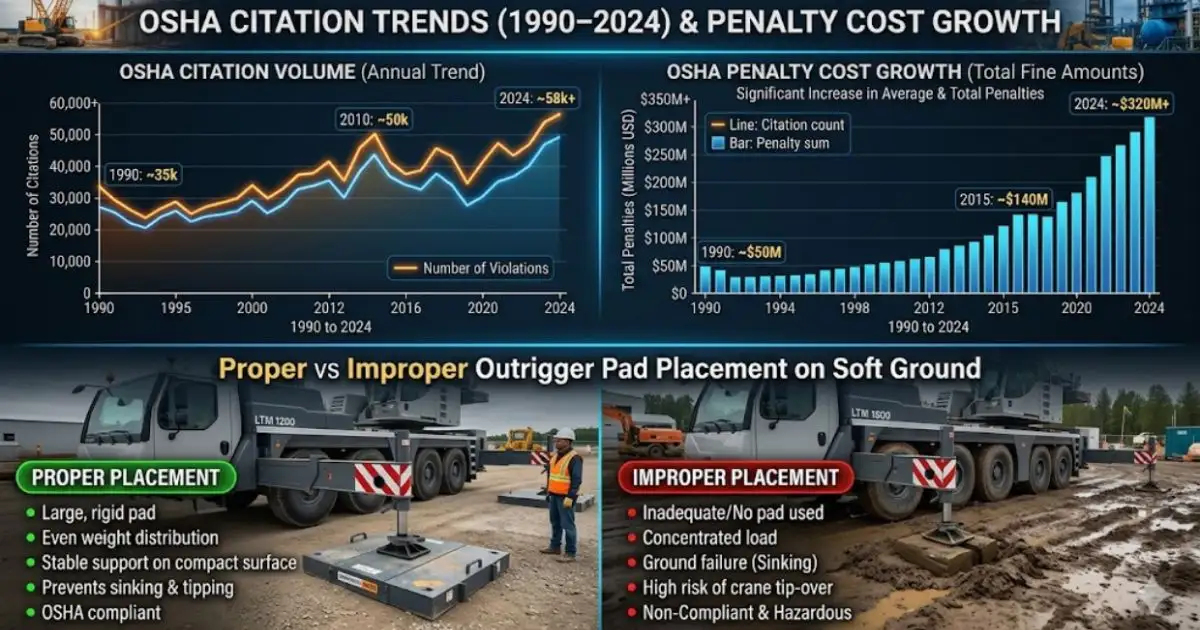
OSHA’s enforcement posture has shifted. Citations dropped from over 400,000 in 1990 to around 146,000 in 2023 — but penalty amounts have gone in the opposite direction, increasing by over 600% in that same period. The average cost per major injury now runs approximately $200,000. A fatality? Over $4 million when direct and indirect losses are combined, according to 360osha30.com’s 2026 analysis.
The agency investigated 826 worker deaths across all industries in fiscal year 2024 — an 11% drop from the prior year, which OSHA attributed partly to intensified crane and trench enforcement. That’s encouraging. But the underlying causes of crane deaths remain nearly identical to what they were in 2010.
Some experts argue that OSHA’s penalty-based enforcement model creates compliance theater — companies respond to fines, not culture. That’s valid for large contractors with legal departments. But for the small subcontractor running two cranes with a crew of eight, a single OSHA investigation is often existential. Both pressures are real.
Quick note: if your operation spans multiple states, verify your state plan OSHA requirements separately — they can exceed federal standards, and several do.
New Safety Technology Actually Worth Knowing About
The crane safety technology landscape moved fast in 2025. Three developments stand out.
Tadano’s “Hey Tadano” AI Assistant — now with voice control. Tadano upgraded its onboard AI assistant with voice command integration and a redesigned interface in early 2025. The system allows operators to query load charts, request inspection reminders, and flag anomalies hands-free. Voice-activated crane safety tools reduce the cognitive load on operators during complex picks — which matters, because operator fatigue and distraction are two of the leading contributors to human error.
Liebherr fibre rope cranes — moving from prototype to standard. Liebherr’s fibre rope technology, which replaces traditional steel hoist rope with high-strength synthetic fibre, is now being positioned as an industry standard rather than an innovation showcase. Fibre rope is significantly lighter, reduces structural load on the crane, and eliminates certain failure modes associated with wire rope fatigue.
The Buddie System — wireless emergency lift alert. Rope and Sling Specialists Ltd. was appointed sole UK distributor for The Buddie System in early 2025. The device is a wireless wearable alert system designed to notify the crane operator and signal crew instantly when a worker enters a danger zone during lifting. It addresses one of the most persistent communication gaps in multi-person lift operations.
Or maybe I should say it this way: these tools don’t make bad operators safe. They make good operators faster to react and harder to surprise.
Quick Comparison — Emerging Crane Safety Technologies
| Technology | Best For | Key Benefit | Limitation |
|---|---|---|---|
| Tadano “Hey Tadano” AI | Mobile crane operators | Hands-free load and hazard data | Tadano-specific; not universal |
| Liebherr Fibre Rope | Heavy lift / high-cycle cranes | Lighter, reduces wire fatigue failures | Higher upfront cost vs steel rope |
| The Buddie System | Multi-worker lift zones | Requires worker compliance to wear the device | Only effective if used — doesn’t help in the field |
| Digital lift planning tools | Pre-lift planning teams | Reduces calculation error pre-pick | Only effective if used — doesn’t help in field |
Best Practices That Still Get Ignored — Even by Experienced Operators
The fundamentals are known. They’re just not consistently applied. Here’s what most safety briefings skip.
Ground bearing capacity is underestimated consistently. Bangkok, Pamban, countless smaller sites — the common thread is a crane set up on ground that wasn’t formally assessed. OSHA 1926.1402(c) requires it. It still gets skipped, especially on time-pressured sites. A geotechnical assessment isn’t bureaucratic overhead — it’s the difference between a stable lift and a tipped crane.
Dismantling kills more operators than active picks. Most crane safety training focuses heavily on the lift cycle. Erection and dismantling phases receive far less attention, yet a disproportionate share of fatalities occur there. The Stallikon incident is one of dozens in recent years. Training should weigh these phases accordingly.
Users who’ve tried implementing “safety stand-down” days before major lifts often report that the conversations that happen in those meetings — between operators, riggers, and site managers — catch more near-misses than any formal inspection does. The structured pause matters.
Power line contact remains the single most preventable cause of fatal crane accidents. OSHA data shows approximately 100 crane-power line contacts per year in the U.S., making up roughly 20% of all construction-related crane fatalities. The 20-foot rule exists. Marking systems exist. This still happens.
I’ve seen conflicting data on whether operator fatigue or inadequate pre-lift planning is the more dominant contributing factor in multi-crane incidents — some studies weigh fatigue heavily, others point to planning failures. My read is that they compound: a fatigued operator on a poorly planned lift is the scenario where serious incidents cluster.
FAQS: Crane Safety News
Human error accounts for over 90% of crane accidents. The leading specific causes are dropped loads from rigging failure (27%), workers struck by objects (over 50% of fatalities), and contact with power lines — approximately 100 incidents per year in the U.S. alone.
The primary standard is 29 CFR 1926 Subpart CC — Cranes and Derricks in Construction. Key sections cover operator certification (1926.1427), ground conditions (1926.1402), power line clearance (1926.1407–1409), and daily inspections (1926.1412).
The U.S. Bureau of Labor Statistics documented an average of 42–44 crane-related fatalities per year based on 2011–2017 data. OSHA reported 7 fatal overhead crane incidents in industrial settings in the first half of 2024 alone.
For lifts involving multiple workers in or near the swing radius, yes — proximity alert systems significantly reduce struck-by risk. They work best alongside, not instead of, designated signal persons and proper exclusion zones.
During the erection and dismantling phases, and during setup on unverified ground. Most tipping incidents occur before or after the primary lift cycle — not during it.
What to Watch in the Rest of 2026
Regulatory activity is worth tracking closely this year. OSHA’s site update notes indicate the federal agency paused updates as of October 2025 due to government operations shifts — meaning some regulatory guidance may be delayed or in flux. Safety managers should monitor OSHA.gov directly and cross-reference with their state OSHA plan for any interim guidance.
The Crane Hub Global safety news feed and publications from IPAF (International Powered Access Federation) remain two of the more reliable sources for international incident tracking. IPAF’s recent position statement on secondary guarding mandates for MEWPs also signals a broader industry debate about whether equipment-specific mandates are more effective than risk-assessment-based compliance — a debate that will almost certainly extend to crane operations.
Anyway, the core situation hasn’t changed: cranes are getting safer in engineering, but human factors remain the dominant variable. Technology helps. Culture determines whether technology gets used.