
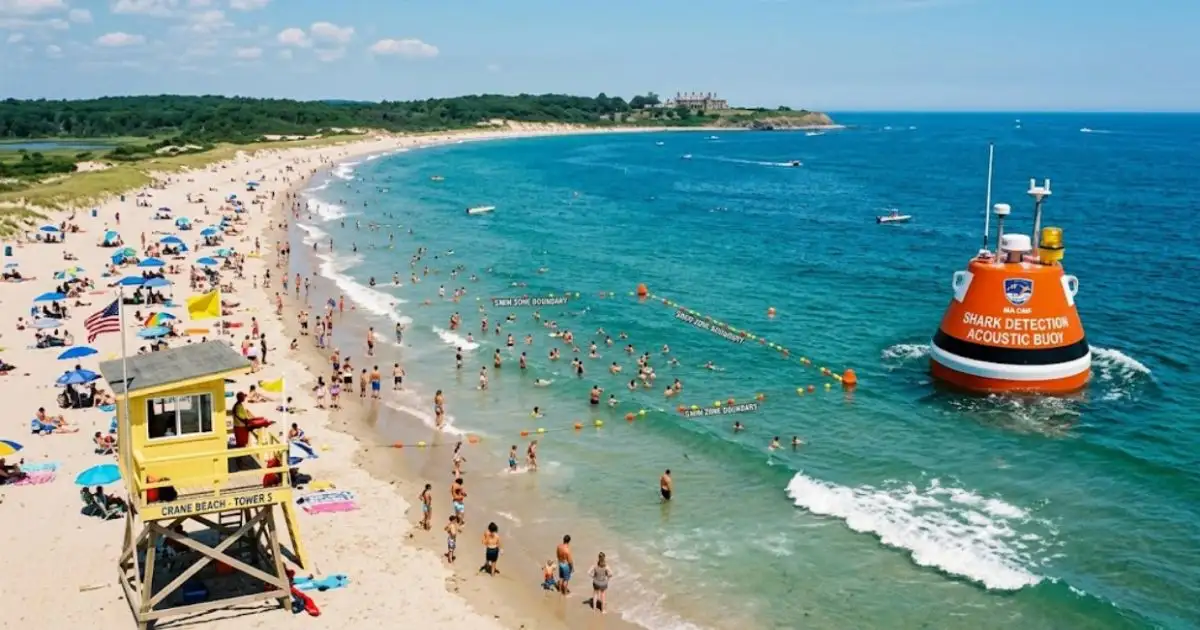
Yes — Crane Beach had a real shark problem in the fall of 2024. And yes, the Trustees of Reservations responded with more than a press release. Here’s what actually changed, what the risk looks like in context, and the fastest way to check conditions before you go.
What “Crane Beach Shark Safety” Actually Means in 2025
Crane Beach shark safety refers to the set of monitoring protocols, trained staff procedures, and real-time detection tools now in place at Crane Beach in Ipswich, Massachusetts, following confirmed great white shark sightings in September and October 2024. A sighting triggers an immediate water closure until public safety personnel clear the area.
That’s the short version.
The longer version matters more if you’re actually planning to swim there.
In September 2024, an oceanic upwelling dropped water temperatures at Crane Beach by roughly 10 degrees in a short period. That shift pushed bait fish closer to shore. The bait fish pulled juvenile great white sharks right into the swim zone — some confirmed in as little as five to seven feet of water. The beach was closed to swimmers on September 17 and stayed closed through the end of October.
It wasn’t a fluke. It was oceanography.
Understanding why it happened is actually the most useful thing you can take from this article. The mechanism — upwelling → temperature drop → bait fish migration → shark presence — can repeat any fall season. What’s different in 2025 is that the beach is now watching for it, with real tools.
What’s New at Crane Beach for Shark Monitoring in 2025
The Trustees of Reservations didn’t just update their website. They worked with local public safety officials, the Ipswich Police Department, the Ipswich Harbormaster, and marine biologists to build out a layered monitoring system. Here’s what that actually looks like on the water.
The shark detection buoy is the centerpiece. At least one buoy has been installed in the specific area where sharks were confirmed to be present in 2024. This type of acoustic monitoring buoy detects tagged sharks when they swim within range and can trigger alerts in near real-time. Most beachgoers have no idea this technology exists — or that Crane Beach is now one of the few North Shore beaches using it.
The buoy works alongside two other monitoring methods: Trustees staff trained to visually scan the swim zone from shore, and Ipswich Harbormaster patrol watercraft running regular sweeps of the swimming area throughout the day.
Crane Beach lifeguards and EMTs are also receiving specific shark safety and response training — not just flag protocols, but actual decision trees for escalation.
Crane Beach has also partnered with Greg Skomal, the marine biologist leading the Massachusetts Shark Research Project at the Division of Marine Fisheries. Any data gathered at Crane Beach this season feeds directly into that research program. That’s a meaningful upgrade: this isn’t a beach trying to manage optics. It’s a beach contributing to science.
Or maybe I should say it this way — there’s a real difference between a beach that reacts to sharks and a beach that’s now part of the infrastructure watching for them.
How to Check Shark Safety Before You Go to Crane Beach
To check current shark safety conditions at Crane Beach before your visit, follow these steps:
- Call the Crane Beach information line: 978-356-4354. Real-time operational updates — including any water closures — are recorded here. This is the official channel.
- Download the Sharktivity app: Free, run by the Atlantic White Shark Conservancy. Shows confirmed and probable sightings across the Massachusetts coastline in near real-time. Check it morning-of.
- Check the Trustees website: thetrustees.org/cranebeach for posted advisories.
- Avoid the water if flags are up: Any shark alert flag or verbal instruction from lifeguards means exit immediately, no exceptions.
- Watch for water temperature drops in late summer: Upwelling events in August–October are the highest-risk window — the same mechanism that triggered the 2024 closures.
Quick note: Crane Beach is no longer posting real-time updates on X (formerly Twitter). If you’re looking there, you won’t find the current safety status. The voicemail line is the right call.
Also read: Crane Safety News 2025–2026: Accidents, OSHA Updates & Best Practices
The Actual Risk — Put in Honest Perspective
Here’s the thing: the fear is understandable, and the risk is real but statistically tiny.
According to the CDC, there were 4,312 unintentional drowning deaths in the United States in 2023 alone. The national average for fatal shark attacks is roughly one every two years. The last fatal shark attack in Massachusetts was in 2018 — a single incident in Wellfleet, off Cape Cod, over six years ago.
Some experts argue that the 2024 Crane Beach sightings signal a long-term shift in shark range northward, driven by warming waters and recovering seal populations — and that North Shore beaches need to permanently recalibrate their safety posture. That’s a valid concern. What I’ve seen in the data, though, suggests these sightings are highly correlated with specific oceanographic events, not a uniform increase in baseline presence. The upwelling scenario is identifiable and now being actively monitored.
The Sharktivity app vs. beach closures — a quick comparison worth knowing:
| Option | Best For | Key Benefit | Limitation |
|---|---|---|---|
| Sharktivity App | Real-time pre-visit check | Crowd-sourced + tagged shark data | Requires tagged sharks to detect |
| Crane Beach Voicemail | Official closure status | Managed by Trustees directly | Updated reactively, not predictively |
| Shark Detection Buoy | Ongoing monitoring | Detects tagged sharks automatically | Only covers the installed zone |
| Harbormaster Patrol | Active water surveillance | Human eyes + watercraft | Limited to patrol schedule |
| Lifeguard Visual Scan | Swim zone monitoring | Continuous during open hours | Weather and visibility dependent |
The buoy is the only tool that doesn’t rely on someone already seeing a shark.
What Happens If a Shark Is Spotted While You’re There
The response protocol is clear and has been rehearsed. If a shark is suspected — even unconfirmed — swimmers will be asked to exit the water. Everyone out, no negotiation. If the sighting is confirmed, the beach closes to swimming until Ipswich Police and Harbormaster staff complete a full patrol of the swim zone and declare it safe to reopen.
Look — if you’re at Crane Beach and a lifeguard blows a whistle or starts waving flags, that’s not a drill. Get out and get clear of the water’s edge. Juvenile great whites were confirmed within 50 yards of shore in 2024. That’s not a hypothetical.
Additional emergency resources can be deployed rapidly through a coordinated chain involving the Trustees, Ipswich Police, Harbormaster, and emergency medical staff already on-site.
FAQS: Crane beach shark safety
Yes, it’s open for swimming with enhanced shark monitoring in place — including a detection buoy, Harbormaster patrols, and trained lifeguards. Check the info line at 978-356-4354 before visiting.
The Sharktivity app by the Atlantic White Shark Conservancy. It’s free and shows confirmed and probable shark sightings along the Massachusetts coastline in near real-time.
Call 978-356-4354 for a recorded real-time update from the Trustees. They post closures there before anywhere else — not on social media.
Late summer through fall, typically August through October, when oceanic upwelling can drop water temperatures and push bait fish — and the sharks that follow them — into shallow water near shore.
No. Wait for an official all-clear from Trustees staff or Ipswich Police before re-entering the water. Don’t rely on the sighting being “far enough away.”
Article Scope: What this article covers: 2026 safety protocols at Crane Beach in Ipswich, MA, real-time checking tools, and risk context for swimmers. It does NOT cover surfing-specific risk, kayak or paddleboard guidance, or beach conditions outside the marked swim zone.