
An average of 44 workers die in crane-related accidents in the U.S. every year. The Crane Inspection & Certification Bureau estimates that roughly 90% of those deaths trace back to human error — not equipment failure. That’s the number that should be on every site manager’s wall.
Yet most crane safety training conversations get stuck on the wrong question. People ask “where do I find a course?” when they should be asking “which of my people legally need what kind of training, and what does compliance actually look like?”
This guide answers the second question.
What Is Crane Safety Training — And Who Legally Needs It?
Crane safety training refers to the structured instruction, practical evaluation, and certification process required to ensure workers can operate, rig, signal, or work near cranes without causing injury or death. It covers operators, riggers, and signalpersons as three legally distinct roles — each with different OSHA requirements.
Here’s where most sites get into trouble: they train the operator and assume that covers the crew. It doesn’t.
OSHA’s crane standard for construction — 29 CFR 1926 Subpart CC — establishes separate qualification requirements for each role. Failing to train riggers or signalpersons is one of the most common citation triggers during post-incident investigations, and it’s one that experienced HSE managers know to watch for even when nothing has gone wrong yet.
According to OSHA’s 1926.1427, every crane operator must be either certified by an accredited third-party certifier, qualified by an audited employer program, or licensed by a state or local government. The standard doesn’t let you pick informally — it requires a documented, verifiable qualification.
OSHA Crane Safety Requirements: The Regulations That Actually Matter
There’s a reason safety managers feel overwhelmed after reading OSHA’s crane standards. The rules span multiple subparts, reference each other constantly, and contain exceptions that only apply to specific equipment types.
Here’s the honest version: most sites need to focus on five core regulatory citations.
29 CFR 1926.1427 — Operator certification and qualification. This is the one that defines whether your operators are legally compliant. It requires certification through an accredited body (NCCCO is the most widely recognized), an audited employer program, or a state/local license where applicable.
29 CFR 1926.1428 — Signal person qualification. Signal persons must be qualified either by a third-party evaluator or through an employer’s own program — and that qualification must be documented. No documentation means no compliance, even if the person has years of experience.
29 CFR 1926.1430 — Training. This is broader than certification. It covers everyone who works in the crane’s operating area — not just the operator. Pre-task hazard briefings fall under this section.
29 CFR 1926.1412 — Inspections. Cranes require pre-shift inspections, monthly inspections, and annual inspections. Each has different scope requirements. What most guides skip is the documentation chain — an inspection with no written record is legally equivalent to no inspection.
29 CFR 1926.1407–1409 — Power line safety. Given that OSHA data shows 45% of crane accidents involve power line contact, this section isn’t optional reading. It governs minimum clearance distances and the steps required before any lift near energized lines.
Some experts argue that employer qualification programs are a practical alternative to third-party certification for experienced operators. That’s valid for large, structured organizations with robust internal auditing. But if you’re managing a site with subcontracted crane crews or operators from multiple firms, third-party certification from a body like NCCCO is the only verification method you can actually trust on day one.
Also read: Crane Safety News 2025–2026: Accidents, OSHA Updates & Best Practices.
Operator Certification Programs: NCCCO, CICB, and What the Difference Is
Not all crane certifications are equal. There are several accredited bodies, and choosing the right one matters depending on your crane type and industry.
Quick Comparison
| Certifying Body | Best For | Key Benefit | Limitation |
|---|---|---|---|
| NCCCO | Construction, general industry | Most widely recognized by OSHA and employers | Separate exams per crane type — costs add up |
| CICB | Construction and inspection | Strong inspection and rigger modules | Fewer test centers than NCCCO |
| ASME B30 Standards | Industrial/manufacturing settings | Sets the technical baseline all programs reference | Not a certification body — it’s a standards framework |
| Employer Qualification Program | Large orgs with internal auditing capability | Cost-effective at scale | Requires formal audit documentation; harder to verify externally |
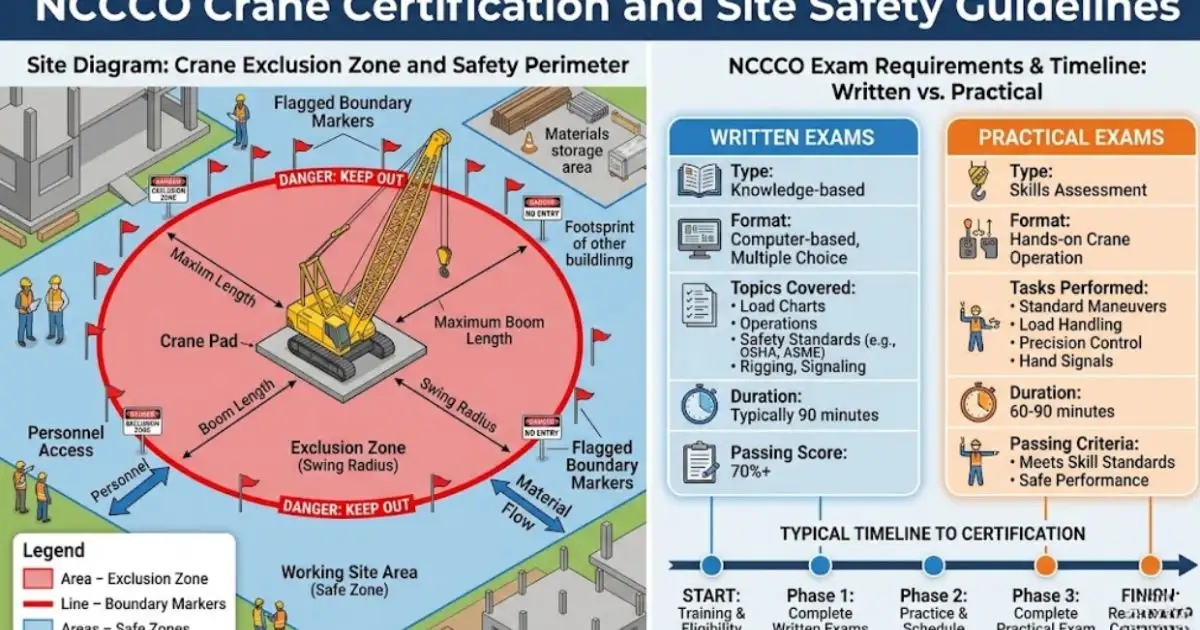
NCCCO certification requires passing both a written exam and a practical exam. The practical component is administered at approved test sites and evaluates real equipment operation — not just classroom knowledge. Certification is valid for five years, with a written recertification exam required to renew.
Or maybe I should say it this way: the exam is the easy part. The harder part is understanding which NCCCO credential applies to which crane type. An operator certified for lattice boom cranes isn’t automatically qualified to operate a telescoping boom crane. This is a detail that creates real compliance gaps on multi-equipment sites.
To get NCCCO certified, follow these steps:
- Confirm which crane type credential applies to your equipment.
- Register at nccco.org and select a written exam date at an approved test center.
- Complete the written examination (multiple choice, equipment-specific).
- Schedule and pass the practical examination at an NCCCO-approved site.
- Receive certification documentation — valid for 5 years from issue date.
Rigger and Signalperson Training: The Two Qualifications Sites Most Often Missed
Let’s be direct. Most crane-related OSHA citations after a workplace incident involve the operator — but a disproportionate number of the underlying accidents trace back to rigging failure or signalperson error.
A review of 249 overhead crane incidents found 838 OSHA violations across them. That’s more than three violations per incident. Many weren’t operator errors. They were system failures — unqualified riggers, absent signal plans, undocumented pre-task checks.
Rigger qualification under 29 CFR 1926.1430 requires that riggers understand load weight calculation, sling types and inspection, hardware ratings, and load path geometry. NCCCO and CICB both offer rigger certification programs. Rigger qualification doesn’t require third-party certification under federal OSHA rules — but it does require documented proof of qualification, which means an employer-run program needs written records of what was assessed and by whom.
Signalperson qualification is often treated as informal. It shouldn’t be. OSHA 1926.1428 requires that signalpersons demonstrate knowledge of the applicable hand signal system, understand crane limitations, and know when to stop a lift. A signalperson who learned “on the job” from watching others is not qualified under OSHA’s definition unless that informal learning was documented and assessed.
Quick note: If you use a third-party signal qualification evaluator, get written documentation at the time of evaluation. Verbal sign-offs don’t survive audits.
Crane Safety Best Practices That Reduce Incidents Beyond Compliance
Compliance keeps you legal. Best practices keep workers alive.
The sites with the lowest crane incident rates share one characteristic: they treat voluntary best practices with the same seriousness as regulatory requirements. Pre-task planning meetings, written lift plans, and exclusion zone enforcement are not mandated for every lift — but the data consistently shows they reduce incident rates in ways that compliance alone doesn’t.
Pre-shift inspection checklists are required by OSHA (1926.1412), but many sites use the minimum standard. A more rigorous checklist also covers: communication equipment function tests, outrigger pad conditions and ground bearing assessments, and load chart review against the specific planned lift — not just generic capacity.
Lift planning for critical lifts is where experienced operators and site managers earn their value. I’ve seen conflicting data on how often “critical lift” thresholds trigger written plans — some sources put it at 75% of capacity, others at 90%. My read is: any lift over 75% of rated capacity, near power lines, or involving a tandem crane operation should have a documented lift plan reviewed by a qualified engineer before the crane moves.
Exclusion zones are underused. OSHA requires certain clearances near power lines, but exclusion zones around the swing radius of the crane are a best practice — not a mandate. Struck-by incidents account for over 50% of crane fatalities, per BLS data. A physical barrier or flagged perimeter costs almost nothing compared to the outcome of removing it.
Training platforms worth knowing:
- Crane Training University (cranetrainingu.com) offers hands-on operator and rigger programs at facilities in Milwaukee, Houston, and Springfield, OH — aligned with ASME B30 standards and OSHA requirements. Their on-site training option is particularly useful for teams that need training on the employer’s own equipment.
- SafetyHub by Safetycare provides an overhead crane safety video module as part of a broader online LMS — useful for general awareness training and toolbox talk prep, though it doesn’t replace hands-on certification.
Also read: Crane Safety: OSHA Rules, Hazards & Site Best Practices
Common Crane Safety Mistakes That Cause OSHA Citations
Most crane violations that result in OSHA citations aren’t dramatic failures. They’re process gaps — missing paperwork, unchecked assumptions, training that was done once and never documented.
Here’s a short list of the ones that appear repeatedly in OSHA post-incident reports:
- Operator working without documentation of certification on-site. Certification alone isn’t enough — you need proof on the job site at the time of operation.
- Ground conditions were not assessed before outrigger deployment. 1926.1402(c) requires adequate ground conditions. Most sites check visually. That’s not sufficient for soft or variable soil — a load calculation or ground bearing assessment is needed.
- No signal plan when a direct line of sight isn’t maintained. Many operators and signal persons improvise when sight lines are broken. OSHA requires a pre-established signal plan for out-of-sight lifts.
- Rigging was inspected at the start of the day, but not between lifts. Slings degrade. A wire rope sling that passed morning inspection can develop a kink or abrasion mid-shift. Regular between-lift checks aren’t mandated every time, but are considered industry standard.
- Operator working under a suspended load. This one’s obvious — and it still shows up in OSHA fatality reports year after year.
FAQS: Crane Safety Training
Register with NCCCO at nccco.org, pass a written exam specific to your crane type, then complete a hands-on practical exam. Certification is valid for five years. It’s the most widely accepted credential under OSHA 1926.1427.
Verify they hold current documentation from an accredited certifier (NCCCO, CICB, or equivalent) or that your employer qualification program includes written assessment records. Having a certificate on file isn’t enough — it must match the specific crane type being operated.
Online training works for awareness, regulations, and pre-certification study. It doesn’t satisfy the practical exam requirement. OSHA requires demonstrated hands-on competency — online-only training doesn’t meet that standard for operator qualification.
Because OSHA treats them as three distinct roles with separate qualification requirements. A certified operator doesn’t automatically qualify the rigger or signalperson. Each must be individually assessed and documented under 29 CFR 1926.1428 and 1926.1430.
OSHA mandates written plans for “critical lifts” — typically lifts exceeding 75% of rated capacity, tandem crane operations, or lifts near power lines. Many safety professionals apply the same standard to any complex or non-routine lift as a best practice.
Important Note on State Regulations
This guide covers federal OSHA standards for construction (29 CFR 1926 Subpart CC) and general industry. State-plan states (California, Michigan, Washington, and others) may have additional or more stringent requirements. Always verify with your state OSHA office.