
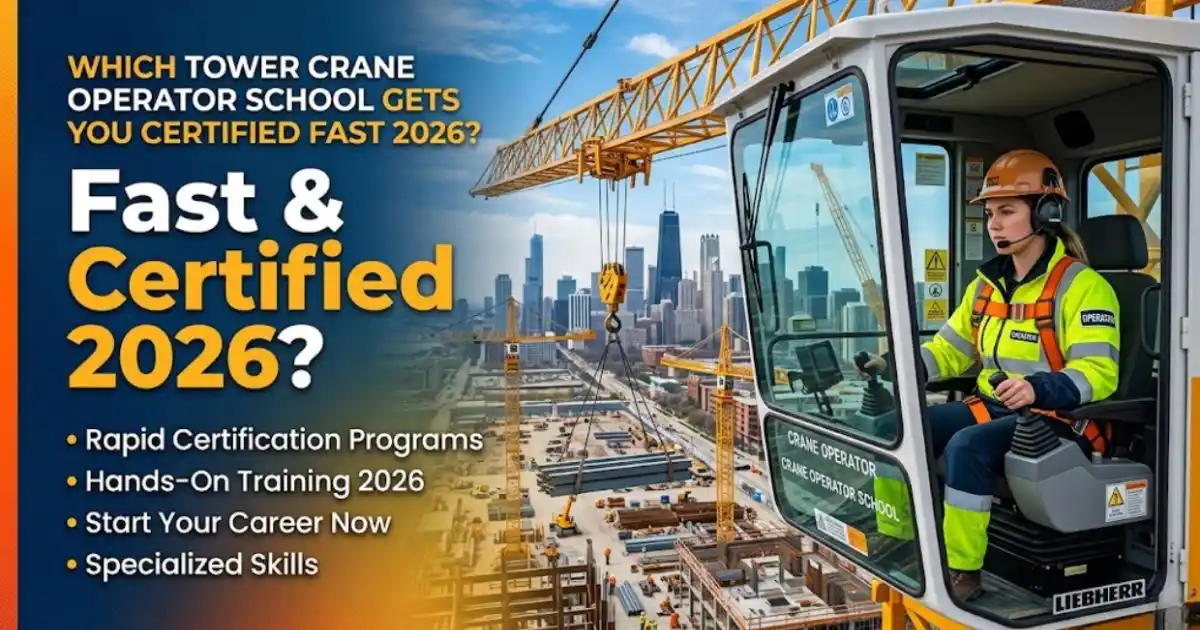
Tower cranes are involved in some of the most catastrophic construction fatalities on record — and in most cases, the operator lacked verified, accredited training. Choosing the right tower crane operator school is not a career formality.
Under OSHA 29 CFR 1926.1427, all crane operators on construction sites must be certified by an ANSI-accredited organization. This guide covers the full path to certification: what to look for in a training program, how the NCCCO tower crane exams work, common failure points, and what Saudi Aramco and Gulf-region contractors specifically require from operators working on their sites.
What Is a Tower Crane Operator School? {#what-is}
A tower crane operator school is an accredited or approved training institution that prepares candidates to safely operate tower cranes and qualify for national certification exams — primarily through the National Commission for the Certification of Crane Operators (NCCCO) in the United States, or equivalent bodies in the Gulf, UK, and South Asia.
Tower cranes are a distinct equipment category. Unlike mobile cranes, they are fixed to the ground during construction and require the operator to work in a cab elevated directly above the job site — sometimes hundreds of feet in the air. This unique operating environment demands specialized training that covers structural mechanics, wind load assessment, load chart interpretation, and anti-two-block safety devices, among other competencies.
Training programs vary in length from 3 days (intensive exam-prep workshops) to 5-day full certification courses with integrated practical time. Some operators progress through longer apprenticeship or vocational programs. No matter the format, the outcome must be the same: a candidate who can pass both the written and practical exams required for NCCCO Tower Crane certification.
Who attends tower crane operator school?
- Entry-level workers transitioning into crane operation
- Experienced mobile crane operators adding a tower crane credential
- Construction workers seeking higher-paying, in-demand roles
- Gulf-region operators pursuing Aramco-approved credentials
OSHA and International Legal Requirements {#legal-requirements}
Federal OSHA: 29 CFR 1926 Subpart CC
Under OSHA 29 CFR 1926.1400 (Subpart CC), and specifically 29 CFR 1926.1427, crane operators must be qualified through a combination of training, testing, and third-party certification for cranes with a capacity greater than 2,000 pounds.
OSHA recognizes NCCCO as meeting these requirements. The NCCCO is an independent body accredited by the ANSI National Accreditation Board (ANAB), which is an OSHA-approved accreditor of certification programs.
What OSHA requires specifically:
- Operator certification by an ANSI-accredited body for cranes over 2,000-lb capacity
- Employer-documented site-specific familiarization before operation
- Retraining when operators are observed operating unsafely or assigned unfamiliar equipment
- Written records of all training and evaluations
State-Plan States
Some states enforce requirements beyond federal OSHA. California’s Cal-OSHA Title 8, Section 5006.1 mandates workplace-specific training tailored to crane types and job site conditions, documented training procedures, and mandatory emergency response scenario training — requirements that exceed federal Subpart CC.
Always verify your specific state or jurisdiction. Sixteen states require NCCCO credentials as part of state licensing laws.
International Standards
For operators working outside the US — particularly in the Gulf region — the applicable standards are:
- ISO 12480-1: Safe use of cranes (Part 1: General)
- ASME B30.3: Tower cranes — design, construction, installation, inspection, testing, maintenance, and operation
- LEEA (Lifting Equipment Engineers Association): Recognized across the UK and the Gulf region
- Saudi Aramco GI-7.024: Marine and offshore crane, hoist, and rigging operations (covers tower crane operations at Saudi Aramco facilities)
| Jurisdiction | Primary Standard | Certification Body |
|---|---|---|
| USA (Federal) | 29 CFR 1926 Subpart CC | NCCCO, NCCER |
| California | Cal-OSHA Title 8 §5006 | NCCCO + Cal-specific |
| UK | PUWER / LOLER | CPCS, NPORS |
| Saudi Arabia | ISO 12480-1, ASME B30.3, GI-7.024 | SASO-approved providers, Aramco JSTD |
| UAE / Qatar / Kuwait | ISO 12480-1, ASME B30.3 | LEEA, OPITO, employer-endorsed |
Step-by-Step: How to Get Certified Through a Tower Crane Operator School {#step-by-step}
Step 1 — Verify Your Eligibility
Before enrolling in any tower crane operator school, confirm you meet NCCCO’s baseline requirements:
You must be at least 18 years old and comply with NCCCO’s Substance Abuse Policy and Code of Ethics. Train For The Crane You must also meet minimum vision standards: 20/30 vision in one eye and 20/50 in the other, with or without corrective lenses.
No formal experience is required to sit the written exam, though hands-on time before the practical exam is essential.
Step 2 — Choose an Accredited Tower Crane Operator School
Select a school whose program includes:
- Classroom instruction on OSHA Subpart CC, ASME B30.3, and load dynamics
- Load chart interpretation practice (this is tested directly)
- Hands-on tower crane operation time
- Written exam preparation and mock testing
- Coordination of your practical exam with an approved NCCCO test administrator
A standard five-day tower crane operator school is designed to help you achieve a nationally accredited NCCCO Tower Crane Operator certification with built-in crane operation practice time, taught by full-time instructors experienced in the crane safety industry.
Also read: Crane Safety Toolbox Talk: OSHA-Aligned Script for 2026
Step 3 — Complete the Written Exam
The NCCCO tower crane written exam consists of 55 multiple-choice questions, six of which are load chart questions.
The written exam covers:
- Tower crane types, components, and systems
- OSHA and ASME regulatory requirements
- Inspection and maintenance procedures
- Load chart interpretation and Safe Working Load (SWL) calculations
- Emergency response procedures
- Signal person communication protocols
The passing score is 70% or higher.
Step 4 — Pass the Practical Exam Within 12 Months
You must also successfully pass a tower crane practical exam within 12 months of passing the written. The practical exam evaluates your ability to operate the crane, follow signal instructions, manage loads safely, and respond to simulated emergency scenarios.
Step 5 — Receive Your NCCCO Credential and Maintain It
NCCCO CCO certification is valid for 5 years. Operators must recertify before expiration by passing recertification exams. OSHA also requires retraining when operators are observed operating unsafely, involved in incidents, or assigned to unfamiliar equipment.
Operators can also renew by documenting 1,000 hours of crane-related experience.
What to Look for in a Tower Crane Operator School {#what-to-look-for}
Not all programs are equal. On most construction sites, the operators who struggle in the cab are those who trained at programs that cut corners on practical time. Here is what separates a credible tower crane operator school from a paper mill:
Accreditation and Exam Access: The school must have a relationship with an NCCCO-approved test administrator. If they cannot facilitate your practical exam on-site or at a nearby testing location, look elsewhere.
Instructor Credentials Instructors should hold active NCCCO credentials — ideally in tower crane operation — and have verifiable field experience. Ask directly. A good school will not hesitate to provide instructor bios.
Equipment Access Tower cranes require actual tower crane time. A school that uses only simulators for the practical portion will not prepare you for the real exam. Verify the school has an operational tower crane for student use.
Written Exam Pass Rate. Reputable schools publish or readily share their NCCCO written exam pass rates. Industry experience shows that candidates who complete a focused training program have significantly higher pass rates Train For The Crane than those who self-study.
Load Chart Training Load chart interpretation appears directly on both the written and practical exams. Your school must dedicate significant time to this. If load charts are treated as an afterthought, that is a red flag.
Program Duration Options
| Program Type | Duration | Best For |
|---|---|---|
| Intensive exam-prep workshop | 2–3 days | Experienced operators seeking credential |
| Full certification course | 5 days | New entrants with limited tower crane time |
| Apprenticeship + school | 3–12 months | Entry-level with no construction background |
| Recertification workshop | 2.5 days | CCOs renewing before 5-year expiry |
Common Mistakes Operators Make During Certification {#common-mistakes}
During audits and post-incident reviews, the same failure patterns appear repeatedly. Avoid these:
1. Treating Load Chart Interpretation as a Soft Skill
Load charts are engineering documents. They define the maximum Safe Working Load at every radius and boom angle. Operators who approach load charts casually — rounding up, skipping derating factors, ignoring counterweight configurations — create conditions for catastrophic structural failure. Your tower crane operator school must drill this. Six of the 55 written exam questions are load chart questions — and the practical exam will test your real-time application of them.
2. Skipping the Pre-Shift Inspection
OSHA 29 CFR 1926.1412 requires documented pre-shift inspections. On sites with multiple operators per crane, this step is frequently skipped on shift handover. Inspections must cover wire rope condition, limit switches, anti-two-block devices, brakes, structural connections, and cab controls. A missed defect at the start of a shift has resulted in crane collapses.
3. Underestimating Wind Load Requirements
Tower cranes have strict out-of-service and in-service wind speed ratings — typically expressed in km/h or mph on the crane’s data plate. Operators who exceed in-service wind limits without lowering or luffing the jib have caused jib failures and collapses. Your training must cover this. It is not a judgment call; it is a manufacturer-specified hard limit.
4. Poor Communication with Signal Persons
During audits, miscommunication between crane operators and signal persons (or riggers) accounts for a significant share of near-miss incidents. OSHA 29 CFR 1926.1419–1422 establishes mandatory signal protocols. If your tower crane operator school does not run signal communication exercises — both hand signals and radio — the practical training is incomplete.
5. Failing to Account for Dynamic Load Factors
Static load calculations are necessary but not sufficient. Swinging loads, acceleration, deceleration, and slewing movements all apply dynamic forces that can exceed the crane’s rated capacity at a given radius. Operators trained only on static charts — without understanding dynamic load factors — routinely exceed safe limits without realizing it.
6. Not Completing the Full 5-Day Program
Some candidates with mobile crane experience attempt the three-day exam-prep workshop for tower cranes without ever having operated one. The practical exam will expose this gap immediately. Tower cranes operate differently from telescopic boom machines. The cab position, slewing dynamics, and hoisting speed controls require hands-on familiarization — not just study.
7. Letting Certification Lapse
OSHA requires retraining when operators are involved in incidents or assigned to unfamiliar equipment. Allowing your NCCCO credential to expire — even by one day — renders you unqualified under Subpart CC. Set your recertification deadline 90 days before expiry and begin the process well in advance.
Tower Crane Operator Training Checklist {#checklist}
Use this before, during, and after your tower crane operator school enrollment:
Before Enrollment
- Confirmed minimum age of 18
- Vision check: 20/30 one eye, 20/50 other (with or without correction)
- Reviewed the NCCCO Candidate Handbook for Tower Crane
- Verified school has an NCCCO-affiliated test administrator
- Confirmed hands-on tower crane access (not simulator-only)
- Signed and submitted the NCCCO Substance Abuse Policy agreement
During Training
- Completed load chart interpretation module
- Practiced pre-shift inspection procedure per OSHA 1926.1412
- Drilled signal communication: hand signals and radio
- Studied ASME B30.3 tower crane-specific provisions
- Completed at least two full mock written exams
- Logged hands-on hours in the cab
After passing the written exam
- Scheduled practical exam within a 12-month window
- Confirmed practical exam site has an operational tower crane
- Reviewed emergency stop, anti-two-block, and limit switch procedures
- Applied for the NCCCO certification card
For Gulf/Saudi Arabia Work
- Obtained ISO 12480-1 / ASME B30.3 training documentation
- Verified SASO-approved training provider (if required)
- Confirmed Aramco contractor credentials with employer (JSTD or TPI certificate)
Gulf Region and Saudi Aramco Requirements {#gulf-region}
If you are pursuing a tower crane operator school qualification for work in Saudi Arabia, the UAE, Qatar, or Kuwait, certification requirements diverge from the US federal model — and in most cases, they are more stringent.
Saudi Aramco
Under Saudi Aramco GI-7.024, all Saudi Aramco and contractor operators of major marine and offshore cranes — including tower cranes — must be tested and certified by a representative of the Dhahran Heavy Equipment Operators Training and Test Unit (JSTD), normally at the work location.
In practice, contractors working on onshore Aramco projects are required to hold either an Aramco-approved certificate or a TPI (Third Party Inspection) certificate from a recognized body. Job listings from Aramco project sites consistently require a valid Saudi Aramco or TPI certificate for crane operators in the oil and gas sector.
For non-Aramco Saudi construction projects, training providers must meet SASO (Saudi Standards, Metrology and Quality Organization) approval. Comprehensive tower crane operator training in Saudi Arabia is delivered under programs aligned with ISO 12480-1 and ASME B30.3 standards, covering load chart interpretation, hazard identification, and emergency response procedures.
What Aramco contractors specifically look for:
- Valid GCC crane operator license (Saudi government-issued)
- Aramco-approved certification or SASO/LEEA-approved training record
- Minimum 2 years of Gulf project experience for most roles
- Current PTW (Permit to Work) familiarization
- English language proficiency (written and spoken) for permit documentation
UAE, Qatar, and Kuwait
Across the broader Gulf region, LEEA-accredited training is widely recognized, as is OPITO-aligned competency assessment. Most project sites operating under international EPC contractors accept NCCCO credentials combined with local operator induction programs.
Contractors working under SIMOPS (Simultaneous Operations) conditions — common in petrochemical and offshore construction — will require additional JSA (Job Safety Analysis) training and PTW receiver qualification before tower crane operations are permitted.
Requirements described are based on publicly available Saudi Aramco standards. Contractor-specific requirements may vary. Always confirm credential acceptance with your contracting employer before enrollment.
FAQS: Tower Crane Operator School
A tower crane operator school is an accredited training institution that prepares candidates to operate tower cranes safely and pass the NCCCO Tower Crane Operator certification exams — including both the written and practical components. Programs range from 3-day exam-prep workshops to full 5-day certification courses with hands-on crane time.
Most tower crane certification programs run 3 to 5 days. A 3-day course suits experienced operators preparing for the NCCCO exam; a 5-day course is designed for candidates with limited tower crane exposure and includes dedicated hands-on operation time. After passing the written exam, you have 12 months to complete the practical exam.
The written exam contains 55 multiple-choice questions, including 6 load chart questions. Topics include tower crane components, OSHA and ASME B30.3 requirements, inspection procedures, load calculations, emergency response, and signal communication. The passing score is 70%.
No prior crane experience is formally required by NCCCO to sit the written exam. However, you must pass a practical exam within 12 months. Schools strongly recommend that candidates with zero crane background complete the full 5-day program with hands-on operation time, rather than the 3-day exam-prep option.
NCCCO credentials are internationally recognized but may not satisfy Saudi Aramco’s site-specific requirements alone. Operators working on Aramco projects typically need Aramco JSTD certification or a TPI certificate. For broader Gulf and Saudi construction projects, SASO-approved or LEEA-accredited training aligned with ISO 12480-1 and ASME B30.3 is required.
NCCCO Tower Crane Operator certification is valid for 5 years. Recertification requires passing the written exam again or documenting 1,000 hours of qualifying crane-related experience. OSHA also mandates retraining any time an operator is involved in a serious incident or assigned to a crane type they have not previously operated.
A ready-to-use tower crane pre-lift checklist — covering pre-shift inspection, load chart verification, signal communication protocols, and Aramco PTW requirements — is available in our HSE Documentation library.
Conclusion
Choosing the right tower crane operator school determines more than your exam result — it determines whether you are actually competent to operate equipment that can kill multiple people in a single incident.
Three things matter most: confirm the school uses a real tower crane for practical training, verify the instructors hold active NCCCO credentials, and do not skip load chart interpretation practice. For professionals targeting Gulf region or Saudi Aramco projects, add ISO 12480-1 and ASME B30.3 compliance documentation to your certification portfolio before applying.