
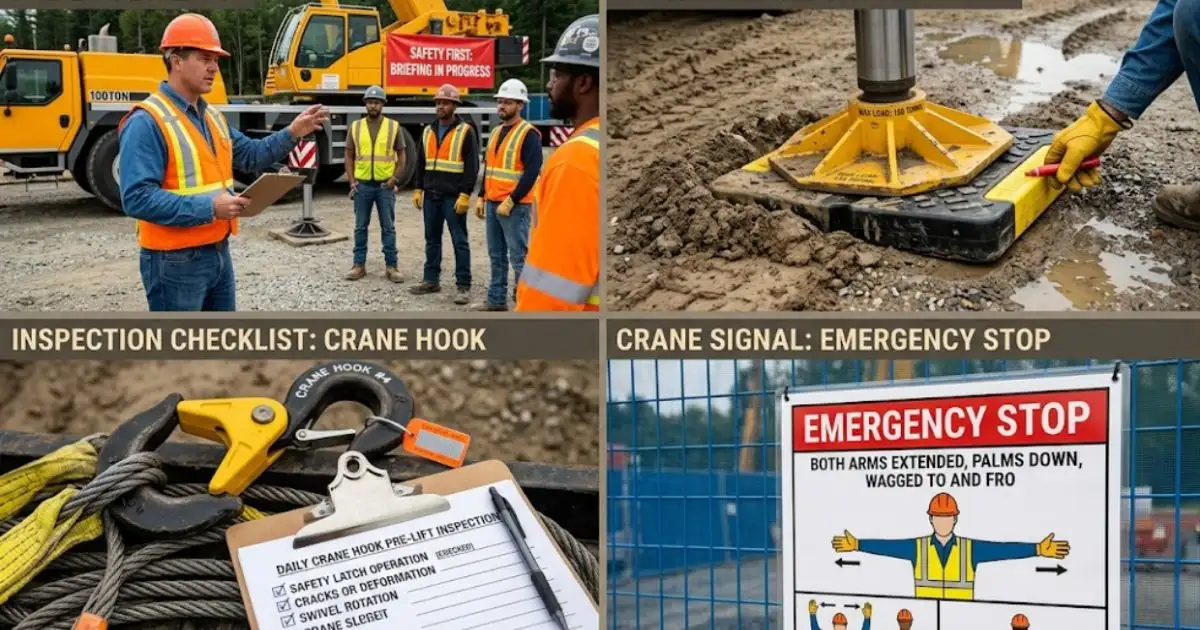
Cranes don’t fail on their own. That’s the uncomfortable truth behind most crane incidents — and it’s why what you say in the five minutes before a lift matters more than most people realize.
What a Crane Safety Toolbox Talk Actually Is (And What It Isn’t)
A crane safety toolbox talk is a brief, focused safety briefing — typically 5 to 15 minutes — delivered to a crew before crane operations begin on a shift. It covers the specific hazards present that day, reviews pre-lift procedures, confirms operator certifications, and opens a direct line of communication between workers and supervisors.
It’s not a lecture. It’s not a legal checkbox. Done right, it’s the fastest risk-reduction tool on your site.
According to the Crane Inspection & Certification Bureau (CICB), roughly 90% of crane accidents are caused by human error — not mechanical failure. That single data point explains why a well-run toolbox talk isn’t optional. It’s your most direct lever for changing the human behavior that actually causes incidents.
The Mojo AI competitor article cites this same 90% figure — but then offers no structured script or discussion questions to actually address it. That’s the gap this article closes.
The Biggest Crane Hazards Your Crew Needs to Know Today
Here’s the thing: most crews already know cranes are dangerous. What they don’t always know is which specific hazard is most likely to kill someone this week. That’s what the talk needs to target.
Power line contact is the hazard that catches crews off guard most consistently. OSHA §1926.1408 requires a minimum 20-foot clearance from energized lines for most voltage levels — and that distance applies to all parts of the crane, not just the hook. Before any lift, someone must physically survey the swing radius for overhead lines. Do not assume. Survey.
Rigging failure is quieter but just as deadly. A review of 249 overhead crane incidents found that 27% involved load drops — primarily from worn slings, improper choker hitches, and overloaded shackles that nobody flagged during the pre-shift inspection. Wire rope condition is especially under-inspected on busy sites.
Ground instability and tip-overs are underestimated because they look rare until they aren’t. A 2024 OSHA fatality investigation in Florida documented a 110-ton Liebherr crane tipping after an outrigger gave way on soft ground — killing a 37-year-old aerial lift operator who was working in the swing radius. Outrigger pads. Ground bearing capacity. Not optional.
Struck-by incidents. Just over half of all fatal crane injuries involve a worker being struck by swinging or falling loads, according to the BLS Census of Fatal Occupational Injuries data. The exclusion zone has to be enforced, not just drawn on paper.
Quick note: the struck-by category is one reason your toolbox talk must explicitly name who is responsible for clearing the exclusion zone before each pick. “Everyone knows” is how people get killed.
The Ready-to-Use Crane Safety Toolbox Talk Script
Estimated delivery time: 8–12 minutes. Adapt the bracketed fields to your site.
OPENING (1–2 minutes)
“Before we start today, we’re doing a quick crane safety review. We have [describe lift — load weight, crane type, location] happening this shift. I want everyone who’s working near or under this crane to pay attention.
Let me ask a quick question to start: Has anyone here ever seen a near-miss with a crane — something that could have gone bad? What happened?“
[Let 1–2 workers respond. This opens engagement and reveals real site-specific hazards you might not know about.]
SECTION 1: Operator and Crew Certification (2 minutes)
Under OSHA 29 CFR §1926.1427, every crane operator on a construction site must be certified, licensed, or employer-qualified before touching the controls. The employer holds legal responsibility — not just the operator.
The gold standard for operator certification is NCCCO (National Commission for the Certification of Crane Operators). If your operator doesn’t hold a valid NCCCO certificate or equivalent state license, and they haven’t been evaluated on this specific crane type by a qualified evaluator, your company is exposed — legally and physically.
Ask your crew:
- “Can our operator show his current NCCCO certification card for this crane type?”
- “Has he been evaluated on this specific model by a qualified evaluator — and is that documented on site?”
Don’t assume the answers are yes. Check.
To verify operator qualification on site, follow these steps:
- Request the operator’s NCCCO or state license credential
- Confirm the certification covers the crane type being used (mobile, tower, overhead)
- Locate the employer evaluation form — it must be kept at the worksite
- Confirm the signal person has documented qualification per §1926.1428
Also read: Crane Safety Training: OSHA Rules, Certifications, and Site Best Practices
SECTION 2: Pre-Lift Inspection Checklist (3 minutes)
No lift happens without a pre-shift inspection. This isn’t a courtesy — it’s §1926.1412(d). Here’s what the operator must check before the first pick of the day:
On the crane itself:
- All controls functional and labeled
- The load chart is present and legible in the cab
- Hooks — check for cracks, deformation, or safety latch damage
- Wire rope — look for broken wires, kinking, or corrosion (6 broken wires in one lay = remove from service)
- Outriggers fully extended and pads in place on stable ground
- Boom condition — no visible cracks, bent chords, or missing pins
On the rigging:
- Slings rated for the load and free of cuts, burns, or deformation
- Shackles — pins fully tightened and moused (safety-wired)
- Load weight confirmed — not estimated, confirmed
On the site:
- Overhead power lines identified and clearance measured
- Exclusion zone marked and communicated to all nearby workers
- Ground bearing capacity assessed, especially after rain
Or maybe I should say it this way — this isn’t a list to scan. It’s a list to touch and check. Visual inspection without physical handling misses most of the failures.
SECTION 3: Communication Protocol (2 minutes)
Crane operations with a single point of communication failure kill people. The signal person must be designated before the lift begins — not during it.
ANSI B30.5 and OSHA §1926.1419 both establish standardized hand signals for crane operations. Every rigger and every worker in the lift zone must know them. Pointing is not a hand signal. Waving is not a hand signal.
If radio communication is used as a supplement, the signal person has priority over all other radio traffic during the lift. One voice. One signal person. No exceptions.
Discussion question for your crew: “Who here can show me the hand signal for ‘stop’ and ’emergency stop’? What’s the difference?”
SECTION 4: Crane Type Matters — Mobile vs. Tower vs. Overhead
This is what almost every competing toolbox talk resource misses entirely.
The safety protocols for a mobile crane (such as a Manitowoc all-terrain) are not the same as for a tower crane, and neither is the same as for an overhead/bridge crane in an industrial shop. The OSHA standard for overhead cranes in general industry is 29 CFR §1910.179, not Subpart CC. If your crew moves between site types, they need to know which rules apply where.
Quick Comparison:
| Crane Type | Key OSHA Standard | Primary Unique Hazard | Certification Required |
|---|---|---|---|
| Mobile Crane | 29 CFR 1926 Subpart CC | Ground instability, tip-over | NCCCO or state license |
| Tower Crane | 29 CFR 1926 Subpart CC | Assembly/disassembly hazards | NCCCO Tower Crane specialty |
| Overhead/Bridge Crane | 29 CFR 1910.179 | Runway clearance, load path | Employer qualification |
| Carry Deck / Pick & Carry | 29 CFR 1926 Subpart CC | Travel with load, stability | NCCCO or state license |
This is what most guides skip. If you’re running a tower crane, your toolbox talk needs to address A/D (assembly and disassembly) hazards under §1926.1404, which require a qualified A/D director on site. That’s a different conversation from a mobile lift.
SECTION 5: Discussion Questions to Close the Talk
End every crane safety toolbox talk with at least two open questions. This isn’t soft leadership — it’s how you surface hazards that your pre-lift paperwork won’t catch.
Suggested closing questions:
- “Is there anything about today’s lift location — ground, overhead lines, nearby workers — that makes you uncomfortable? Say it now.”
- “When did you last inspect the rigging on this job? Who signed off?”
- “What’s the plan if the load starts swinging and the signal person loses line of sight with the operator?”
Silence isn’t agreement. Silence means people haven’t thought about it yet. These questions make them think.
OSHA Citations and Real Penalty Exposure
Some experts argue that toolbox talks are mainly a morale or culture tool — that real compliance comes from audits and engineering controls. That’s valid for established programs. But if you’re dealing with a subcontractor crew that rotates every two weeks, the toolbox talk is often the only safety contact that happens.
OSHA crane and rigging violations carry serious financial weight. In FY2024, serious violations carry penalties up to $16,131 per instance. Willful or repeated violations can reach $161,323 per violation. The Adcock Cranes case in 2024 demonstrated that these aren’t theoretical numbers — OSHA issues them.
The most common crane-related OSHA citations include:
- Failure to certify or qualify operators (§1926.1427)
- No documented signal person qualification (§1926.1428)
- Missing or incomplete pre-shift inspection records (§1926.1412)
- Inadequate power line clearance procedures (§1926.1408)
- Failure to conduct a lift plan for critical lifts
Tools That Make This Easier
Running toolbox talks manually — paper forms, printed scripts, signature sheets — works, but it creates compliance gaps. Digital platforms like Safety Mojo let supervisors deliver, document, and store crane toolbox talks with crew attendance records tied to the job site and date. That documentation matters when OSHA shows up.
For operator certification management, NCCCO’s online credential verification lets employers confirm in real time whether an operator’s certification is current, which crane types it covers, and when it expires. Use it before every new operator starts on your site — not after.
FAQS: Crane Safety Toolbox Talk
It should cover operator certification status, pre-shift inspection findings, rigging condition, power line clearance, exclusion zone setup, communication protocols, and site-specific hazards for that day’s lift. Keep it under 15 minutes.
Before every shift where crane operations are planned. Many safety programs also require a separate critical lift briefing for any lift exceeding 75% of the crane’s rated capacity.
Under 29 CFR §1926.1427, employers must ensure operators are certified or licensed and have been evaluated on the specific crane being used. NCCCO certification is the most widely accepted credential.
According to the Crane Inspection & Certification Bureau, approximately 90% of crane accidents stem from human error — including improper rigging, lack of communication, and failure to follow pre-lift procedures.
Yes. Tower cranes have specific assembly/disassembly hazards under §1926.1404 that require a qualified A/D director. Mobile cranes focus more on ground stability, outrigger setup, and travel radius. The hazard profiles are meaningfully different.