
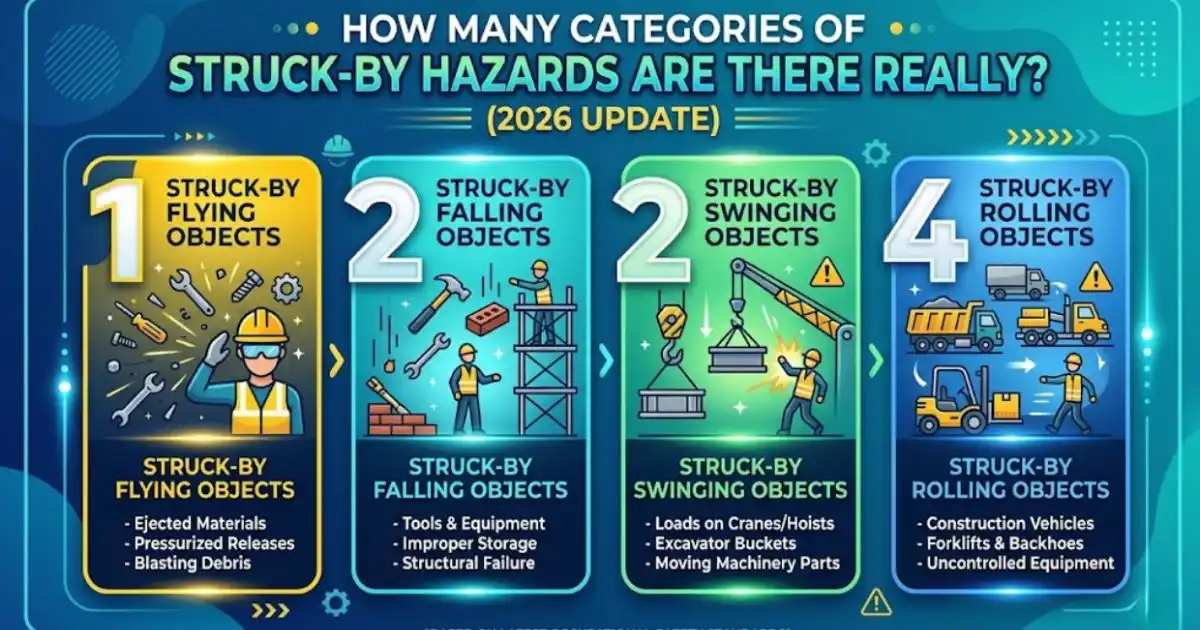
There are four categories of struck-by hazards—but how many categories of struck-by hazards are there according to OSHA standards, and why does it matter on real job sites? The answer is critical for safety awareness.
The four recognized types include being struck by flying objects, being struck by falling objects, being struck by swinging objects, and being struck by rolling objects. According to OSHA’s own fatality data, struck-by incidents accounted for more than 17% of all construction fatalities in 2025, making them the second-leading cause of death on construction sites, just behind falls.
OSHA defines a struck-by hazard as forcible contact or impact between a person and an object or piece of equipment. The definition is simple—but identifying every real-world scenario where it applies is not.
This guide breaks down all four OSHA-defined struck-by categories, the key regulations behind each, the most common on-site failures, a practical prevention checklist, and how these hazards are controlled under Saudi Aramco’s PTW (Permit to Work) system across the Gulf region.
What Is a Struck-By Hazard? {#what-is}
A struck-by hazard is defined as any condition in which a worker is exposed to forcible contact or impact from an object or piece of equipment in motion. The keyword is forcible — the object must be moving and must make contact with the worker’s body.
This separates struck-by events from caught-in/between incidents, where the injury comes from compression rather than impact. In practice, however, the two categories often occur together. A worker struck by a swinging crane load and then pinned against a structure faces both hazards simultaneously.
OSHA formally categorizes struck-by hazards under the OSHA Focus Four program, which is embedded in the OSHA 10-Hour and OSHA 30-Hour Outreach Training curriculum. Any competent person responsible for construction site safety must be able to identify all four struck-by sub-categories, assess their likelihood, and implement controls before work begins.
OSHA’s Focus Four and Why Struck-By Matters {#focus-four}
Falls, Struck-by, Caught-in/between, and Electrocution — together these four hazard categories account for more than 60% of all construction worker fatalities annually. OSHA calls this group the “Focus Four” or “Fatal Four.” Every employer conducting OSHA-required safety training must cover all four categories.
Struck-by incidents accounted for 17.2% of construction deaths in 2018 and 15.4% in 2019. Year over year, these numbers remain stubbornly consistent — largely because struck-by hazards are dynamic, arise quickly, and workers often fail to recognize them until it is too late.
Approximately 75% of struck-by fatalities involve heavy equipment, including vehicles. Construction workers account for one in four workplace “struck by vehicle” deaths — more than any other occupation.
In any toolbox talk or JSA (Job Safety Analysis) that involves overhead work, crane lifts, mobile equipment, or pneumatic tools, a struck-by hazard assessment is not optional — it is a regulatory baseline.
The 4 Categories of Struck-By Hazards Explained {#four-categories}
Struck-by hazards are divided into four groups: flying objects, falling objects, swinging objects, and rolling objects. Below is a field-level breakdown of each category with real examples and the conditions that cause them.
Category 1: Struck by Flying Objects
Hazards from flying objects exist when something has been thrown or propelled across the worksite. Common activities that may lead to flying object injuries include using a nail gun or other pneumatic or powder-actuated tools. The projectiles ejected from these tools can be extremely hazardous. Using compressed air for cleaning can also cause flying object hazards.
Additional sources of flying object hazards include:
- Grinders and cutting tools — disc fragments, sparks, or cut material ejected at high velocity
- Concrete demolition — jackhammers and chipping guns send fragments in unpredictable directions
- Pressurized systems — burst hoses, fittings, or hydraulic lines can release material at lethal speeds
- Defective hand tools — cracked hammer heads or chisels that fragment under impact
The critical control for flying objects is a combination of engineering barriers (deflection shields on grinders, nail gun nose guards) and PPE — specifically safety glasses, face shields, and hard hats. The hazard zone extends well beyond the immediate work area, which is the point most workers miss.
Category 2: Struck by Falling Objects
Multi-level construction projects, telecommunications work, or the use of scaffolding are common environments with the potential for falling objects. When workers are on a walking/working surface below a work area, they must be protected from falling objects.
Common falling object scenarios:
- Tools or materials dropped from scaffolding or elevated platforms
- Unsecured loads shifting during crane lifts
- Stacked materials that topple due to poor storage
- Debris knocked off formwork during concrete pours
The physics of falling objects makes them extremely dangerous. A 1-pound tape measure falling from 150 feet can cause serious injury. A 5-pound wrench dropped from 20 feet can be lethal. A 10-pound toolbox falling from 50 feet almost always results in severe or fatal injuries.
Controls include toeboards, debris nets, tool tethering systems, and hard hats as mandatory PPE whenever overhead work is in progress. OSHA 29 CFR 1926.502(j)(1) specifically requires toeboards along overhead walking/working surface edges to protect employees below.
Category 3: Struck by Swinging Objects
Swinging object injuries are caused by swinging objects and usually occur when materials are being moved, and something causes the load to sway. They can also happen when a worker is inside the swing radius of a heavy piece of machinery.
Swinging hazards are particularly associated with:
- Crane operations — a freely-suspended load will pendulum in wind or during acceleration/deceleration
- Excavators and backhoes — workers entering the swing radius of the house or boom
- Rigging failures — improperly secured loads that rotate during lift
- Vehicles with projecting loads — steel beams, long conduit, or rebar extending from flatbeds
Workers on a construction site must be authorized to enter the swinging area and must notify the equipment operator before entering the hazard zone. Ensure weather conditions are not extremely windy when moving loads, as extreme wind increases the risk of swinging hazards.
OSHA 29 CFR 1926.1424(a)(2)(i) requires employers to train each employee assigned to work near equipment to recognize struck-by and pinch/crush hazard areas around that equipment. Establishing a clear exclusion zone around crane operations and heavy equipment swing arcs is the minimum preventive requirement.
Category 4: Struck by Rolling Objects
Stacked material may pose potential struck-by hazards, especially if they are not secured properly or have the potential to roll. Workers on the same level as heavy material that could roll or slide must be cautious and keep out of storage areas when loads are being moved. Always watch for materials, equipment, or machinery that may become rolling object hazards — such as pipes, reels, rebar, coils, rolls, barrels, tires, wheels, or even vehicles.
Rolling objects include vehicles, heavy equipment, or materials that move or slide along surfaces in a worker’s path. Unsecured pipes, barrels, or carts can also roll unexpectedly, creating serious hazards.
Key rolling hazard scenarios on industrial and construction sites:
- A vehicle rolling on a grade while the operator exits the cab
- Pipe sections stored on uneven ground without chocking or dunnage
- Reels of cable or electrical conduit that roll during unloading
- Compactors, rollers, or excavators moving in reverse without audible warning
OSHA 29 CFR 1926.250(a)(1) requires all materials stored in tiers to be stacked, racked, blocked, interlocked, or otherwise secured to prevent sliding or falling.
Also read: What Are the Rigging Hand Signals Every Rigger Must Know
OSHA Regulations That Apply to Each Category {#osha-regs}
The table below maps each struck-by category to the primary OSHA standards that govern it:
| Struck-By Category | Primary OSHA Standard | Key Requirement |
|---|---|---|
| Flying Objects | 29 CFR 1926.100, 1926.102 | Head and eye/face protection; PPE selection |
| Flying Objects | 29 CFR 1926.303(c)(9) | Eye protection for abrasive wheel users |
| Falling Objects | 29 CFR 1926.502(j)(1) | Toeboards, debris nets for overhead work areas |
| Falling Objects | 29 CFR 1926.451(h) | Falling object protection on scaffolds |
| Swinging Objects | 29 CFR 1926.1424(a)(2)(i) | Training on struck-by/pinch hazard areas near equipment |
| Swinging Objects | 29 CFR 1926 Subpart CC | Crane and derrick safety — swing radius control |
| Rolling Objects | 29 CFR 1926.250(a)(1) | Stacking, blocking, and securing stored materials |
| Rolling Objects | 29 CFR 1926 Subpart O | Material handling equipment requirements |
No single OSHA standard covers all struck-by hazards. Because the hazard is defined by the object’s motion rather than the work type, compliance requires reading across multiple subparts — particularly Subparts E (PPE), H (materials handling), L (scaffolds), O (motor vehicles), and CC (cranes and derricks).
Common Mistakes and Violations on Site {#common-mistakes}
During site audits and incident investigations, the same failure points appear repeatedly. Here are the seven most common — and the corrective actions that eliminate them.
1. Assuming the hard hat is enough. Hard hats protect against falling and flying objects — but they are not a substitute for exclusion zones, toeboards, or overhead netting. On sites where the only struck-by control is a hard hat, a serious incident is a matter of time. Fix: Layer controls. PPE is the last line of defense, not the first.
2. No exclusion zones around crane operations. Workers routinely walk under suspended loads or inside swing radius areas without authorization. This violates 29 CFR 1926.1424 and is one of the most frequently cited crane-related violations. Fix: Physically barricade the swing radius and suspended load path. Verbal warnings alone are not compliant.
3. Improper tool tethering on elevated platforms. Tools are dropped from scaffolding because no one assigned tool tethers before work began. This is a JSA failure before it is a PPE failure. Fix: Require tool tethering as a pre-task checklist item on every elevated work assignment. Document it in the safe work method statement.
4. Ignoring rolling hazard potential during material laydown. Pipe sections, rebar bundles, and reels are frequently offloaded and left on sloped or uneven ground without chocking. One shift later, a worker is walking that same route. Fix: Establish a formal material storage procedure that requires chocking, banding, and dunnage for any cylindrical or unstable material.
5. Compressed air misuse for cleaning. Workers use compressed air to blow debris off equipment or clothing. Flying particles from this practice routinely cause eye injuries. Fix: Enforce 29 CFR 1926.303(c)(9) — require chip guards, limit air pressure, and mandate safety glasses before any compressed air task.
6. No toolbox talk before overhead work begins. New crew members are assigned to elevated work without being briefed that overhead work is occurring. Fix: Require a site-specific toolbox talk that identifies active overhead work zones before each shift, with acknowledgment signatures.
7. Assuming the weather does not affect the swinging hazard risk. Wind load on suspended crane loads is routinely underestimated. Lift plans often specify maximum wind speed limits that the signal person is not actually monitoring. Fix: Assign wind monitoring responsibility explicitly in the lift plan and establish a stop-work threshold.
Struck-By Hazard Prevention Checklist {#checklist}
Use this checklist before any task where struck-by hazard exposure is possible. It is designed for use during the JSA or pre-task safety meeting.
Flying Object Controls:
- All workers in the area are wearing safety glasses or face shields as required
- Hard hats inspected and worn — no cracked or modified shells
- Deflection guards in place on grinders, saws, and power tools
- Compressed air use restricted — chip guards fitted, pressure regulated
- An exclusion zone is established around all pneumatic or powder-actuated tool use
Falling Object Controls:
- Toeboards are installed at all elevated work platform edges
- All tools and materials are tethered or secured on elevated work surfaces
- Debris nets or catch platforms are in place below the overhead work
- Overhead work schedule communicated to all workers on lower levels
- Materials storage areas above are clear of loose items before work begins
Swinging Object Controls:
- The swing radius of all cranes and heavy equipment is clearly barricaded
- Entry to the swing radius requires equipment operator notification and authorization
- Lift plan reviewed, including maximum wind speed limits
- All workers are trained on swing radius hazards before the equipment commences
Rolling Object Controls:
- All cylindrical materials (pipe, rebar, reels) are chocked or secured on flat ground
- Vehicles operating in reverse equipped with audible backup alarms
- Wheel chocks in place on all parked mobile equipment on any grade
- Storage areas inspected for rolling hazard potential before work begins
Download the full Struck-By Hazard Prevention checklist and JSA template from our HSE Documentation library.
Gulf Region and Saudi Aramco Context {#gulf-context}
Struck-by hazards are a priority concern across all Saudi Aramco, ADNOC, and Gulf contracting environments — and for good reason. The combination of crane-intensive construction, high temperatures affecting worker alertness, and fast-paced multi-contractor environments creates elevated struck-by risk on every large project.
Under Saudi Aramco’s GI-0002.102 (Work Permit System), work involving crane lifts, overhead work, and heavy mobile equipment requires a formal PTW (Permit to Work) before commencement. The permit issuer and receiver must both assess struck-by hazards as part of the pre-job safety review. Failure to identify a struck-by risk in the PTW documentation is an audit deficiency under Saudi Aramco’s Safety Management System.
Saudi Aramco GI-0006.021 (Scaffolding) mandates falling object protection systems — including full netting and toeboards — as a default on all scaffolding over 2 meters where work below is ongoing. This is more stringent than the federal OSHA 6-foot trigger for fall protection, and it applies to Aramco-contracted sites regardless of the worker’s nationality.
For contractors operating under SIMOPS (Simultaneous Operations) conditions — where multiple work crews operate in proximity — a formal struck-by risk assessment is a mandatory deliverable under the SIMOPS plan. Crane swing arcs, vehicle movement corridors, and overhead work zones must all be mapped and controlled before SIMOPS activity begins.
Workers holding a Saudi Aramco Safety Passport who are assigned to crane or rigging operations are expected to demonstrate knowledge of all four struck-by categories and the specific exclusion zone requirements during passport validation assessments.
Disclaimer: Requirements described are based on publicly available Saudi Aramco standards. Contractor-specific requirements may vary. Always verify current GI requirements directly with your Saudi Aramco project coordinator.
FAQS: How many categories of struck-by hazards are there
There are exactly 4 categories of struck-by hazards, as defined by OSHA’s Focus Four program: struck by flying objects, struck by falling objects, struck by swinging objects, and struck by rolling objects. Each category involves a different object trajectory and requires different controls.
Struck-by hazards account for approximately 15–17% of all construction worker fatalities each year, making them the second-leading cause of construction deaths after falls. Together with the other Focus Four hazards, they are responsible for over 60% of all construction fatalities annually.
A struck-by injury results from the initial forcible impact of a moving object against a worker’s body. A caught-in/between injury results from compression or crushing — being pinned, squeezed, or buried. In some incidents (such as a worker struck by a crane load and then pinned against a wall), both hazard types are present simultaneously.
The core PPE for struck-by protection includes a hard hat (ANSI Z89.1-compliant) for falling and flying objects, safety glasses or a face shield for flying debris, and high-visibility clothing when near moving vehicles and equipment. Steel-toed boots provide additional protection from rolling objects. PPE is a last-resort control — engineering and administrative controls must be established first.
No. Because struck-by hazards arise across many work types, multiple 29 CFR 1926 subparts apply: Subpart E (PPE), Subpart H (materials handling), Subpart L (scaffolds), Subpart O (motor vehicles and equipment), and Subpart CC (cranes and derricks). A competent person must be familiar with all applicable subparts, not just one.
You can download a site-ready JSA template covering all four struck-by categories from the HSE Documentation library at hse-documents.com.
Conclusion
There are 4 categories of struck-by hazards — flying, falling, swinging, and rolling objects — and all four appear regularly on construction and industrial job sites. Understanding the difference between them is not just a training exercise. It determines which controls you select, which OSHA standards apply to your work, and which PPE requirements your crew must meet before the task starts.
The most important takeaways: recognize that approximately 75% of struck-by fatalities involve heavy equipment; no single OSHA standard covers all four categories; and PPE alone does not constitute compliance. Your JSA and PTW documentation must address struck-by hazards by category, not as a generic checkbox.
For a complete set of site-ready tools, download the [Struck-By Hazard Prevention Checklist and JSA Template] from hse-documents.com. If you are preparing for an OSHA 30-hour exam or a Saudi Aramco Safety Passport assessment, review our [OSHA Focus Four Complete Study Guide] for exam-targeted coverage of all four hazard categories.