
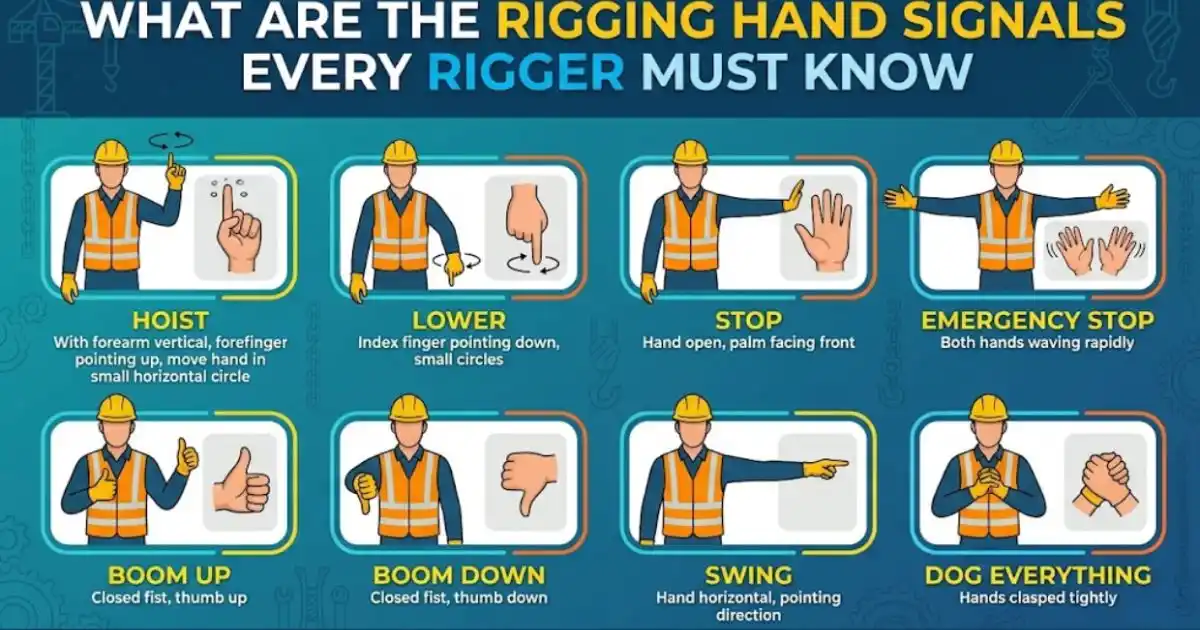
Rigging hand signals are a legally required means of communication between signal persons and crane operators on construction and industrial sites. Under OSHA 29 CFR 1926.1422, hand signals must conform to ASME B30.5 standards, and misuse of these signals is one of the most frequently cited violations during crane operation audits.
A single misread signal can result in a dropped load, struck-by fatality, or equipment collapse. This guide covers every standard hand signal, who is authorized to give them, legal requirements under OSHA and Saudi Aramco GIs, and the mistakes that get workers killed or contractors fined.
What Are Rigging Hand Signals?
Rigging hand signals are standardized body gestures used to direct crane operators when verbal communication is impossible due to noise, distance, or an obstructed line of sight. They are the primary control mechanism between the signal person on the ground and the crane operator in the cab.
ASME B30.5 (Mobile and Locomotive Cranes) defines the complete set of hand signals applicable to crane operations in the United States and internationally. These signals are not optional or site-specific — they are a codified system recognized across industries, jurisdictions, and regulatory frameworks, including OSHA, the UK HSE, and Saudi Aramco General Instructions.
The signals apply to all crane types: mobile, tower, overhead, and crawler cranes. Every signal person must demonstrate knowledge of these signals before being assigned to a lift — especially critical lifts involving multiple cranes or loads above the crane’s rated capacity.
OSHA and ASME Legal Requirements
OSHA 29 CFR 1926.1422 — the federal standard governing signals for crane and derrick operations in construction — sets out requirements that every HSE officer and site supervisor must understand.
Key regulatory requirements under 29 CFR 1926.1422:
- Only one signal person at a time. The crane operator must respond to signals from a single designated individual only. Multiple signalers giving simultaneous directions is prohibited and constitutes a serious OSHA citation.
- Stop signals from anyone. Although only the designated signal person directs movement, any worker on site may give the emergency stop signal, and the crane operator must comply immediately.
- Signals must be visible. If the operator cannot see the signal person clearly, operations must stop until visual contact is restored or a radio communication system is established.
- Radio or telephone substitution. When hand signals are replaced by radio, 29 CFR 1926.1422(c) requires that voice communication be clear, unambiguous, and confirmed before any movement begins.
ASME B30.5 and B30.2 standards:
ASME B30.5 covers mobile and locomotive cranes. ASME B30.2 covers overhead and gantry cranes. Both define the standard signal library. For construction sites, B30.5 is the primary applicable standard and is directly referenced by OSHA.
General Industry (non-construction):
Under OSHA 29 CFR 1910.179 (overhead and gantry cranes), the same signal principles apply. The key requirement is that hand signals conform to ASME or an employer’s written code, and that all operators are trained on whichever system is used.
Regulatory note: Requirements described here are based on federal OSHA standards. State-plan states (California, Michigan, Washington, etc.) may have equivalent or more stringent requirements. Always verify with your local OSHA office.
All Standard Crane Hand Signals Explained
The reference chart above shows the 12 most critical signals in color-coded categories. Below is the full textual description of each signal, as specified in ASME B30.5.
Vertical motion signals
Hoist — Extend your arm fully to the side, index finger pointing straight up. Rotate your hand in small horizontal circles. This tells the operator to raise the load.
Lower — Extend your arm fully to the side, index finger pointing straight down. Rotate your hand in small horizontal circles. This signals the operator to lower the load.
Use the main hoist — Before any vertical signal, tap the top of your head with a closed fist. This tells the operator which hoist you want to use. Then follow with the Hoist or Lower signal.
Use auxiliary/whip line — Tap your elbow with the opposite hand before issuing the motion signal. This designates the secondary hoist.
Stop signals
Stop — Extend your arm horizontally at shoulder height with your palm facing outward (like a “halt” gesture). Hold it steady. This is the normal stop signal for any motion.
Emergency stop — Extend both arms horizontally at shoulder height with palms down. Swing both arms back and forth laterally across the body. This signals immediate cessation of ALL crane movement. Any worker — not just the signal person — can give this signal.
Dog everything — Clasp both hands together in front of the body at waist height. This means “stop all motion and hold position.” The load stays where it is; no further movement.
Boom operations
Boom up — Extend your arm and make a closed fist with your thumb pointing up. Give a short, sharp upward jerk with your fist. This tells the operator to raise the boom angle.
Boom down — Same motion with your thumb pointing down and a short, sharp downward jerk. This lowers the boom angle.
Extend boom (telescoping cranes) — Hold both fists in front of your body with thumbs pointing outward, away from each other. This signals the operator to extend the boom.
Retract boom — Same position with thumbs pointing inward, toward each other. This signals retraction.
Travel and swing signals
Swing — Point with a closed fist in the direction you want the crane to swing. The operator rotates the upper works toward that direction.
Travel — Extend your arm forward in the direction of travel with your hand open and palm facing the direction of movement. Push forward. For tower cranes or gantries without cab travel, adapt this signal according to your written signal code.
Speed modifier
Move slowly — Place your non-signaling hand palm-down over your active signaling hand. This modifies any signal to indicate slow speed. It is not a standalone signal — it must overlay another signal.
Who Can Give Rigging Hand Signals?
Under 29 CFR 1926.1419 through 1926.1422, the signal person must meet one of two criteria:
- Qualification by a third-party assessor — such as NCCCO (National Commission for the Certification of Crane Operators) signal person certification.
- Qualification by an employer — through a documented assessment that confirms the individual knows and understands all the signals used on that site, and has demonstrated their ability to give and interpret them correctly.
The signal person must be designated in writing before each lift. On critical lifts (those involving personnel hoisting, loads near capacity, or multiple cranes), this designation is part of the lift plan documentation required under 29 CFR 1926.1431.
On Saudi Aramco and Gulf sites:
The qualified rigger designation under Saudi Aramco GI-0002.102 (Crane and Rigging Operations) requires demonstrated knowledge of hand signals as part of the competency assessment. Contractors must maintain records of this assessment. Workers without a documented signal person qualification may not direct crane movements under any circumstances.
Common Violations and Mistakes
During site audits, these are the signal-related failures that appear most consistently — and the ones most likely to result in OSHA citations, serious injuries, or fatalities.
1. Unauthorized signal persons giving directions
The most common violation: a laborer, rigger, or foreman who has not been designated or qualified to give hand signals because “the signal person stepped away.” This is a direct violation of 29 CFR 1926.1419. The crane must stop all movement until a qualified, designated signal person is in place. The fix: site protocols must include clear coverage arrangements so signal persons are never informally substituted.
2. Non-standard, site-specific signals used without a written code
Some sites develop their own signals — a thumbs-up for “go,” a waving hand for “come toward me.” Under OSHA, this is only legal if you have a written signal code, all involved parties are trained on it, and copies are kept on site and in the lift plan.
In practice, these improvised systems are rarely ever documented. The result is a conflicting interpretation of the same gesture by different operators.
Also read: Where Can I Get Boom Truck Certification Near Me Fast
3. Signals given with obstructed sight lines
A signal person positioned behind a column, behind a concrete pour, or partially obscured by the load itself is giving signals that the operator may not see clearly. On busy construction sites, this happens regularly. The required fix is repositioning the signal person, using a relay signal person, or switching to radio. Continuing operations without verified visual contact is a recordable incident waiting to happen.
4. Failure to use the “Dog everything” signal before a position change
When the signal person needs to move — to get a better angle, cross a hazard zone, or confer with the lift supervisor — the “Dog everything” signal must be given first. Operators often continue making small adjustments, assuming the repositioning is temporary. If a load shifts while the signal person is not in position to observe it, the results can be catastrophic.
5. Mistaking the “Move slowly” modifier for a standalone signal
“Move slowly” is a modifier, not a movement command. Giving it without an overlaid direction signal communicates nothing to the operator. Newer signal persons sometimes give this gesture alone — expecting the operator to intuit the direction, which results in miscommunication, unexpected movement, or operator frustration.
6. Ignoring environmental factors during signal planning
Wind, dust storms, and bright sun can all impair signal visibility. On Gulf region sites — particularly during shamal (sandstorm) conditions — hand signal reliability is severely reduced. Sites must have a written protocol for when radio communication becomes mandatory. This is rarely addressed in toolbox talk materials and rarely covered in pre-shift JSA (Job Safety Analysis) documentation.
Rigging Hand Signal Checklist
Use this pre-lift checklist to verify signal readiness before any crane operation begins. Incorporate it into your daily toolbox talk and lift plan review.
Signal person qualification
- The signal person is designated in writing for this lift
- Signal person’s qualification documentation is on file (employer assessment or NCCCO certification)
- The operator has been introduced to and acknowledges the designated signal person for today’s shift
Communication system readiness
- Hand signal method confirmed (visual hand signals vs. radio — document in lift plan)
- If radio: both the operator and the signal person have tested and confirmed channel clarity
- Emergency stop signal procedure confirmed with all persons in the exclusion zone
Visibility and positioning
- The signal person’s position gives a clear, unobstructed sight line to the operator.
- Operator confirms they can see the signal person from the cab position
- The signal person’s position does not place them in the swing radius or beneath the load path
- Relay signal person designated if needed (long-distance or obstructed lifts)
Environmental conditions
- Visibility conditions assessed (dust, glare, low light)
- Radio backup plan confirmed for reduced-visibility conditions
- Wind speed checked — if above site threshold, lift suspended per lift plan
Signal clarity check
- The signal person and operator have reviewed all signals to be used in this lift.
- Non-standard signals are reviewed against the written signal code
- “Dog everything” protocol confirmed before any signal person repositioning
Download the full Rigging Hand Signal Pre-Lift Checklist from our HSE Documentation library:
Saudi Aramco and Gulf Region Requirements
Saudi Aramco’s crane and rigging operations are governed primarily by GI-0002.102 (Crane Operations) and GI-0006.021 (Scaffolding, Rigging and Lifting). These General Instructions layer additional requirements on top of ASME B30.5 and OSHA-equivalent standards.
Key Saudi Aramco-specific requirements for signal persons:
Safety Passport system: Signal persons working on Saudi Aramco facilities must hold a valid Safety Passport. This passport documents completion of applicable GI awareness training, including rigging and lifting. Contractors must verify passport validity before assigning signal persons to any lift.
Critical lift pre-approval: For lifts classified as critical under GI-0002.102 (lifts over 75% of the crane’s rated capacity, tandem lifts, personnel hoisting, or lifts near energized equipment), the signal person must be specifically named in the pre-approved lift plan submitted to the Area Authority.
SIMOPS (Simultaneous Operations): On Saudi Aramco facilities where SIMOPS are in effect, crane operations require additional coordination under the SIMOPS plan. Signal person protocols during SIMOPS must be reviewed in the pre-job meeting and documented in the PTW (Permit to Work) system.
Language and communication: Saudi Aramco sites employ workers from dozens of countries. Aramco’s HSE policy requires that signal persons demonstrate the ability to communicate the signals — and the stop commands in particular — in a language understood by the crane operator. Where this is not possible, a visual signal-only protocol must be established and confirmed before the lift begins.
UAE, Qatar, and Kuwait:
ADNOC (Abu Dhabi), Qatar Petroleum, and Kuwait Oil Company all reference ASME B30.5 as the baseline standard. All three national oil companies maintain contractor HSE management system requirements that include signal person competency documentation as an audit checkpoint.
Requirements described are based on publicly available Saudi Aramco standards. Contractor-specific requirements may vary. Always verify current GI versions through your Saudi Aramco contract administrator.
FAQS: Rigging Hand Signals
OSHA 29 CFR 1926.1422 requires that hand signals conform to ASME B30.5 for mobile cranes or ASME B30.2 for overhead cranes. The standard signals include hoist, lower, stop, emergency stop, swing, travel, boom up, boom down, extend boom, retract boom, use main hoist, and move slowly. Employers may use a different code, but it must be in writing, and all parties must be trained on it.
Only a qualified and designated signal person may direct crane movements using hand signals. Under 29 CFR 1926.1419, the signal person must be qualified either by a third-party assessor (such as NCCCO) or by the employer through a documented assessment. This designation must be made in writing before each lift begins.
Yes. Under OSHA regulations, any worker on site — not just the designated signal person — may give the emergency stop signal. The crane operator is required to stop all movement immediately upon receiving it. This is the only signal that overrides the “one designated signal person” rule.
Only one. Under 29 CFR 1926.1422(a), the crane operator must respond to signals from a single designated signal person. The only exception is the emergency stop signal, which can come from any worker. Having two people give conflicting signals simultaneously is a serious OSHA violation.
Yes. When visibility conditions make hand signals unreliable — such as during dust storms, at night, or in heavy smoke — the site must switch to radio or telephone communication as outlined in 29 CFR 1926.1422(c). The communication method must be confirmed as functional before the lift begins. On Gulf region sites, pre-shift environmental assessment should address this explicitly.
Download the printable ASME B30.5 Rigging Hand Signal Chart from our Crane Safety Documents library. Laminated copies should be posted at the crane staging area and included in every critical lift plan package.
Conclusion
Rigging hand signals are not a formality — they are the last line of communication between a multi-ton load in motion and the workers below it. OSHA 29 CFR 1926.1422 and ASME B30.5 set the non-negotiable baseline: one designated signal person, standardized signals, and verified visual contact before every movement. On Saudi Aramco and Gulf region sites, GI-0002.102 adds further accountability through the PTW system and Safety Passport requirements.
Three takeaways every HSE officer should act on immediately: verify signal person qualifications are documented before every lift, include signal visibility assessment in your pre-lift JSA, and establish a written radio protocol for reduced-visibility conditions. Start with the pre-lift checklist above and integrate it into your standard lift plan template.
Further Reading & HSE Resources
To build a complete safety protocol on your site, we recommend exploring our specialized guides that complement these rigging signals:
- Qualified Rigger vs. Qualified Signal Person: Learn the critical differences in training and legal responsibilities between these two roles.
- Crane Critical Lift Plan Template: Download our ready-to-use template for lifts exceeding 75% capacity or involving personnel.
- Saudi Aramco GI-0002.102 Compliance Guide: A detailed breakdown of rigging standards specifically for Aramco projects and Gulf-region contractors.
- Crane Pre-Use Inspection Checklist: Ensure your equipment is as ready as your signal person before the first lift of the shift.