
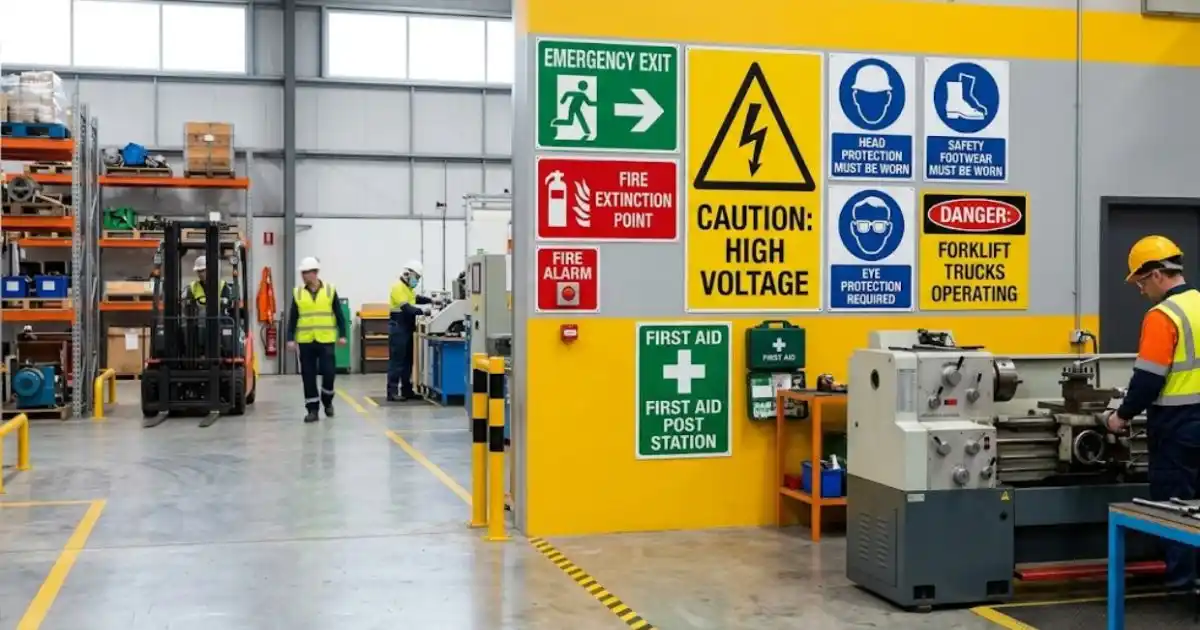
Health and safety signs are your first line of defence against workplace injuries — and getting them wrong is a compliance failure, not just a visual one. OSHA 29 CFR 1910.145 establishes the federal requirements for workplace safety signs and accident prevention tags, outlining how hazards must be clearly identified and communicated to employees.
Ignore or misuse these signs, and you expose your workforce to preventable incidents and your organisation to citations, fines, and legal liability. This guide covers every sign category, the exact regulatory codes that govern them, ISO 7010 vs ANSI Z535, Saudi Aramco signage requirements, the most common site violations, and a ready-to-use audit checklist.
What Are Health and Safety Signs?
Health and safety signs are standardised visual devices — boards, labels, tags, or floor markings — that communicate hazards, required actions, prohibited behaviours, or safe routes to anyone present on a site or in a facility. They work through a combination of colour, shape, and pictogram, delivering a message in under two seconds, without words, and across language barriers.
The primary purpose of safety signs is to communicate important hazard information immediately, but they play a much broader role in supplementing safety training, highlighting safe exit routes, indicating safety equipment like first aid stations, and enforcing company safety policies.
Who is responsible for health and safety signs? Every employer. OSHA 29 CFR 1910.145 requires that safety signs be posted wherever hazards exist, and that all employees be instructed as to the meaning of each sign type used throughout the workplace. Responsibility flows from the HSE Manager or Safety Officer down to supervisors and, in contractor environments, to the contractor’s on-site safety representative.
Legal Requirements and Official Standards
Three frameworks govern health and safety signs internationally. Your obligation depends on where you operate.
OSHA 29 CFR 1910.145 — United States
29 CFR 1910.145 specifies the design, application, and use of signs or symbols intended to indicate specific hazards whose failure to designate could lead to accidental injury to workers or the public, or to property damage. The standard defines four sign classifications — Danger, Warning, Caution, and Safety Instruction — with specific colour and wording requirements for each.
OSHA recommends the following colour scheme: “Danger” signs should be red or predominantly red with contrasting lettering; “Caution” signs yellow or predominantly yellow; “Warning” signs orange or predominantly orange; and “Biological Hazard” signs fluorescent orange or orange-red.
Also read: What Are the Rigging Hand Signals Every Rigger Must Know
ISO 7010:2019 — International Standard
ISO 7010:2019 prescribes safety signs for accident prevention, fire protection, health hazard information, and emergency evacuation. The shape and colour of each sign follows ISO 3864-1, and the design of graphical symbols follows ISO 3864-3.
The current edition contains over 200 registered symbols across five categories, with each symbol assigned a unique reference number — for example, P002 for “No smoking” or E001 for “Emergency exit left.”
ANSI Z535 — US Domestic Standard
ANSI Z535, the standard for communicating safety and accident prevention information in the United States, corresponds with the ISO 3864 standard. Although ANSI Z535 is not required by law, voluntarily adhering to it can safeguard your workplace and ensure compliance with OSHA’s baseline regulations.
Key Differences at a Glance
| Standard | Jurisdiction | Format | Legal Status |
|---|---|---|---|
| OSHA 29 CFR 1910.145 | USA | Text + colour | Mandatory (USA) |
| ANSI Z535 | USA | Text + pictogram | Voluntary (widely adopted) |
| ISO 7010:2019 | International | Pictogram-only | Voluntary (EU: EN ISO 7010) |
| EN ISO 7010 | European Union | Identical to ISO 7010 | Regulatory within EU |
In the United States, OSHA does not mandate ISO 7010 directly. Most US workplaces follow ANSI Z535. However, multinational facilities, export products, and sites with non-English-speaking workforces increasingly adopt ISO 7010 signs alongside or in place of ANSI signs.
Regulatory disclaimer: Requirements vary by jurisdiction. Always verify your specific obligations with your local OSHA Area Office, national safety authority, or regulatory body. This article is for informational purposes.
The 5 Categories of Health and Safety Signs
The reference diagram above shows all five categories at a glance. Here is what each one requires in practice.
1. Danger Signs
Danger signs mark immediate, life-threatening hazards. Examples: exposed live conductors, unguarded machine points, confined space entries during hazardous operations.
- Colour: Red background, white lettering, black oval panel (OSHA standard format)
- Signal word: DANGER
- Under 29 CFR 1910.145(c)(1), all employees must be instructed that Danger signs indicate immediate danger and that special precautions are necessary.
- ISO equivalent: Prohibition signs (red circle, diagonal bar) signal “must not” rather than “immediate danger” — these are distinct categories
2. Warning Signs
Warning signs communicate hazards that could cause serious injury but are one step below “immediate death risk.”
- Colour: Orange background, black lettering
- Signal word: WARNING
- Common use: Forklift operating zones, overhead crane paths, high-temperature surfaces, arc flash boundaries
- Misclassifying a Warning hazard as Caution is a compliance failure
3. Caution Signs
Caution is the yellow middle ground in OSHA’s hierarchy — use it only for hazards that could cause minor or moderate injury. Section 29 CFR 1910.145(c)(2) states that a Caution sign must warn of potential hazards or unsafe practices using the signal word “CAUTION” on a yellow background with black lettering.
- Common use: Wet floors, low overhead clearances, pinch points, trip hazards
- ISO equivalent: Warning signs — yellow triangle with black border and black pictogram (ISO 7010 W-series)
4. Mandatory Action Signs
Mandatory signs tell workers what they must do — not what to avoid.
- Colour: Blue circle with white pictogram (ISO 7010 M-series)
- Common use: PPE requirements — hard hat, safety glasses, ear protection, hi-vis vest, safety boots
- Under ANSI Z535, these appear with a blue panel header reading “NOTICE” or with a blue safety alert symbol
- On sites with multilingual crews — common across Gulf construction projects — blue circle pictograms communicate PPE requirements without any text
5. Safe Condition Signs (Emergency / Evacuation)
Safe condition signs use green squares with white graphics — the classic example being the “Running Man” emergency exit sign.
- ISO 7010 E-series reference: E001 (Emergency exit left), E002 (Emergency exit right), E003 (First aid)
- Fire protection signs: Red squares with white pictograms (ISO 7010 F-series) — fire extinguisher locations, hose reels, manual call points
- These signs must remain visible even in smoke or low-light conditions — photoluminescent materials are the field standard for exit signs in enclosed industrial facilities.
How to Select, Size, and Place Safety Signs
Step 1 — Conduct a Hazard Identification Walk
Before ordering a single sign, map every hazard on your site. Use your JSA (Job Safety Analysis) outputs, incident reports, and near-miss logs as your source. Every identified hazard becomes a candidate for a sign.
Step 2 — Classify the Hazard Severity
Match the hazard to the correct sign type using OSHA’s severity hierarchy: Danger → Warning → Caution → Safety Instruction. Downgrading a lethal hazard to a Caution is a citation risk and a moral failure. During audits, the most common gap we see is Danger-level electrical exposure marked with a yellow Caution board.
Step 3 — Calculate the Required Sign Size
ISO 3864-1 provides the formula h = L / Z, where h is the minimum sign height, L is the viewing distance, and Z is 100 for normal lighting or 50 for poor lighting. A sign readable at 10 metres in good light needs a minimum height of 100mm. Industrial zones with long sightlines — tank farms, warehouse aisles, loading docks — need significantly larger boards.
Step 4 — Choose the Right Material
| Environment | Recommended Material |
|---|---|
| Indoor office / light industrial | Self-adhesive vinyl |
| Outdoor / weathering exposure | Aluminium or rigid PVC |
| Chemical splash zones | Chemical-resistant polycarbonate |
| High heat areas | Powder-coated aluminium |
| Emergency exits | Photoluminescent (glow-in-dark) |
Step 5 — Mount at the Right Height and Position
Signs must be posted at or near the point of hazard, visible before a person enters the danger zone. OSHA requires signs to be readable from the maximum approach distance. Eye-level mounting (1.5–1.8m for standing workers) works for most facility signs. For roadway-adjacent or overhead hazards, mount signs at vehicle cab height or above the hazard entry point.
Step 6 — Record and Inspect
Log every sign location in your HSE documentation system. Inspect signs quarterly for fading, damage, or obstruction. A missing or illegible sign during an OSHA inspection carries the same weight as having no sign at all.
Common Mistakes and Violations
During site audits and inspections, the same failures appear repeatedly. Here are the seven most frequent — and how to correct them.
1. Using the wrong severity level. A slippery floor with a “Danger” sign, or a confined space with a “Caution” board. Both misclassifications confuse workers about actual risk and, in OSHA’s view, misrepresent the hazard. Fix: Map hazards to severity using your risk assessment and apply the correct signal word.
2. Signs blocked by equipment or materials. A fire extinguisher sign hidden behind a stacked pallet is useless in an emergency. Fix: Include sign visibility in your weekly housekeeping inspection. Mark a clear zone around safety signs on the floor.
3. Faded, damaged, or missing boards. Compliance with OSHA signage standards helps businesses avoid costly fines. Reduced workplace accidents and a culture of awareness depend on signs that are legible and intact. Fix: Quarterly inspection schedule with a photographic log. Replace any sign with text or pictograms that are less than 80% legible.
4. English-only signs on multilingual sites. Contractors working under Saudi Aramco PTW (Permit to Work) systems, Gulf construction projects, and UK sites with diverse workforces consistently report incidents where workers did not understand English-only text warnings. Fix: Add ISO 7010 pictograms or bilingual text. For facilities with employees who may not speak English as a first language, or in noisy workplaces where verbal warnings might be missed, the importance of pictogram-based safety signs cannot be overstated.
5. Posting signs without worker training. A sign communicates nothing if workers have never been told what it means. OSHA requires that all employees be trained on sign meanings — but this is one of the most frequently skipped steps in toolbox talks. Fix: Include a safety sign briefing in site induction and refresh it at each PTW briefing cycle.
6. Using non-standard colours or custom designs. Some sites create bespoke “safety” signs in non-standard colours that look official but carry no legal meaning. This creates confusion between legitimate hazard warnings and facility housekeeping notices. Fix: Purchase signs from suppliers who certify compliance with ANSI Z535 or ISO 7010.
7. Failing to remove temporary signs after hazard clearance. A LOTO (Lockout/Tagout) “Do Not Operate” tag left on equipment after the work is complete is a violation and a confusion hazard. Fix: Make sign removal part of the PTW close-out procedure, documented and signed off.
Safety Signs Audit Checklist
Use this checklist during quarterly inspections or before any regulatory audit.
General Compliance
- All signs match the correct hazard severity (Danger / Warning / Caution)
- Signal words are correct (no mixed or inconsistent labelling)
- All signs comply with OSHA 29 CFR 1910.145 or the applicable national standard
- ISO 7010 or ANSI Z535 format confirmed for each sign type
Visibility and Legibility
- Every sign is legible from the maximum approach distance
- No sign is obstructed by equipment, stock, or structures
- Photoluminescent exit signs confirmed functional (tested in darkness)
- Faded or damaged signs are identified and flagged for replacement
Multilingual and Pictogram Coverage
- Sites with non-English speakers have ISO 7010 pictograms or bilingual signs
- A..ll five sign categories represented where hazards exist
PPE Mandatory Signs
- Blue circle PPE signs are posted at all zone entry points
- PPE requirements match the site’s JSA and risk assessment outputs
Emergency and Evacuation
- Emergency exit signs (green, ISO E-series) cover all escape routes
- Fire equipment signs (red, ISO F-series) are visible at all extinguisher and hose reel locations
- Assembly point signs are posted and clearly visible from all site areas
Documentation
- Sign locations recorded in the HSE management system
- Last inspection date logged
- Training records confirm workers have been briefed on sign meanings
Gulf and Saudi Aramco Requirements
Saudi Aramco Signage Standards
Contractors working on Saudi Aramco facilities must comply with Saudi Aramco General Instructions alongside OSHA and ISO requirements. Saudi Aramco GI 5.005 specifically addresses signage posting and colour coding across Aramco facilities. Key requirements for contractors include:
- Bilingual signage: All safety signs within Saudi Aramco facilities must appear in both Arabic and English. This is non-negotiable on all Saudi Aramco sites and many other Gulf-region industrial facilities.
- Colour coding compliance: Saudi Aramco’s Engineering Standard for safety identification and safety colours (SAES) governs pipe marking, equipment identification, and area demarcation in addition to standard signboards.
- PTW zone marking: Areas under active Permit to Work must be demarcated with consistent barriers and signs identifying the permit type, the authorised person, and the work scope.
- HAZCOM signage: Saudi Aramco GI 150.100 (HAZCOM) governs chemical hazard communication on site, including GHS (Globally Harmonised System) pictograms on chemical containers and storage area signs.
Note: Requirements described are based on publicly available Saudi Aramco standards. Contractor-specific requirements may vary. Always confirm current requirements with your Saudi Aramco Proponent organisation.
UAE, Qatar, and Kuwait
Across the GCC region, the dominant international standard for facility safety signs is ISO 7010, often enforced alongside local civil defence regulations that mandate specific fire safety sign formats, luminescence levels for emergency exit signs, and Arabic language requirements.
The UAE’s Ministerial Decision No. 32 of 1982 (as updated) and Qatar’s QCDD (Civil Defence Department) codes both require clear, legible bilingual emergency signage in all industrial and commercial facilities.
UK — HSE Regulations
In the United Kingdom, health and safety signs are governed by the Health and Safety (Safety Signs and Signals) Regulations 1996, which implement EU Directive 92/58/EEC.
The HSE UK framework requires employers to use safety signs where hazard control measures alone cannot adequately manage risks, and mandates that signs follow the ISO 3864 colour and shape system (broadly equivalent to ISO 7010).
FAQS: Health and safety signs
The five categories are: Danger (red — immediate lethal hazard), Warning (orange — serious injury risk), Caution (yellow — minor to moderate injury), Mandatory (blue circle — required action such as PPE), and Safe Condition (green — exits, first aid, assembly points). ISO 7010 adds a sixth: Fire Protection (red square — extinguisher and hose reel locations).
OSHA 29 CFR 1910.145 requires that safety signs be posted to identify specific hazards whose failure to designate could lead to accidental injury to workers or the public. Signs must have rounded or blunt corners, legible text, approved colour coding, and must be maintained in good condition. All employees must be trained on the meaning of every sign type used in their workplace.
ISO 7010 is the international standard, relying on pictograms alone — it communicates hazards without text, making it effective in multilingual environments. ANSI Z535 is the US domestic standard, combining text panels with safety alert symbols. ANSI Z535.3 explicitly allows ISO-style pictograms to be used within the ANSI sign format, so many US facilities now use both systems on a single sign.
Use the formula from ISO 3864-1: minimum sign height (h) = viewing distance (L) divided by 100 for normal lighting, or divided by 50 in poor lighting. A sign required to be read from 5 metres in good light needs a minimum height of 50mm. Most industrial warning signs should be readable at a minimum of 10 metres, requiring at least 100mm height.
Yes. On Saudi Aramco sites and throughout Saudi Arabia’s regulated industrial sector, all safety signs must appear in both Arabic and English.
This applies to hazard warnings, PTW demarcation, emergency exit signs, and PPE mandatory signs. Contractor non-compliance is a common audit finding during Saudi Aramco safety inspections.
The full Safety Signs Inspection Checklist — aligned with OSHA 29 CFR 1910.145, ISO 7010, and Saudi Aramco GI requirements — is available to download from our HSE Documentation library.
Conclusion: Health and Safety Signs
Health and safety signs are a legal obligation, a hazard control measure, and a direct line of communication to every worker on your site. Three things matter most: use the correct sign category for the actual hazard severity, ensure every sign is legible and unobstructed, and verify that every worker has been trained on what the signs mean — especially on multilingual sites. A sign that nobody understands offers zero protection.
Pair your signage programme with a documented inspection schedule and align your sign selection with OSHA 29 CFR 1910.145, ISO 7010, and — if you operate in the Gulf region — Saudi Aramco GI 5.005. Download our guide to build a compliant, audit-ready signage system from the ground up.