
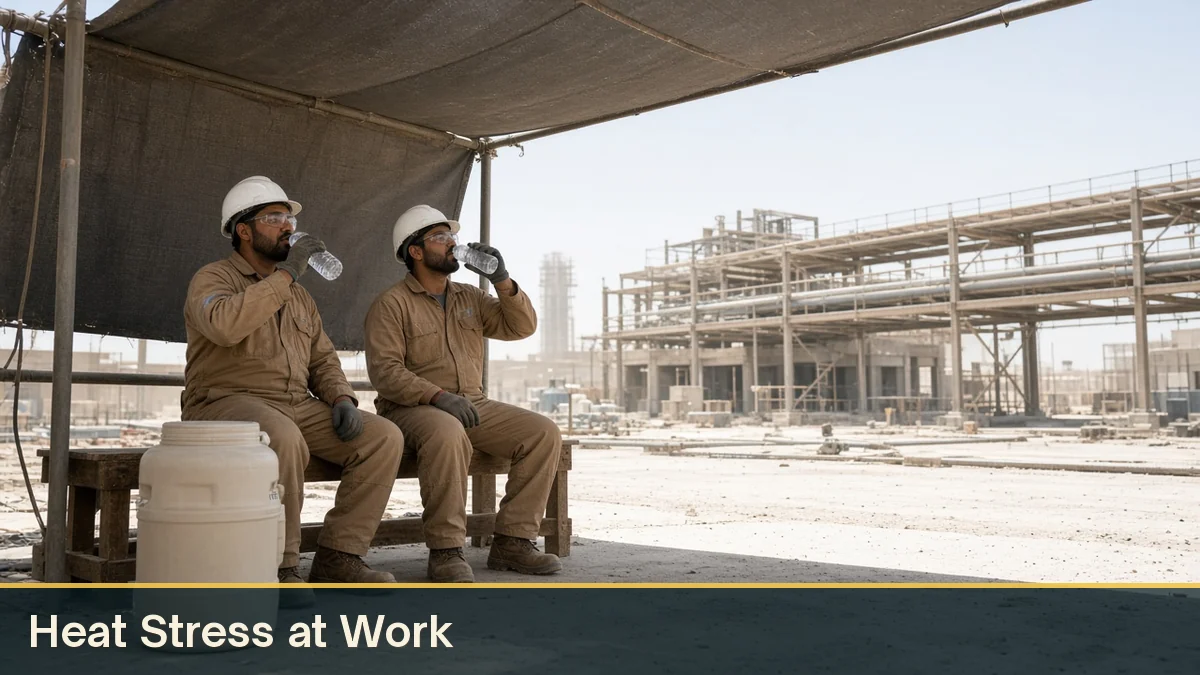
What heat stress looks like on a job
Heat stress covers the range from early strain to heat exhaustion and heat stroke. The first signs are often ignored because they look like ordinary site tiredness: headache, heavy sweating, cramps, dizziness, irritability, or a person who has gone quiet.
Heat exhaustion and heat stroke are not the same, and the response is not the same.
| Sign or situation | Treat it as | Immediate action |
|---|---|---|
| Heavy sweating, weakness, dizziness, nausea, pale or clammy skin, still reasonably alert | Heat exhaustion until proven otherwise | Stop the work, move the person to shade or a cool cabin, loosen clothing, give small sips of water if they are conscious and able to drink, and stay with them. |
| Confusion, fainting, seizures, hot skin, or sweating that has stopped | Heat stroke — medical emergency | Call emergency response at once. Cool the person while you wait (shade, remove excess clothing, cool water or ice packs at neck, armpits and groin if available). Do not leave them alone or try to “walk it off”. |
Take a typical pipe-rack job in July in the Eastern Province. A helper says he is “just dizzy” at 10:40, well before the midday ban. If the supervisor treats that as laziness and sends him back up, the next change can be confusion and collapse. The time of day does not make the symptom safe.
The Saudi midday sun-work ban — and what it does not cover
The Ministry of Human Resources and Social Development (HRSD), with the National Council for Occupational Safety and Health (NCOSH), implemented the 2026 ban on work under direct sunlight from 15 June to 15 September, 12:00 to 15:00, for private-sector establishments. Those dates and hours were stated in the official HRSD announcement.
When the 2026 period ended on 15 September, HRSD and NCOSH were clear that the end of the ban period does not end the duty to assess heat and keep controls in place through the rest of the year. Outdoor work in May, or night work in a still yard, can still produce heat illness.
The ban is about work under direct sunlight in the stated hours. It is not a blanket stop of all site activity, and some operations may be treated differently under the official decision (for example, certain continuous or emergency work, subject to the current official text). Do not rely on a WhatsApp summary. Read the current HRSD/NCOSH notice and your client’s written instruction before you change a shift pattern.
A practical failure: a crew “complies” by sitting in an unshaded pickup from 12:00 to 15:00, with the engine off and no water. The legal work stop happened. The heat exposure did not.
Controls that actually reduce exposure
Use the hierarchy of controls thinking, even before you write a dedicated hierarchy article into your plan: change the work, then the workplace, then the rules, and only then the clothing.
- Move what you can out of the sun and out of the peak hours: prefabrication, indoor fit-up, early pours, night shifts where the client allows them.
- Provide shade that people can actually use — a rest area with airflow, not a flag that casts a one-metre shadow at noon.
- Keep cool drinking water within reach of the workface, not only at the welfare cabin 200 metres away. Supervisors should check that people are drinking, not just that a cooler exists.
- Set work–rest cycles that match the heat and the clothing. A person in a flame-resistant coverall on a roof needs more rest than a clerk walking between offices.
- Acclimatise new joiners and people returning from leave. Putting a new helper on the heaviest outdoor task on day one is a common pattern in heat incidents.
- Use a buddy system. Heat illness steals judgement; the person who needs help may not ask for it.
- Adjust PPE only within the residual-risk decision: a wide-brim attachment or cooling collar can help, but never remove required eye, head or foot protection to “feel cooler.”
Clothing colour, hydration the night before, and medical conditions (including some medicines) change susceptibility. Occupational health should be in the plan, not added after a first case.
What belongs in a heat-stress plan
A usable plan is short enough for a supervisor to brief, and specific enough to audit. As a minimum it should state:
- Who is responsible for checking the day’s heat risk and stopping or rescheduling outdoor work.
- How the midday ban (when in force) is built into the work schedule, permit times and toolbox talk.
- Where water, shade and first aid are, and how often they are checked. Link this to your first-aid kit inspection and the day’s safety officer report.
- How new workers are acclimatised and how this is recorded at site induction.
- The symptoms to watch for, and the exact emergency number and assembly or medical point.
- What happens to the permit if a person is taken ill mid-task (the job is not left in an unsafe state).
If you already deliver a cold-stress toolbox talk in winter, use the same discipline in summer: a short talk, attendance, and a check that the controls are actually on the ground.
OSHA heat enforcement is not a Saudi legal substitute
For readers who also work to OSHA expectations: OSHA updated its National Emphasis Program on indoor and outdoor heat-related hazards on 10 April 2026. That programme directs inspections and outreach; it is not itself a final federal heat standard. OSHA’s proposed Heat Injury and Illness Prevention rule (published 30 August 2024) is still in rulemaking, with a supplemental proposal and final action still projected rather than in force. Until a final standard exists, OSHA can still use the General Duty Clause. None of that replaces HRSD or NCOSH requirements on a Saudi site.
Check the current official HRSD notice each season before you print dates on a poster. Then walk the job at 10:30, not only at 12:01, and confirm that water, shade and supervision are real.
1. A worker is confused, has hot skin and has stopped sweating. What is the correct first priority?
Confusion, fainting, seizures, hot skin or a stop in sweating are treated as heat stroke — a medical emergency. Cooling and emergency response come first. Rest-and-return is the wrong action.
2. Which statement about the 2026 Saudi midday sun-work ban is accurate?
HRSD and NCOSH announced the 2026 ban for 15 June–15 September, 12:00–15:00, for private-sector establishments, covering work under direct sunlight. They also stated that the end of the period does not end year-round heat-prevention duties.
3. A new helper starts on a roof task at 07:00 in August, in a flame-resistant coverall, on his first day after arriving from a cooler country. What is the main heat-plan gap?
New joiners and people arriving from cooler climates need acclimatisation. Putting them on the heaviest outdoor task on day one is a common pattern in heat illness, even when work starts early.
4. Is a signed work permit enough to continue outdoor work during official ban hours?
A permit authorises work within legal and site limits. It does not cancel a binding midday ban or the client’s written instruction.
5. Why is “I cannot smell any problem” a poor check for heat illness?
Heat illness is a medical and supervision issue, not an odour issue. Look at the person, not the air, and act on the symptoms.
Frequently asked questions
What is heat stress in safety?
It is the strain on the body when it cannot get rid of heat fast enough during work. It includes early symptoms, heat exhaustion and heat stroke. The workplace response is to reduce exposure and to treat illness early, not to wait for the official midday pause.
What were the Saudi midday work ban hours and dates in 2026?
HRSD and NCOSH applied the 2026 ban from 15 June to 15 September, 12:00 to 15:00, to private-sector establishments, for work under direct sunlight. Confirm each new season from the official announcement before you brief a crew or print a poster.
How do you prevent heat stress on site?
Reschedule or relocate work, provide usable shade and cool water at the workface, set work–rest cycles, acclimatise new and returning workers, use a buddy system, brief symptoms, and have a real emergency plan. The midday ban is one legal control, not the whole plan.
What should a heat-stress management plan include?
Roles, how ban hours are built into the schedule and permits, water and shade checks, acclimatisation, symptom recognition, emergency contacts, and what happens to a live permit if someone falls ill.
Does the end of the ban season mean heat controls can stop?
No. HRSD and NCOSH stated when the 2026 period ended that establishments should continue to assess heat risk and keep preventive measures in place through the year.