
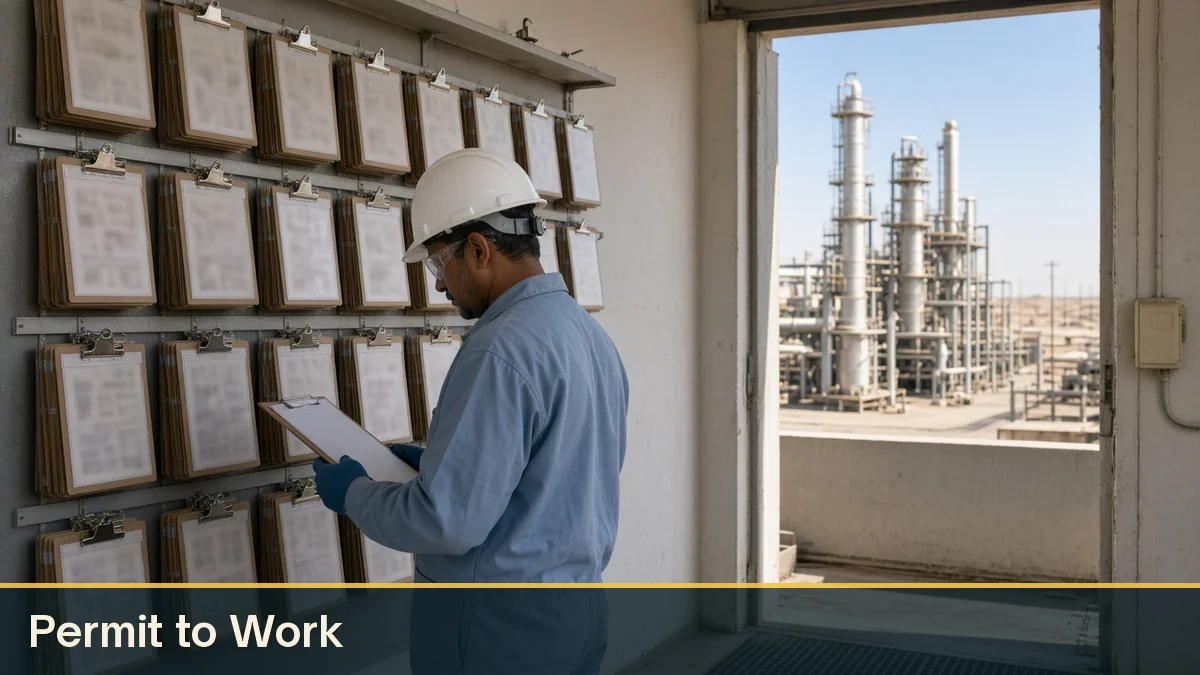
What the system is trying to prevent
Most serious site incidents in maintenance and construction happen when two things coincide: a hazardous energy or atmosphere, and work that was allowed to start without the controls being in place. The permit-to-work (PTW) system is the site’s way of slowing that moment down and making the checks visible.
HSE UK describes permit-to-work as a formal, documented system used to control certain types of work that are potentially hazardous. That is the right scale: certain work, not every job on the site, and formal, not a verbal “yes, go.”
A permit is not a badge of safety. It is permission to work only if the conditions written on it are true at the moment of issue and remain true until close-out.
Common permit types, and when they overlap
Exact names vary by client. The underlying hazards do not. On a typical industrial or large construction site you will meet some or all of the following:
| Permit type | Usual trigger | A control that must be real, not only ticked |
|---|---|---|
| Hot work | Welding, cutting, grinding, or other ignition sources | A fire watch and a check for combustibles; gas test if a flammable atmosphere is possible. See the hot work permit checklist. |
| Confined space | Entry into a space with limited access and a foreseeable hazardous atmosphere or engulfment risk | Isolation, ventilation, atmospheric test, attendant and rescue plan. Use the entry permit checklist as the record, not as the whole procedure. |
| Excavation / breaking ground | Digging, piling, or penetrating the ground or a slab | Service location, side support, access, and spoil control. Start from the excavation permit checklist. |
| Electrical / LOTO | Work on or near isolated electrical or other energy systems | A proved isolation and a personal lock, recorded on the isolation register. |
| Work at height / lifting / cold work | Fall risk, crane work, or other hazardous work that is not “hot” | The right additional permit or certificate, plus the general cold-work checks where that form is used: cold work permit checklist. |
One job can need more than one permit. Opening a tank to grind inside it is confined space and hot work, and may need a gas test and a fire watch. The system should make that overlap visible, not hide it under a single tick.
Roles that should not be collapsed into one person
- Area authority or asset owner: knows the plant condition and neighbouring work.
- Issuer: checks that the job can be authorised in that location, at that time, with the stated controls.
- Receiver (performing authority): accepts the conditions, briefs the crew, and stops if conditions change. For Aramco-style systems, this is the role trained in the work permit filling guide.
- Gas tester: tests with a calibrated instrument and writes the readings.
- Fire watch or attendant: stays at the job for the purpose written on the permit, not “available on the radio in another unit.”
- Isolating authority: applies and records isolations that the issuer can verify.
Suppose a night-shift receiver is asked to “just sign” a confined-space permit because the day issuer already looked at the tank at 14:00. The atmosphere, the crew, and the neighbouring hot work may all be different at 21:00. The night issuer or area authority still has to confirm the conditions that exist now.
Issue, work, handover and close-out
A working system has a rhythm: request, site check, isolations and tests, issue, briefing, work under the stated limits, shift handover if the job continues, and close-out with a look at the worksite. The shift handover checklist exists because a live permit at change of shift is a common place for conditions to drift.
Close-out is not a formality. Residual hot work, an open excavation, a missing lock, or a job left in an unsafe state are often found at this point — or found the next morning by someone who was not briefed. SIMOPS checks belong in the issue discussion, not only in a separate meeting that the crew never hears.
If a condition cannot be met, the honest action is to withhold the permit, not to issue it with a hopeful remark. The paper should describe the world as it is.
1. What is a permit-to-work system?
PTW is formal authorisation for certain hazardous work. The permit does not itself perform the isolations or tests.
2. A job will grind inside a vessel. Which statement is most accurate?
Hazards overlap. Opening a vessel to grind inside it typically brings entry hazards and ignition hazards together.
3. Why should the gas tester not be “anyone free to sign”?
A signature is not a test. Competence, a calibrated instrument and recorded readings are the control.
4. A confined-space permit was issued at 14:00. Work will now start at 21:00 on night shift. What is the problem if nobody re-checks conditions?
A permit authorises work under conditions that must still be true. Time of day does not freeze the atmosphere or the interfaces.
5. What is the limit of a signed permit?
The paper is not the isolation or the test. If the control is not actually in place, the signature has not made the job safe.
Frequently asked questions
What is a permit-to-work system?
It is a formal, documented system for authorising certain hazardous work, in a defined location and period, under stated controls, with named competent people and a close-out.
What types of work permit are commonly used?
Hot work, confined space, excavation or breaking ground, electrical or LOTO, work at height, lifting, and cold work are common. Clients use different titles; match the form to the hazard, not to habit.
Who is involved in a permit?
Typical roles include the area authority, issuer, receiver, isolating authority, gas tester, and fire watch or attendant. One person should not quietly do every role unless the written system allows a defined combination and the competence is real.
Does a signed permit replace isolation or gas testing?
No. The permit is the authorisation and the record. The isolation, the test, the attendant and the briefing still have to be done.
What happens if conditions change after issue?
Stop the work, make the area safe, and return the permit to the issuer or area authority. Do not carry on under a condition that is no longer true.