
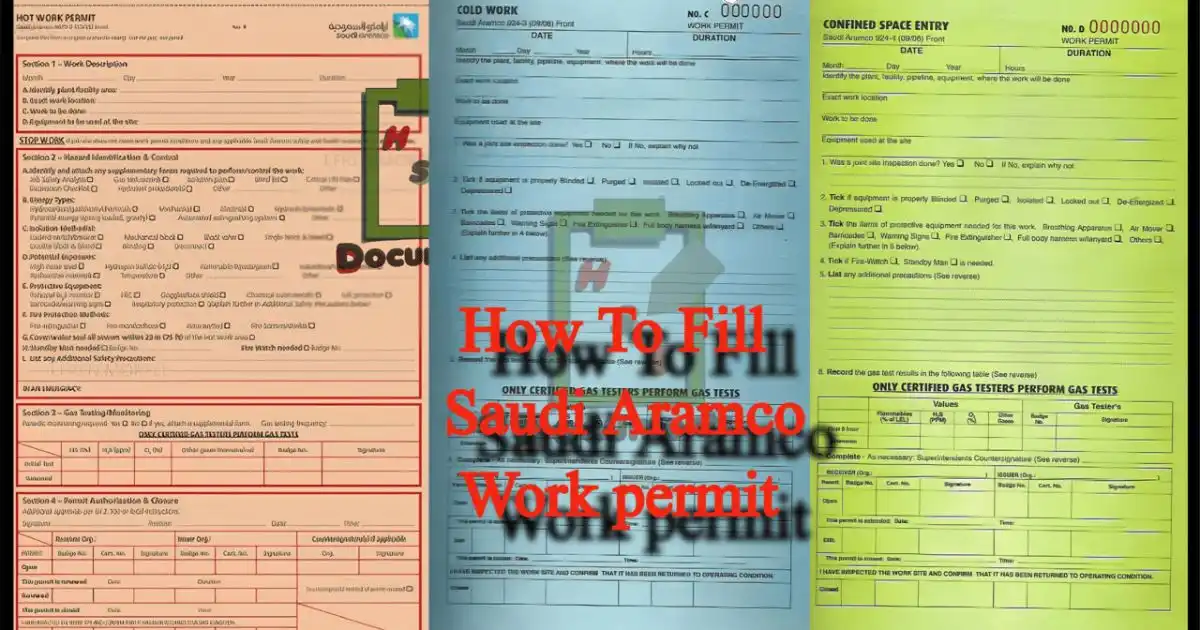
A Saudi Aramco work permit is filled in and signed by two certified people: the permit receiver, who requests it for the job, and the permit issuer, who approves it after a joint site inspection and writes the specific precautions on it. The receiver does not complete the permit alone. This guide follows chapter I-4 (Work Permit System) of the Saudi Aramco Construction Safety Manual, 5th edition (2011), which refers to Aramco’s General Instruction GI 2.100.
GI 2.100 is an Aramco-controlled document and the forms have been revised since 2011, so treat this page as a plain-language summary of the rules and confirm the current form and rules with your Aramco issuer or proponent. Checked against the manual on 1 Nov 2026.
Who does what
| Role | What the manual requires |
|---|---|
| Permit receiver | Holds a valid Aramco receiver certificate (passed the course run by Saudi Aramco Training and Development). Requests the correct permit from a certified issuer before the job, takes part in the joint site inspection, briefs the workers, stays on site and keeps a copy at the job location |
| Permit issuer | Holds a valid issuer certificate. Approves and issues the permit only after a joint site inspection with the receiver, gas tests where needed, and writing the specific precautions on the permit |
| Supervisors and the proponent (SAPO) | The responsible superintendent signs the issuer or receiver certificate. For contractors, the proponent organization’s superintendent signs, and contractor permit receivers are certified by the Projects Review and Coordination Division. A certificate from one organization cannot be used at another facility unless a reissued certificate is signed |
If you want the certification itself, see how to become a certified work permit receiver.
The four permit types
| Permit | Purpose | Used for |
|---|---|---|
| Hot work permit | Controls work that can produce enough energy to ignite flammable atmospheres or combustible materials | Open flame, welding or torch cutting in a restricted area, or within 30 m (100 ft) of a pipeline or facility containing hydrocarbons; work on live electrical equipment or non-intrinsically-safe devices in a restricted area; other fire hazards such as internal combustion engines, grit blasting or electrical hand tools in a restricted area |
| Cold work permit | Controls work that cannot ignite flammable atmospheres or combustibles but could cause injury | Structural demolition, asbestos work, cryogenic materials, scaffold erection or demolition, painting, hand excavation, concrete pouring and formwork, non-powered hand tools, in restricted areas (the list is not exhaustive) |
| Confined space entry permit | Makes sure the space is prepared, entry is safe including rescue, and the space is restored | Entry into a confined space. The 2017 Safety Handbook counts any space with limited means of entry or exit, not designed for human occupancy, that holds or may hold a hazardous atmosphere or another serious hazard. Examples are tanks, vessels, manholes, sewers and excavations 1.2 m (4 ft) deep or deeper. It may be issued together with a hot or cold work permit |
| Release of hazardous liquids or gases permit | Makes sure planning and precautions are in place where a release may occur. It does not authorize a release | Work where hazardous liquids or gases may be released |
Reading the form: four sections
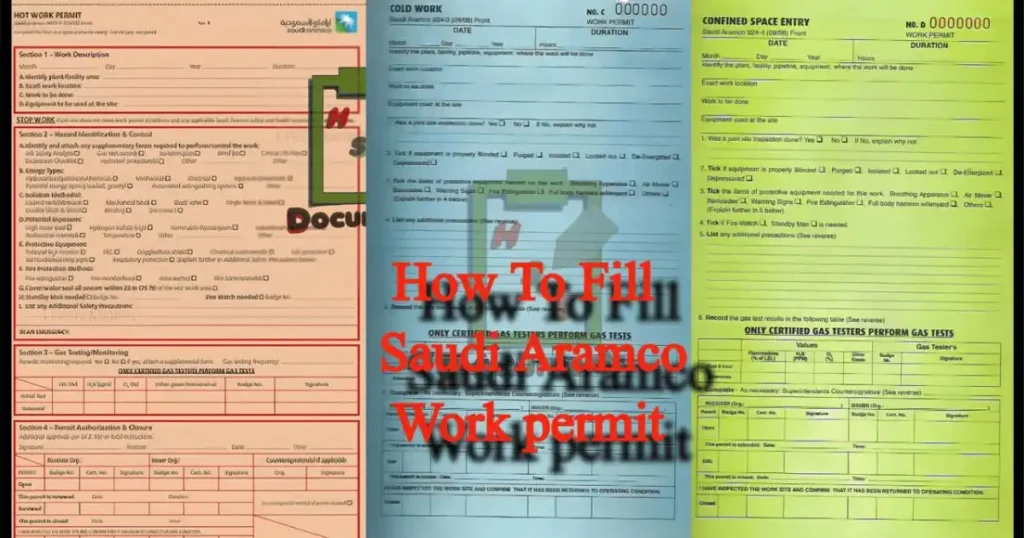
The hot work permit in the image above is laid out in four sections. The pad is color-coded: the Saudi Aramco Safety Handbook (2nd edition, 2017) lists hot work as Form 9873-2 (red), cold work as Form 9873-3 (blue), confined space entry as Form 9873-4 (green) and equipment opening/line break as Form 9873-1 (yellow). The 2011 manual names release of hazardous liquids or gases as the fourth permit, and the 2017 Handbook names equipment opening/line break, so ask your issuer which fourth permit your site uses. The forms have also been revised since the version in the image, so read the layout of your current permit before you fill it.
| Section | What goes in it | Who is involved |
|---|---|---|
| 1. Work description | Date, plant or facility area, the exact work location, the work to be done and the equipment to be used on site | Receiver describes the job; issuer checks it at the joint site inspection |
| 2. Hazard identification and control | Supplementary forms needed, energy types, isolation methods, potential exposures, protective equipment, fire protection measures, whether a standby man or fire watch is needed, and additional safety precautions | Issuer writes the specific precautions, using locks and hold tags where they apply |
| 3. Gas testing and monitoring | Gas test readings (flammables as % LEL, hydrogen sulfide, oxygen and other gases), the tester’s badge number and signature, and how often to retest | Only certified gas testers perform gas tests, as printed on the form |
| 4. Permit authorization and closure | Receiver and issuer organizations, names and badge or certificate numbers, signatures, time opened, any renewal, and the closeout signatures | Issuer and receiver sign to open, renew and close; a countersignature applies if another organization is affected |
Section names and items are taken from the permit shown in the image. Your current Aramco form is the authority.
Step by step: from request to closeout
- Hold the right certificate. Receivers and issuers need a valid certificate for the organization or facility they work in.
- Plan the job. Permits are craft-specific and location-specific. One permit does not cover more than one location, and the job description and equipment to be used must be clearly stated.
- Request the correct permit or permits. More than one may be needed, for example confined space entry with hot work.
- Do the joint site inspection. The issuer and receiver inspect the site together before signing. Work does not begin before the permit has been properly signed.
- Complete gas tests. Use Aramco-approved portable gas monitoring equipment for confined space, release of hazardous liquids or gases, and hot work permits where flammable vapors or gases may be present. Test for hydrogen sulfide, oxygen, flammable gases and any relevant toxics before issue, and record the readings.
- Write specific precautions. The issuer lists the isolations and precautions. General statements such as “work safely” or “wear PPE” are inadequate. Fire watches, breathing apparatus, lifelines and barricades go on the permit when needed. Use locks and hold tags where they apply. For welding and cutting, the Safety Handbook calls for a trained fire watch during the work and for 30 minutes afterward.
- Complete every box. All check boxes must be filled in or marked N/A, and gas test readings recorded.
- Sign. The issuer’s and receiver’s signatures, and any other required approvals or countersignatures, must be on the completed permit.
- Brief the crew. Before work starts, the receiver tells all workers under the permit about the hazards, precautions and other requirements on it.
- Keep the permit at the job. The receiver keeps copies in their possession or posted in plain view at the job location.
- Review during the job. Periodic reviews of the site, including gas testing, are done as required.
- Stop and cancel if conditions change. If the work or site conditions change in a way that could affect safety, the permit is voided, work stops and a new permit is issued once the site is safe. In an emergency all active permits are cancelled and work stops.
- Close out. When the job is finished or the permit expires, the receiver takes the permit to the issuer, both inspect the site and sign both copies. At remote sites, closing by telephone is possible only if the issuer agreed to it when issuing the permit.
Validity, extensions and records
| Item | Rule in the manual |
|---|---|
| Normal validity | A single operating shift |
| Extension | Allowed for two consecutive operating shifts, regardless of shift length but not more than 24 hours. The oncoming issuer and receiver inspect the site, write the extended time and sign |
| Long permits | Up to 30 days for extended construction or maintenance work where job requirements remain essentially unchanged, only if it is highly unlikely that conditions will change, precautions are taken before the work, and both the operations division head and the maintenance or construction division head agree and sign |
| Receiver leaving the area | The permit goes to another Aramco-certified receiver, a responsible senior crew member agreed in advance by the issuer, whose name and badge number the issuer writes on the permit |
| Records | The issuing department keeps the original permit on file for at least 3 months |
Gas test limits and breathing apparatus
| Condition | Requirement |
|---|---|
| Hot work | Not permitted if the atmosphere is above 0% of the lower explosive limit (LEL) |
| Oxygen below 20.0% | Breathing apparatus required |
| Flammable mixtures at or above 5% and below 50% of the LEL | Breathing apparatus required |
| Hydrogen sulfide between 10 and 100 ppm | Breathing apparatus required |
Common mistakes
- Vague precautions. “Work safely” or “wear PPE” is not accepted. Name the specific precautions.
- One permit for two locations. A permit covers one task at one location.
- Blank boxes. Every box is completed or marked N/A, and the gas readings are written down.
- Starting before the permit is signed by both issuer and receiver, or without the joint site inspection.
- No briefing. The receiver must explain the hazards and precautions to every worker.
- Letting a permit run on after it expires or after conditions change.
- Leaving the area without a handover. The permit must go to an agreed, certified alternate.
- Using a certificate at a different facility without a reissued one.
- Wrong permit type. Check which permits the job needs. Hot, cold, confined space and release permits can be combined.
Contractor projects before hydrocarbons
For grassroots projects during construction and before hydrocarbons are introduced, the manual says contractors implement an equivalent work permit system in place of GI 2.100, subject to approval by the proponent organization. After hydrocarbons are in, the Aramco system under GI 2.100 applies.
Frequently asked questions
1. Who fills in the Aramco work permit?
The receiver requests the permit and the issuer approves and issues it after the joint site inspection. The issuer writes the specific precautions, and both sign.
2. Can work start before the permit is signed?
No. Work must not begin before the permit has been properly signed, and the issuer and receiver must do a joint site inspection before signing.
3. Can one permit cover several jobs?
No. Permits are for specific tasks at specific locations, and one permit does not cover more than one location.
4. How long is an Aramco work permit valid?
Normally one operating shift. It can be extended for two consecutive shifts, up to 24 hours. A permit of up to 30 days is possible for extended construction or maintenance work only under the conditions in the manual.
5. What happens if the receiver has to leave the work area?
The receiver gives the permit to another Aramco-certified receiver, agreed in advance with the issuer, whose name and badge number are written on the permit.
6. What happens if an emergency occurs?
All active permits are cancelled immediately and work stops.
Related guides
- Saudi Aramco work permit exam
- How to become a certified work permit receiver
- Work permit receiver questions and answers
- Hot work permit checklist, cold work permit checklist and confined space entry permit checklist
- Permit to work shift handover checklist
- Lifting permit checklist and excavation permit checklist
- Aramco approved safety officer requirements
Sources
- Saudi Aramco, Construction Safety Manual, 5th edition (2011), Volume 2 Work Site Safety Manual, chapter I-4 Work Permit System, and Contractor Safety Administrative Requirements, as published on a third-party site, read 1 Nov 2026. Cites GI 2.100 Work Permit System and GI 2.709 Gas Testing Procedure. Later editions may differ; confirm with Aramco.
- Saudi Aramco, Safety Handbook: Minimum Safety Rules, 2nd edition (2017), Operational Safety Processes 1 to 4 (permit form numbers and colors, confined space criteria) and Cutting, Welding, and Brazing, as published on a third-party site, read 1 Nov 2026.