
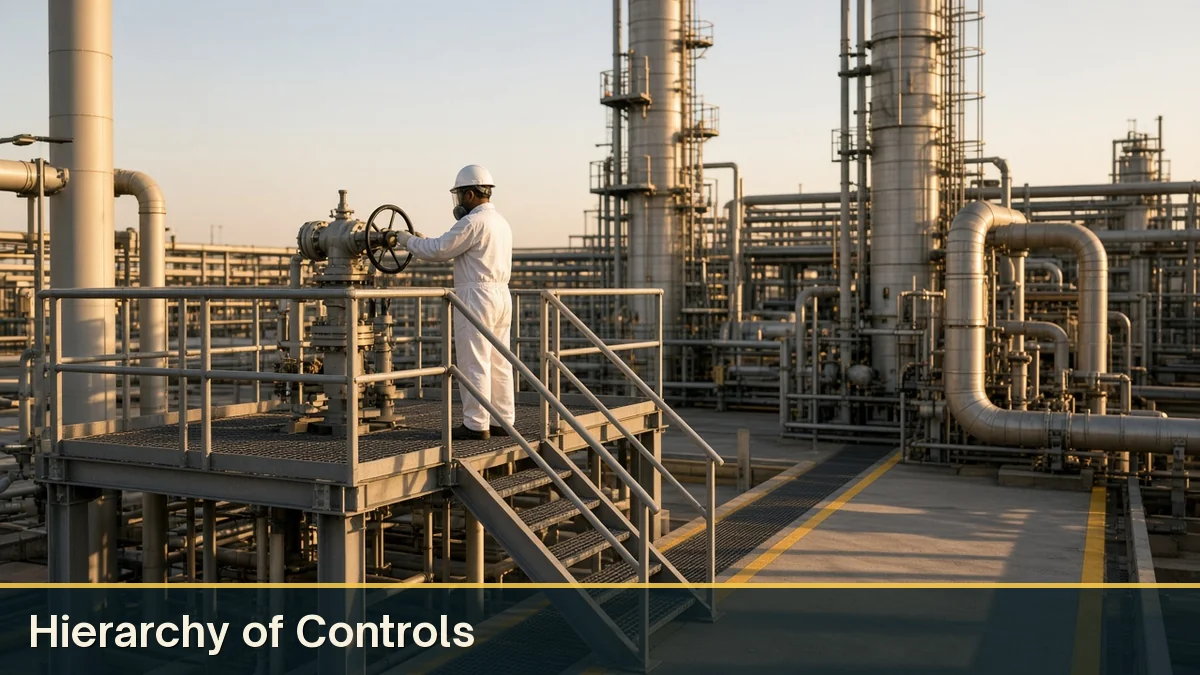
The order, and why it is in that order
NIOSH and OSHA set out the same preferred order. You try to remove the hazard, then replace it, then separate people from it with a physical arrangement, then use procedures and training, and only then rely on PPE. The order is about reliability. A guard that is bolted in place does not depend on a helper remembering a rule at 02:00.
| Level | Meaning | Field example |
|---|---|---|
| Elimination | Remove the hazard so the task no longer exists in that form | Prefabricate a spool at grade so nobody welds from a cramped basket over a live walkway. |
| Substitution | Replace the hazard with something less dangerous | Use a water-based cleaner instead of a solvent that requires a high level of respiratory protection, where the specification allows it. |
| Engineering | Isolate people from the hazard or change the plant or workplace | Add a fixed platform and handrails instead of repeated ladder work; use local exhaust for welding fume; fit a machine guard. |
| Administrative | Change the way people work | A permit, a JSA, a work–rest cycle in the heat, a restricted access zone, training, and supervision. |
| PPE | Protect the person from residual risk | Eye protection, gloves selected for the chemical, a harness on a checked anchor, a respirator after the airborne risk has been reduced so far as is practicable. |
The pyramid is a decision order, not a claim that PPE is useless. Some residual risk remains on almost every live job. The failure is starting at the bottom because it is quick to write.
A permit-desk example
A crew needs to operate a valve that sits 4 metres above a corridor. The first suggestion is often “two men, a ladder, and harnesses.” That is almost all administrative control and PPE. A better conversation, in this order, is:
- Can the valve be relocated or can a chain wheel or extension be fitted so it is operated from grade? (elimination or engineering of the fall hazard)
- Can the job wait until a proper platform or scaffold with a green tag is built? (engineering)
- If temporary access is still required, what is the assessed access, the exclusion zone below, and the rescue plan? (administrative, then PPE)
The harness may still be needed on the temporary access. It should not be the only control discussed. The same thinking applies to the work-at-height risk assessment: arrest equipment is not a reason to leave a poor access arrangement in place.
Where sites quietly invert the hierarchy
- Noise: issuing ear plugs but never isolating or maintaining the noisy machine.
- Dust: a paper mask for silica work instead of wet methods, extraction, and exclusion. The silica toolbox talk only helps if those higher controls are real.
- Chemical: “wear gloves” with no glove type, while a less hazardous product or a closed transfer would have been possible.
- Traffic: a marshaller asked to hold vehicles by eye, instead of a physical segregation plan such as the approach in the pedestrian traffic plan.
Administrative controls are not a failure in themselves. Permits, JSAs, and toolbox talks are often essential. They fail when they are used to excuse the absence of a practical higher control that the site could have provided.
How to record the decision so it can be audited
In the risk assessment or method, write the higher option you considered and why it was not practicable, then the engineering or administrative controls you will use, then the PPE for what is left. “PPE as required” tells a reviewer nothing.
If cost or schedule is the reason a better control was rejected, be honest on the paper. A reviewer can then challenge it. A sentence that jumps straight to gloves hides the decision.
When you brief the crew, say the same thing out loud: what was removed, what is guarded, what the rules are, and what they must wear. If the only sentence is “PPE on,” the hierarchy did not reach the workface.
1. What is the correct preferred order in the hierarchy of controls?
NIOSH and OSHA use that preferred order. Higher levels reduce the hazard itself; PPE is the last layer.
2. A valve is operated from a ladder over a walkway, and the only written control is “wear a harness.” What is the main problem?
The fall hazard might be eliminated or engineered out. A harness may still be needed for residual risk, but it should not be the first and only answer.
3. Which option is an engineering control?
A physical guard separates people from the hazard and does not depend only on memory.
4. Why is “PPE as required” a weak line in a risk assessment?
Name the residual risk and the item (and standard, where the site uses one). Vague PPE lines cannot be briefed or audited.
5. Are permits and JSAs a failure of the hierarchy?
Administrative controls are a real level of the hierarchy. The error is using them as a substitute for a higher control the site could have put in place.
Frequently asked questions
What is the hierarchy of controls?
It is a preferred order for reducing risk: elimination, substitution, engineering controls, administrative controls, and finally PPE. It is used in risk assessments, methods, and permit discussions.
Why is PPE at the bottom?
Because it relies on the right item being selected, worn, fitted and maintained every time, and it usually protects only the wearer. Higher controls reduce the hazard for everyone in the area.
Can you use more than one level at the same time?
Yes. In practice you often combine them: a better method, a guard, a permit, and PPE for residual risk. The hierarchy tells you which to try first, not that you may use only one.
Is a permit an engineering control?
No. A permit is an administrative control. It is still important. It should sit on top of isolations, guards, ventilation or other physical controls, not instead of them.
How do you apply the hierarchy on a short-duration job?
Ask the same questions, even if the job will take twenty minutes. Duration does not make a fall or an unguarded rotating part acceptable. If a higher control cannot be put in place in time, the honest choice may be to delay the job.