
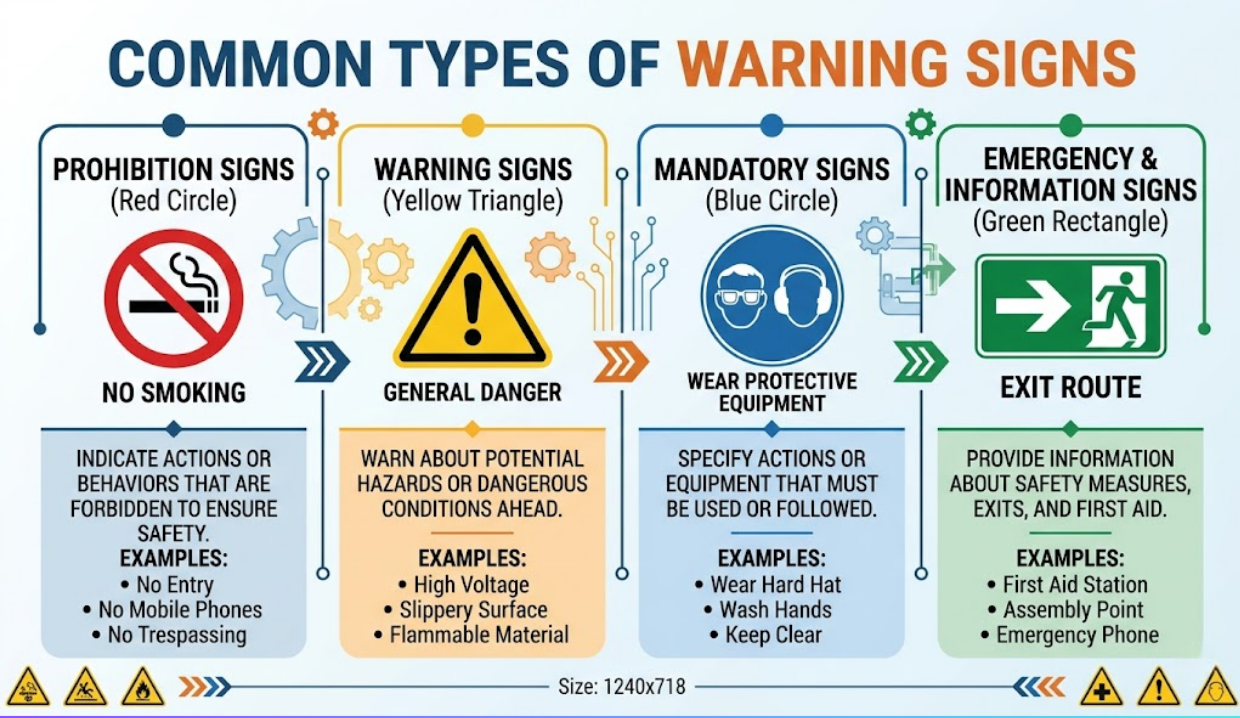
Warning signs prevent injuries. According to OSHA, inadequate safety signage contributes to thousands of recordable incidents every year across construction, oil and gas, and manufacturing sites. Understanding the types of warning signs — their shapes, colors, and legal requirements — is not optional for any HSE officer, site supervisor, or safety-conscious contractor.
This guide covers every major category of safety warning sign, including OSHA 29 CFR 1910.145, ISO 7010, ANSI Z535, and Saudi Aramco GI compliance requirements. Whether you manage a construction site in Texas, a petrochemical plant in Jubail, or an offshore platform in the North Sea, the principles here apply directly to your signage program.
What are the warning signs in HSE?
A safety warning sign is a standardized visual communication tool used to alert workers and the public to hazards that cannot be eliminated through engineering controls or administrative measures alone. Under 29 CFR 1910.145, OSHA defines warning signs as those used to indicate a hazardous situation that, if not avoided, could result in death or serious injury.
Warning signs are not decorative. They are a last line of defense in the hierarchy of controls — placed after elimination, substitution, and engineering controls have been applied. If a hazard still exists at the point of worker or visitor contact, a sign must communicate that hazard clearly enough for anyone — including non-native speakers — to understand.
HSE officers are responsible for ensuring sign selection, placement, and maintenance comply with applicable standards. Site workers depend on these signs to make real-time risk decisions. When signs are missing, faded, or incorrect, incident rates rise.
The 5 Main Types of Warning Signs
The international safety sign system, governed by ISO 7010 and aligned with ANSI Z535 in the United States, divides safety signs into five functional categories. Each type serves a distinct purpose in your hazard communication program.
1. Danger Signs
Danger signs indicate an immediately hazardous situation that will result in death or serious injury if the hazard is not avoided. Under ANSI Z535.2, danger signs use a red background on the signal word panel, white lettering, and a white or black safety alert symbol (⚠).
Use danger signs for: energized electrical panels above 480V, confined spaces with immediately dangerous to life or health (IDLH) atmospheres, areas where active crane lifts are in progress directly overhead, and chemical exposure zones where a single unprotected breath can cause irreversible harm.
OSHA 29 CFR 1910.145(c)(1) requires that danger signs be used only when an immediate hazard exists. Misusing “DANGER” for routine caution situations desensitizes workers and reduces sign effectiveness over time — a pattern auditors cite regularly on process plant inspections.
Also read: What Do Guards Do To Protect the Worker From Harm
2. Warning Signs
Warning signs indicate a potentially hazardous situation that could result in death or serious injury if not avoided. The signal word panel uses an orange background with black lettering under ANSI Z535.2.
Warning signs are the most commonly misused category on industrial sites. They are appropriate for: moving vehicle zones, elevated work areas where falling objects are possible, areas where PPE is required before entry, and chemical handling zones where exposure causes serious but not immediately fatal harm.
ISO 7010 uses a yellow triangle with a black pictogram and a black border for equivalent warning-level signs — this is the format you will see throughout Europe, the Gulf Cooperation Council (GCC) countries, and on Saudi Aramco facilities.
3. Caution Signs
Caution signs indicate a potentially hazardous situation that, if not avoided, may result in minor or moderate injury. ANSI Z535.2 specifies a yellow background with black lettering and a black safety alert symbol.
Common caution applications include: wet floor conditions, low headroom warnings, uneven walking surfaces, areas with limited visibility for pedestrians, and equipment startup warnings. Caution signs should never be used as a substitute for engineering controls — if a wet floor requires a permanent sign, the drainage design needs reconsideration.
4. Notice Signs
Notice signs convey general information that is important but not directly linked to a personal injury hazard. These signs use a blue background with white lettering under ANSI Z535.2. The safety alert symbol is not used on notice signs because no direct injury threat exists.
Typical notice sign applications include: no smoking zones, PPE requirements at facility entrances, visitor check-in instructions, equipment operating instructions, and access restriction areas without an active injury hazard.
5. Safety Instruction Signs
Safety instruction signs provide general safety information or directions related to safe practices and first aid. Under ANSI Z535.2, these use a green background with white lettering.
You will see safety instruction signs at: first aid station locations, emergency eyewash and shower stations, emergency exit routes, assembly points, and safe behavior reminders such as “Always Lock Out Before Service.”
Color and Shape Standards: OSHA, ANSI, and ISO Requirements
Understanding the color and shape system behind safety signs is essential for correct sign selection. Three primary standards govern sign design globally.
OSHA 29 CFR 1910.145 — The U.S. federal standard. It specifies three signal words: DANGER (red), CAUTION (yellow), and SAFETY INSTRUCTION (green). OSHA does not currently mandate the full ANSI Z535 format for all industries, but it references it as an acceptable compliance pathway.
ANSI Z535 — The American National Standard for Safety Signs and Tags. ANSI Z535.2 (Environmental and Facility Safety Signs) and Z535.5 (Safety Tags) are the most relevant for HSE professionals in the United States. ANSI Z535 added “WARNING” (orange) and “NOTICE” (blue) to the OSHA framework, providing more granular hazard severity communication.
ISO 7010 — The international standard specifying safety sign pictograms. ISO 7010 signs use geometric shapes to convey meaning independent of language: triangles for warnings, circles with diagonal bars for prohibitions, circles with a color fill for mandatory actions, and squares or rectangles for emergency information. ISO 7010 is the required format on Saudi Aramco facilities and across the GCC.
| Sign Type | ANSI Color | ISO Shape | Signal Word |
|---|---|---|---|
| Danger | Red | — | DANGER |
| Warning | Orange | Yellow triangle | WARNING |
| Caution | Yellow | Yellow triangle | CAUTION |
| Notice | Blue | — | NOTICE |
| Mandatory | — | Blue circle | (Pictogram only) |
| Prohibition | — | Red circle + bar | (Pictogram only) |
| Emergency | Green | Green square | (Pictogram only) |
| Fire Safety | Red | Red square | (Pictogram only) |
On most international industrial sites, both ANSI text-based signs and ISO pictogram signs are used in combination — ensuring comprehension for all workers regardless of language.
Legal Requirements for Warning Signs
OSHA Requirements (United States)
OSHA 29 CFR 1910.145 governs the specification, use, and maintenance of accident prevention signs and tags in general industry. Key requirements include:
- Danger signs must use red as the dominant color, with the word “DANGER” in white on a red background.
- Caution signs must use a predominantly yellow background with the word “CAUTION” in black lettering.
- Safety instruction signs must use a white or green background with the word “SAFETY FIRST” or equivalent.
- Signs must be maintained in good condition and legibility at all times — faded, torn, or obscured signs are citable violations.
- Temporary hazard signs (tags) fall under 29 CFR 1910.147 for LOTO (Lockout/Tagout) applications.
OSHA’s construction standard at 29 CFR 1926.200 mirrors these requirements for construction sites and additionally requires signs at barricades, excavation edges, and areas with overhead work in progress.
ISO 7010 Requirements (International)
ISO 7010:2011 (updated) establishes safety sign pictograms accepted across the European Union, GCC countries, and most international industrial facilities. It does not prescribe placement distances but requires pictograms to remain recognizable at the viewing distance from which a hazard would first be encountered.
ANSI Z535 Requirements
ANSI Z535.2-2011 (reaffirmed 2017) is the most comprehensive U.S. framework for environmental and facility safety signs. While voluntary at the federal level, many state OSHA plans, insurance underwriters, and large industrial operators (including Aramco contractors) treat ANSI Z535 compliance as mandatory through contractual requirements.
Disclaimer: Regulations may vary by jurisdiction. Always verify requirements with your local OSHA office or regulatory authority before implementing a signage program.
How to Select and Place Warning Signs Correctly
Sign selection errors are one of the most frequently cited deficiencies during safety audits. Follow this process on every project:
- Complete a hazard identification for the work area or task. Use a JSA (Job Safety Analysis) or site walkthrough to identify all hazards that cannot be engineered out.
- Classify hazard severity. Determine whether each hazard is immediately life-threatening (Danger), potentially fatal if ignored (Warning), or likely to cause minor injury (Caution). This drives your signal word selection.
- Select the correct pictogram. Reference ISO 7010 for the appropriate pictogram — there are over 80 standardized pictograms covering everything from high voltage (W012) to biological hazard (W009) to falling objects (W035).
- Determine viewing distance. Signs must be readable from the point at which a person could first take action to avoid the hazard. A general formula: sign height (in inches) × 30 = maximum viewing distance in feet. At 6 inches tall, a sign is readable at up to 180 feet.
- Position signs at eye level where possible. OSHA and ANSI both recommend sign centers at 55–65 inches above floor level for standing workers. Adjust for seated workers, vehicle operators, and overhead hazards.
- Ensure contrast with the background. A yellow caution sign against a beige wall loses effectiveness. Install a contrasting backing panel if necessary.
- Inspect and maintain signs on a scheduled basis. Include sign legibility checks in your monthly site inspection and toolbox talk checklist.
- Document your signage program. Record sign locations, types, and inspection dates. This documentation is your first line of defense during an OSHA inspection.
Common Mistakes and Violations
During site audits across construction and petrochemical facilities, the following sign-related deficiencies appear repeatedly.
Mistake 1: Using “DANGER” for low-severity hazards. Overuse of the Danger signal word causes workers to normalize it. When everything is a danger, nothing is. Reserve Danger exclusively for immediately life-threatening conditions. Use Caution or Notice for lower-severity situations.
Mistake 2: Using text-only signs on multilingual sites. In the Gulf region, construction crews may include workers from South Asia, Southeast Asia, and the Middle East — all with different primary languages. A text-only sign in English fails to communicate with a significant portion of your workforce. ISO 7010 pictograms solve this. Use them alongside or instead of text-based signs wherever multilingual workforces are present.
Mistake 3: Placing signs after the hazard point. A warning sign placed at the edge of a chemical storage area does not give workers sufficient time to don PPE before exposure. Signs must be placed far enough in advance of the hazard that the required protective action can be completed before the hazard is reached.
Mistake 4: Failing to remove temporary signs after hazard resolution. Temporary danger signs left in place after a work permit has closed create confusion and erode sign credibility. Establish a formal sign removal procedure as part of your PTW (Permit to Work) closeout checklist.
Mistake 5: Selecting the wrong ISO pictogram. ISO 7010 contains over 80 pictograms. Substituting a similar-looking sign for the correct one is a compliance failure. For example, using W004 (Warning: non-ionizing radiation) in place of W003 (Warning: ionizing radiation) communicates completely different hazard information. Always verify the correct ISO number.
Mistake 6: Ignoring sign maintenance. OSHA 29 CFR 1910.145(e)(1) requires that signs be maintained in good condition. Faded, damaged, or obscured signs are both a citation risk and a genuine safety failure. Build quarterly sign inspections into your HSE management system.
Mistake 7: No bilingual or pictogram-only options in contractor areas. Saudi Aramco GI-0002.102 and similar contractor safety requirements mandate effective hazard communication for all workers on site, regardless of language. Text-only English signs on Aramco facilities with non-English-speaking labor contractors are a common audit finding.
Warning Signs in Saudi Arabia and the Gulf Region
Across Saudi Arabia, the UAE, Qatar, and Kuwait, safety signage requirements follow ISO 7010 as the primary pictogram standard, often combined with Arabic text equivalents. On Saudi Aramco facilities, the requirements are more specific.
Saudi Aramco GI-0002.102 (Loss Prevention) governs hazard communication on all Aramco-operated and contractor-managed sites. Key requirements include: ISO 7010 compliant pictograms for all hazard sign categories, bilingual signage (English and Arabic) at all entry control points, color-coded pipe marking consistent with Aramco standards, and mandatory warning signage at all PTW (Permit to Work) work fronts.
Contractors operating under Aramco’s SAPMT system must ensure all warning signs conform to Saudi Aramco Engineering Standard SAES-B-006 for facility signage. This includes sign material specifications — signs in high-temperature areas near process equipment must use materials rated for the ambient temperature and chemical exposure environment.
In the UAE, the Occupational Safety and Health (OSH) standards issued by MOHRE (Ministry of Human Resources and Emiratisation) align closely with ISO 7010 and require bilingual Arabic/English signage across all construction and industrial sites.
For contractors in Qatar, the Qatar National Construction Standards (QNCS) mandate ISO 7010-compliant signs at all hazard points, with specific requirements for LNG and petrochemical plant environments where hydrocarbon exposure hazard signs must be weather-resistant and chemical-resistant.
One practical note from audits across the region: the most common finding is not missing signs — it is signs that are physically present but unreadable due to sun bleaching, sand abrasion, or weathering. In the Gulf climate, sign material selection matters as much as sign selection itself. Aluminum substrates with UV-resistant printing outperform vinyl stickers in outdoor applications by a significant margin.
Requirements described are based on publicly available Saudi Aramco standards and regional regulatory frameworks. Contractor-specific requirements may vary. Verify current requirements with your Aramco contract administrator or local regulatory authority.
FAQS: Types of warning signs
A danger sign indicates an immediately hazardous situation that will result in death or serious injury if not avoided — it uses a red signal word panel. A warning sign indicates a potentially hazardous situation that could result in death or serious injury. The probability and immediacy of harm distinguishes the two: danger is certain and immediate, warning is probable and avoidable.
Under ANSI Z535.2, warning signs use an orange background with black lettering. OSHA 29 CFR 1910.145 specifies yellow as the dominant color for caution signs. “Warning” (orange) was introduced by ANSI Z535 to fill the gap between Danger (red) and Caution (yellow). OSHA’s federal standard does not separately define the Warning category, though ANSI Z535 compliance is widely accepted as meeting or exceeding OSHA requirements.
The five standard types, per ANSI Z535, are: Danger (red), Warning (orange), Caution (yellow), Notice (blue), and Safety Instruction (green). ISO 7010 uses a parallel system based on geometric shapes: triangles (warning), circles with diagonal bars (prohibition), filled circles (mandatory action), and squares (emergency and fire information).
Signs must be placed far enough before the hazard that a worker can read the sign and complete the required protective action before reaching the hazard. A practical minimum is 5–10 meters for pedestrian areas. For vehicle traffic, calculate based on the stopping distance at the posted or expected speed. OSHA does not specify a universal minimum distance — the sign must be effective at the specific location.
Yes. OSHA 29 CFR 1910.145 (general industry) and 29 CFR 1926.200 (construction) both require appropriate safety signs and tags wherever hazards exist that cannot be controlled by other means. There is no minimum site size exemption. Even a single-trade contractor working in a temporary space must post appropriate hazard warning signs where required.
A ready-to-use warning signs inspection and compliance checklist is available in the HSE Documentation library on hse-documents.com. The checklist covers OSHA 29 CFR 1910.145, ANSI Z535.2, ISO 7010, and Saudi Aramco GI-0002.102 requirements in a single audit-ready format.
Conclusion
Three things matter most in any warning sign program: selecting the correct sign type for the actual severity of the hazard, placing signs where they give workers actionable advance notice, and maintaining sign legibility through regular inspection. Getting these three things right puts you well ahead of the compliance baseline — and more importantly, it keeps your workforce alive and injury-free.
For Saudi Aramco contractors and GCC-based HSE officers, add a fourth requirement: ISO 7010 pictogram compliance with bilingual Arabic/English labeling is not optional. It is both a regulatory requirement and a practical necessity on multilingual sites.
Download the complete HSE signage compliance checklist from the HSE Documentation section at hse-documents.com to run your next site inspection against all applicable standards in one structured document.