
During a routine safety inspection at a mid-rise commercial construction project, I observed something that is unfortunately still common across many worksites—blocked escape routes.
Scaffolding materials were stacked along the designated emergency stairwell. A temporary electrical cable reel was left coiled across the evacuation path. The workers on site had never been formally briefed on fire escape safety, assuming “the site is too open for anything serious to happen.”
Two weeks later, a minor electrical fire broke out in a temporary office container. The fire itself was contained quickly, but evacuation was delayed because workers had to navigate obstructed exit routes. No fatalities occurred, but the incident triggered a regulatory investigation, work stoppage, and major compliance penalties.
This is exactly why fire escape safety is not just a compliance checkbox—it is a life-critical system that determines survival during emergencies.
Understanding Fire Escape Safety in Workplace Environments
Fire escape safety refers to the planning, design, maintenance, and execution of safe evacuation routes that allow workers to exit a building or site quickly during fire or emergency situations.
From an HSE perspective, it is a core pillar of workplace safety, integrated with:
- Hazard identification
- Risk assessment
- Emergency preparedness
- Safety procedures
- Incident prevention systems
In construction, oil & gas, manufacturing, and industrial plants, fire escape systems must be functional under real emergency conditions—not just on paper.
Why Fire Escape Safety is Critical in HSE Management
In real operational environments, emergencies rarely give warning. Poor fire escape safety leads to:
- Delayed evacuation during fire outbreaks
- Panic-driven injuries and stampedes
- Non-compliance with safety regulations
- Increased severity of incidents
- Operational shutdowns and financial losses
From an HSE standpoint, evacuation failures are classified as high-severity risks because they directly impact life preservation.
Step-by-Step Fire Escape Safety Implementation (On-Site HSE Approach)
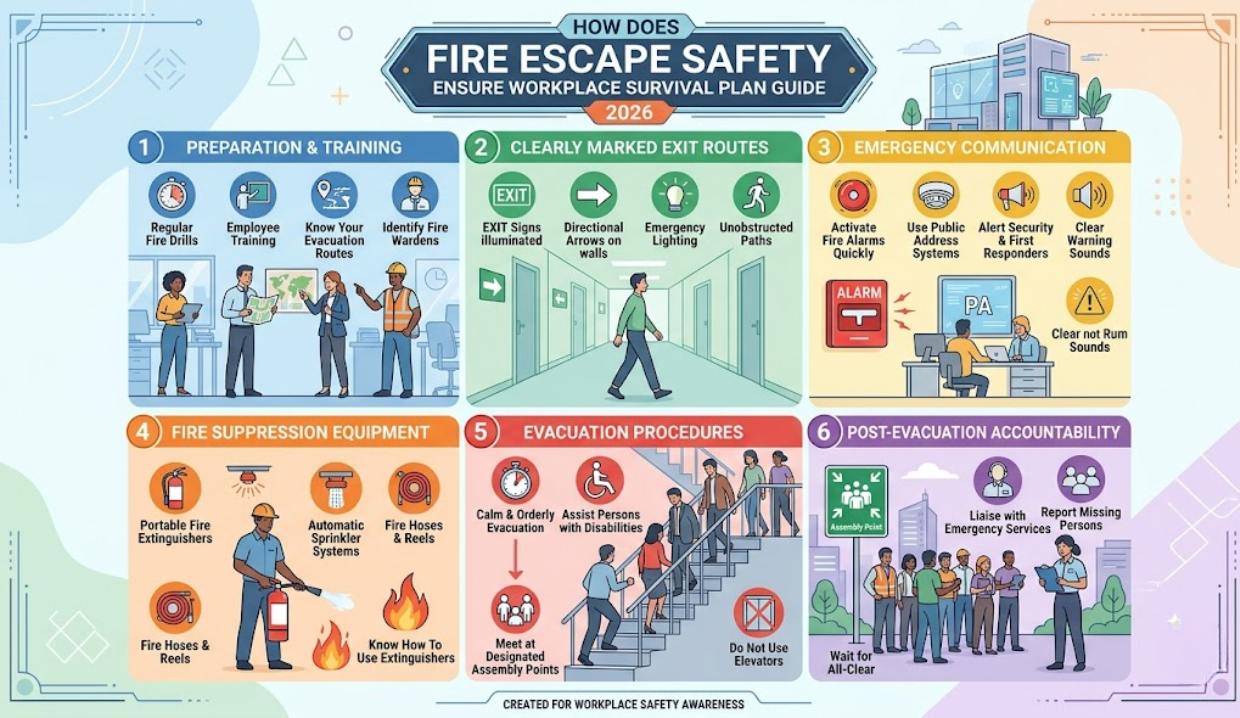
1. Risk Assessment and Hazard Identification
Before designing any evacuation plan, conduct a structured risk assessment:
- Identify fire ignition sources (electrical panels, hot work zones, fuel storage)
- Evaluate occupancy load
- Map structural bottlenecks
- Assess accessibility of exits
This is the foundation of effective fire escape safety planning.
2. Designing Clear and Accessible Escape Routes
Every site must ensure:
- Minimum two escape routes per area (where possible)
- Clearly marked exit signage
- Emergency lighting systems
- Unobstructed pathways at all times
In industrial environments, escape routes must be reviewed after every layout change.
3. Installation of Fire Safety Systems
A proper evacuation system integrates:
- Fire alarms
- Smoke detectors
- Emergency communication systems
- Fire extinguishers at strategic points
These systems ensure that fire escape safety is activated immediately at the earliest sign of danger.
4. Emergency Evacuation Planning
Develop a documented evacuation plan that includes:
- Site-specific escape maps
- Assembly points
- Roles of fire wardens
- Communication hierarchy during emergencies
Workers must not only read the plan—they must understand it through drills.
Also read: how can you ensure fire drill safety in workplace safe nowok
5. Training and Mock Drills
One of the most neglected areas in fire escape safety is practical training.
Regular drills should include:
- Full site evacuation simulations
- Night shift drills
- High-noise environment scenarios (for oil & gas sites)
- Time-based evacuation performance tracking
Without drills, even the best-designed system fails under pressure.
6. Continuous Inspection and Monitoring
HSE officers should conduct:
- Weekly escape route inspections
- Monthly fire equipment checks
- Post-change risk reviews
Any obstruction or modification should trigger immediate corrective action.
Common Risks and Mistakes in Fire Escape Safety
From field experience, these are the most frequent failures:
Blocked Exit Routes
Storage materials, waste, or temporary structures blocking escape paths.
Poor Signage Visibility
Missing or unclear exit signs, especially in low-light areas.
Lack of Maintenance
Emergency lights not functioning during power failure.
Untrained Workforce
Workers unaware of evacuation procedures or assembly points.
Complacency in Low-Risk Zones
Assuming open sites or small facilities don’t require strict fire escape safety controls.
Each of these mistakes significantly increases incident severity during emergencies.
Industry Best Practices for Fire Escape Safety
International HSE frameworks emphasize proactive control measures:
1. Hierarchy of Controls Application
Eliminate hazards where possible before relying on procedural controls.
2. Integration with Permit-to-Work Systems
Ensure hot work and electrical work permits include evacuation considerations.
3. Digital Evacuation Mapping
Modern facilities now use digital floor plans accessible via mobile devices for rapid evacuation guidance.
4. Behavioral Safety Programs
Encourage workers to report blocked exits or unsafe conditions immediately.
5. Safety Leadership Involvement
Supervisors and managers must actively participate in drills and inspections—not just delegate them.
These practices significantly strengthen fire escape safety performance across all industries.
Compliance and Safety Impact
Failure to maintain proper fire escape safety can lead to:
- Legal penalties under occupational safety laws
- Audit failures during regulatory inspections
- Increased insurance premiums
- Work stoppage orders
- Criminal liability in severe incidents
From an HSE compliance perspective, evacuation readiness is a non-negotiable audit parameter.
Regulators expect documented evidence of:
- Emergency plans
- Training records
- Drill reports
- Inspection logs
Without these, organizations are considered non-compliant regardless of physical infrastructure quality.
These internal links help build structured HSE knowledge clusters and improve SEO performance.
FAQS: Fire Escape Safety
It refers to planned and controlled evacuation systems that ensure safe exit during fire emergencies, integrated into workplace safety systems.
Ideally, weekly inspections should be conducted, with immediate checks after any site layout changes.
Construction sites have constantly changing layouts, making evacuation routes vulnerable to obstruction and requiring continuous monitoring.
Assuming workers already “know what to do” without regular drills and practical training.
The responsibility lies with management, but HSE officers and site supervisors play a critical enforcement role.
Conclusion
In real-world operations, fire escape safety is not defined by documentation—it is defined by execution under pressure.
A well-designed evacuation system can only succeed when supported by continuous inspection, worker training, hazard control, and leadership commitment.
From construction sites to industrial plants, every second matters during emergencies. The difference between safe evacuation and catastrophic outcomes often comes down to preparation, discipline, and adherence to basic HSE principles.
Organizations that treat evacuation planning as a living safety system—not a static requirement—consistently achieve higher safety performance and lower incident rates.
Ultimately, fire escape safety is not just about compliance. It is about ensuring that every worker has a guaranteed, protected path to survive when things go wrong.