
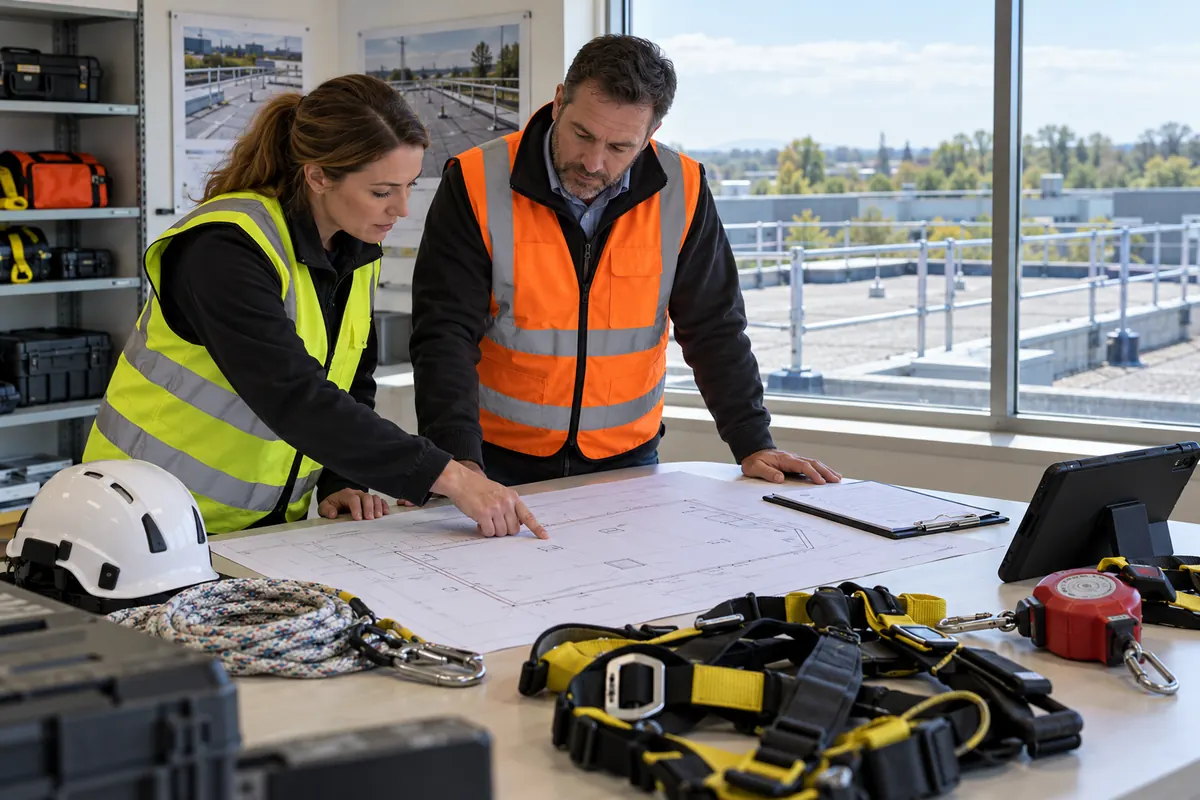
A roof work rescue planning checklist helps a team test whether its emergency arrangements will work at the roof where the task is planned. Access, edges, fragile surfaces and the casualty position all affect the response. A rescue kit in the store does not establish that people can reach and recover a casualty safely.
Before using the template
Start with the task risk assessment and prioritise preventing a fall. Then plan for foreseeable emergencies with competent advice. HSE guidance for Great Britain requires planning for emergencies and rescue and cautions against relying on the fire brigade because delay may be critical. Confirm current local requirements and involve specialist rescue competence where the work demands it.
Copy and adapt: Add the actual task, asset or location, relevant instructions and the person responsible for each decision. This original template supports the site process.
Practical review checklist
| Review item | What to confirm or record |
|---|---|
| Roof and task | Identify the building, access point, task, work area and roof features affecting emergency access. |
| Emergency scenarios | Assess foreseeable injury, incapacity and fall-related situations relevant to the proposed protection system. |
| Rescue method | Record a competent task-specific method, its limitations and the conditions in which it cannot be used. |
| Anchors and equipment | Confirm suitable assessed anchors, compatible equipment, inspection status and availability under the rescue plan. |
| People | Name trained responders and confirm their presence during the work rather than relying on an absent person. |
| Access and casualty route | Check how responders and equipment reach the location and how a casualty will be moved to further care. |
| Alarm and assistance | Record communication, site location details, emergency access and medical assistance arrangements. |
| Validation and change | Confirm briefing and safe practice or verification, and define when the plan must be reviewed. |
A worked planning example
Illustrative example: the planned rescue equipment is available, but the only roof access ladder cannot accommodate the assessed casualty route. The team refers the access problem back to the competent planner before work begins. Possession of equipment and training certificates does not resolve an unusable access arrangement.
Follow-up and records
Keep drawings and equipment references with the plan so the response is not left to memory. Record the person who verified each readiness item and any hold point. Do not introduce a generic rope-rescue sequence from a toolbox talk. Stop and reassess when roof access, weather, work position or protection arrangements change. Rescue planning supports a safe system; it cannot justify avoidable exposure to a fall.
Keep the date, finding, action owner, due or hold point and closure evidence traceable. Record a reason for not applicable items. Escalate unresolved safety concerns before releasing the affected work.
Track outstanding actions in the daily safety officer report and review repeated issues through the safety committee action log.
Common questions
Is a rescue plan needed only for fall arrest?
Consider all foreseeable emergencies in the actual roof task, including incapacity or injury without a fall.
Can this checklist certify a rescue system?
No. It supports planning and review by competent people using the correct equipment and instructions.
Primary sources and applicability
Source jurisdictions are identified below. Confirm current Saudi requirements, the site assessment and applicable manufacturer instructions. No client or regulator approval of this example is claimed.
- HSE: Construction work-at-height questions — Great Britain guidance.
- HSE HSG33: Health and safety in roof work — Great Britain roof-work guidance.