
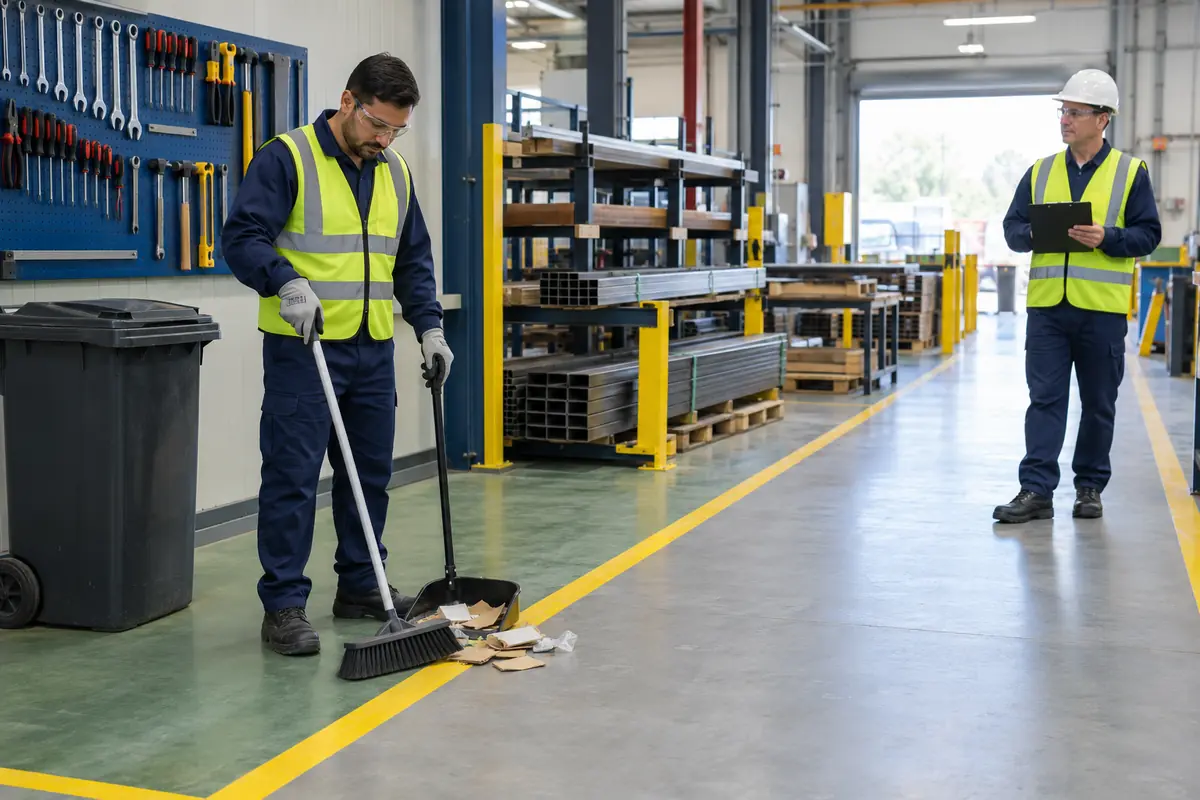
Regular waste removal helps keep workshop access routes clear throughout the shift.
A workshop can look tidy at the morning inspection and become difficult to move through after the first delivery. Packaging appears beside a bench, offcuts collect near a saw and a temporary cable crosses the route to the stores. The problem is often how the work is organised, not simply whether somebody swept the floor.
Good housekeeping safety observations explain the condition, the people exposed and the action needed. The corrective action should also address why the condition keeps returning. This guide focuses on that practical work: what to record, who should act and what to check before closure.
What should you look for during a housekeeping inspection?
Look at the area as it is used. Follow pedestrian routes, delivery points, workstations and waste collection routes. Ask workers where materials accumulate and what makes it difficult to keep the area clear. An empty workshop may not reveal the same problems as a busy shift.
- Access routes, stairs and exits remain usable.
- Materials have suitable, defined storage locations.
- Waste can be collected without creating extra exposure.
- Leaks, wet surfaces, cables and loose objects are controlled.
- Cleaning arrangements match the material and the task.
For US construction, OSHA 1926.25 addresses clearing debris from work areas and routes, removing combustible scrap and providing appropriate waste containers. OSHA 1910.22 addresses walking-working surfaces in general industry. Their scopes differ; neither should be presented as automatic Saudi legal or client approval.
8 housekeeping safety observations and corrective actions
The following examples are sample wording. Record proposed actions as proposed. Only write “removed”, “repaired” or “verified” after the action has actually happened.
1. Packaging left in a pedestrian route
Observation: Empty cartons and plastic wrapping were left in the marked route beside the receiving bench, reducing clear access for pedestrians.
Immediate response: Protect the affected area and arrange safe removal. Do not direct people into a vehicle route as an informal alternative.
Corrective action: The receiving supervisor should provide a suitable unpacking and waste collection arrangement at the point where packaging is generated. Check collection frequency during delivery peaks.
Closure: Observe the route during the next relevant delivery, not only immediately after cleanup.
2. Offcuts collecting around a workstation
Observation: Loose offcuts had accumulated around the fabrication bench, including in the operator’s standing and access area.
Immediate response: Have the responsible team make the work area safe before collection. Use appropriate handling methods for sharp or heavy pieces; do not reach into operating equipment.
Corrective action: The workshop supervisor should arrange suitable offcut containers and a collection method that fits the work sequence.
Closure: Check that containers remain accessible and are emptied before they create an obstruction. “Sweep at the end of the day” may not control accumulation during the task.
3. A wet floor without effective protection
Observation: Water remained on the workshop access floor following cleaning, while pedestrians continued to use the area.
Immediate response: Prevent exposure and provide safe alternative access while the surface is made safe. A warning sign alone may be insufficient where people can still enter the slippery area.
Corrective action: The facilities lead should review cleaning timing, drying arrangements and drainage where relevant. Investigate whether the water comes from cleaning or another source.
Closure: Confirm safe footing and check the arrangement during the next cleaning cycle.
4. Temporary leads and hoses obstructing access
Observation: Temporary leads and hoses crossed the access route between two workstations, exposing workers to trips and possible damage to the services.
Immediate response: Restrict the affected access and arrange a suitable temporary route. Relocation or disconnection should be carried out by authorised personnel where required.
Corrective action: The task supervisor should review service routing and the positions of the workstations. Use a suitable designed arrangement where a crossing cannot be avoided.
Closure: Check the route with the task running under its normal controls; a clear route before the equipment is set up proves little.
5. An overflowing waste container
Observation: Waste projected above the container and had spilled onto the floor beside the workshop collection point.
Immediate response: Secure the affected area and arrange appropriate collection. Do not climb into the container or compact waste by hand.
Corrective action: The waste coordinator should review container suitability, waste segregation, access for collection and collection frequency.
Closure: Check the location before the next scheduled collection. One empty bin photograph does not demonstrate that capacity now matches the waste generated.
6. Materials stored beside an emergency exit
Observation: Delivered materials restricted the approach to an emergency exit and interfered with its normal use.
Immediate response: Escalate immediately and arrange safe removal to restore the exit and its approach. Do not wait for a routine housekeeping round.
Corrective action: The logistics supervisor should agree a suitable delivery holding area and make clear which access areas must remain free of storage.
Closure: Check the approach, door operation and route against the site’s emergency arrangements, including while deliveries are being handled.
7. Dust disturbed during cleaning
Observation: A cleaning method was visibly disturbing settled process dust into the work area without confirmation that the method was suitable for that material.
Immediate response: Stop the unsuitable cleaning activity and control access as required. Escalate the uncertainty about the material and exposure.
Corrective action: The responsible supervisor should arrange assessment of the dust and specify a suitable cleaning method and equipment. Do not assume a general vacuum, dry sweeping or compressed air is suitable for hazardous or combustible dust.
Closure: Verify the selected method, equipment, worker instructions and any necessary exposure checks.
8. An unidentified spill treated as ordinary waste
Observation: An unidentified liquid was present beneath stored containers, but the area had not been isolated or assessed before routine cleanup was proposed.
Immediate response: Keep people clear and notify the responsible supervisor or emergency contact according to the site procedure. Do not touch, smell, mix or wash away an unknown substance.
Corrective action: Competent personnel should identify the material where safe, arrange the appropriate response and investigate the source. Review containment and storage findings.
Closure: Confirm the area is safe for use, waste is handled appropriately and the source has been resolved. An unknown or hazardous spill is not an ordinary housekeeping task.
Turn “clean the area” into an accountable action
A useful action names the owner, the required result and the deadline appropriate to the risk. “Housekeeping to be improved” leaves too much interpretation. “Receiving supervisor to relocate packaging to the designated collection point and review collection frequency before the next delivery” is easier to act on.
For immediate danger, control exposure now. A future deadline is not permission to leave a hazardous route in use. Where a longer-term solution is needed, record the interim control and who will maintain it.
Involve the team creating the waste as well as the cleaning team. If storage space is unavailable or the collection point is unsuitable, asking cleaners to work harder will not resolve the cause.
A short housekeeping close-out checklist
- Check the condition: Is the area safe for its intended use?
- Check the source: Has the reason for the accumulation, leak or obstruction been addressed?
- Check the arrangement: Are storage, containers and collection routes suitable?
- Check the evidence: Does it show the actual location and action, without exposing personal information unnecessarily?
- Check effectiveness: Will you revisit during the next relevant task, delivery or shift?
Record any outstanding work separately. Do not close the entire observation because the visible waste has been removed while the leak, storage conflict or collection problem remains unresolved.
Common housekeeping reporting questions
How often should housekeeping be checked?
Base the frequency on the activity, risk and rate at which conditions change. Include task changes, deliveries and shift handovers where relevant. A daily form does not replace immediate action when a hazard appears.
Is housekeeping only the cleaner’s responsibility?
No. Work teams should manage the materials and waste their tasks generate, while supervisors provide workable storage and collection arrangements. Specialist cleaning or spill response may need trained personnel.
Can I use the same wording for every inspection?
Use consistent fields, but describe the actual location and condition. Repeated generic comments make it difficult to identify recurring problems or verify that the correct action was completed.
Keep the area usable while the work continues
The aim of housekeeping safety observations and corrective actions is a work area that stays safe in use, not just a good photograph after cleaning. Start with the condition, agree practical ownership and return when the activity is happening again.
Use our safety observation report guide for the wider reporting format, and browse the safety checklist resources for related inspection material. Adapt examples to your workplace and current approved procedures.