
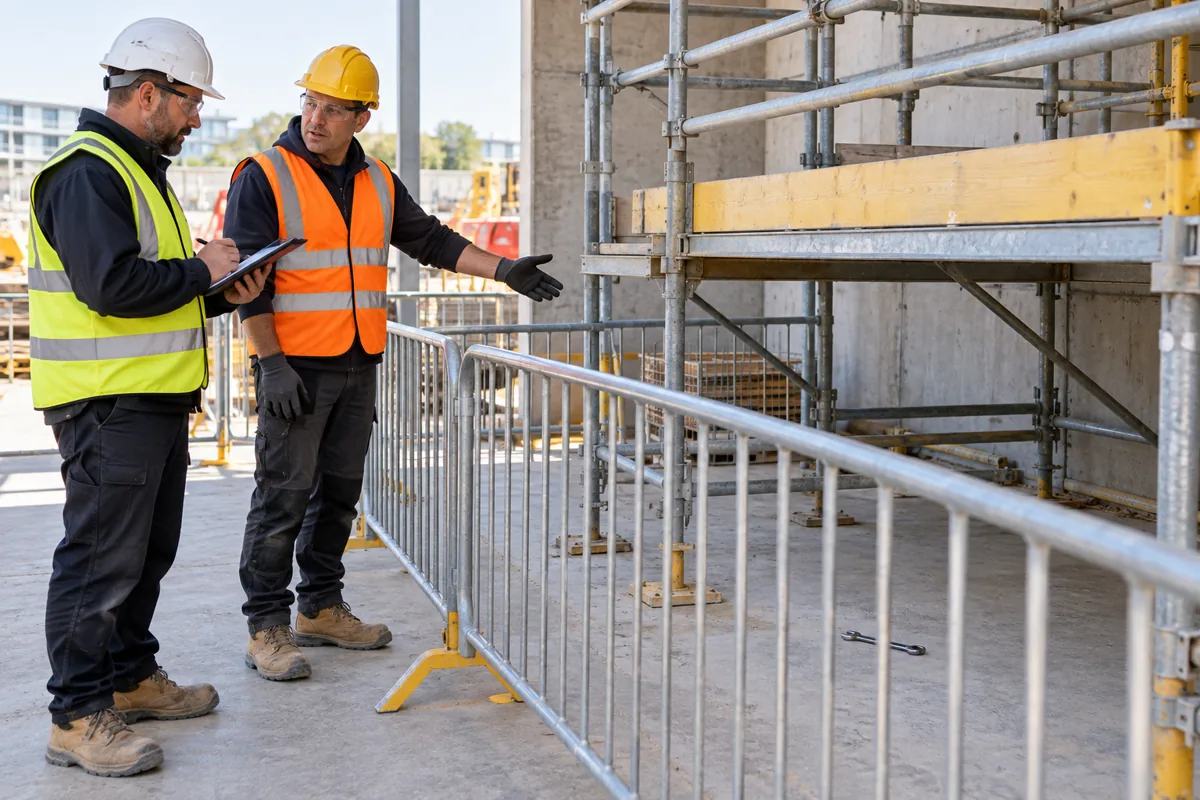
A spanner drops beside a walkway. Nobody is hit, but the outcome could have been very different. A useful near-miss report captures that warning clearly enough for the team to act on it.
This guide gives practical near miss reporting examples for construction, a copy-and-adapt reporting format and follow-up checks. The scenarios below are fictional training examples, not records of actual incidents.
What counts as a near miss?
A near miss is an unplanned event that could have harmed someone but did not. OSHA’s incident investigation guidance encourages employers to investigate close calls and examine underlying causes rather than stop at blame.
For reporting purposes, distinguish an event from a condition. A loose cable across a route is a hazard observation. A person catches a boot on it and regains balance without injury: that is a near-miss event. Record what happened, then apply your organisation’s classification rules. Damage or injury may change the incident category.
How to write the first report
- Locate it: date, time, project, work area and the activity underway.
- Describe the sequence: what moved, failed or changed, and where people were positioned.
- State the outcome: record confirmed injury and damage information. Mark anything not yet verified.
- Explain the credible potential: describe possible harm without inventing a worst-case story.
- Record immediate protection: affected work stopped, access restricted and the supervisor notified, as applicable.
- Assign follow-up: name the responsible role, target time and evidence needed before closure.
Separate observations from assumptions. “A spanner landed on the concrete beside the marked route” is an observation. “The worker was careless” is an unsupported judgement. If nobody saw how the tool fell, write “mechanism not yet established” and leave the investigation open.
Six construction near-miss reporting examples
1. Tool falls beside a pedestrian route
Report wording: During platform work, a spanner fell to ground level beside the pedestrian route. A pedestrian was approaching the area; no contact or injury was reported. The supervisor stopped the affected activity and restricted access below.
Follow-up: Review tool containment, work-area layout and the effectiveness of overhead-work segregation. Agree suitable controls before restarting. Closure evidence: supervisor verifies the revised arrangement at the work front and records the briefing and check.
2. Reversing vehicle approaches a person
Report wording: A delivery vehicle began reversing while a worker was crossing behind it. The driver stopped after a warning. No contact occurred. Vehicle movement was paused and pedestrians were redirected.
Follow-up: Review delivery planning, pedestrian separation, visibility and agreed communication. Do not treat a warning shout as a lasting control. Closure evidence: check the revised route during a controlled delivery and confirm that workers understand the crossing arrangement.
3. Worker slips but regains balance
Report wording: A worker slipped on wet flooring at the temporary welfare entrance and regained balance without falling. No injury was reported. Access was restricted while the surface was made safe.
Follow-up: Establish the source of water and review drainage, cleaning and entrance arrangements. Closure evidence: verify the surface and source control, then recheck under the conditions that created the problem.
4. Unsecured material shifts during unloading
Report wording: A bundle shifted on the vehicle bed during unloading preparation. A worker moved clear and was not struck. Unloading stopped, and the area was isolated pending review by the responsible unloading team.
Follow-up: Review load condition, restraint-release sequence and the planned method. Do not approach or try to catch unstable material. Closure evidence: the responsible competent team confirms a safe revised method and checks it before work resumes.
5. Temporary access panel moves underfoot
Report wording: A temporary access panel moved when a worker stepped onto it. The worker stepped back without injury. The access route was closed and an alternative route identified.
Follow-up: Arrange competent assessment of the panel, support and securing arrangement. Closure evidence: record the assessment, corrective work and authorised return to use. A photograph alone does not establish load capacity.
6. Door opens into a passing worker’s path
Report wording: A site-store door opened into the walkway as a worker passed. The worker stopped before contact. The supervisor introduced temporary access control while the layout was reviewed.
Follow-up: Review door swing, sightlines and route position, keeping emergency access requirements in view. Closure evidence: inspect the agreed arrangement with the users and confirm that it does not introduce another obstruction.
Copy-and-adapt near-miss report format
| Field | What to record |
|---|---|
| Reference and location | Unique ID, date/time, project, exact work area and task |
| Factual event | Short sequence, people positions and actual outcome |
| Potential consequence | Credible harm and priority using the site’s assessment method |
| Immediate controls | Protection introduced, time and person notified |
| Evidence | Safe photographs, relevant records and witness accounts stored appropriately |
| Investigation status | Known facts, unanswered questions and assigned investigator |
| Corrective actions | Specific action, responsible role, due time and interim protection |
| Close-out | Verifier, date, evidence and effectiveness recheck |
Worked example: turning a vague note into a useful record
Weak note: “Near miss at gate. Driver warned. Closed.”
Better initial record: “At 09:15 at the east delivery gate, a van reversed while a pedestrian was crossing behind it. The driver stopped after a warning; no contact or injury was reported. Deliveries were paused and the crossing closed temporarily. The logistics supervisor will review pedestrian separation and the delivery sequence before the next delivery. Investigation and final close-out remain open.”
The second version gives the next shift something to work with. It does not invent a root cause or claim that a briefing has fixed the layout.
Follow up until the control works
- Escalate serious potential promptly using the site’s procedure; no injury does not automatically mean low priority.
- Keep the initial report linked to the investigation and action register.
- Check whether similar work fronts have the same problem.
- Verify the physical or procedural change before marking an action closed.
- Tell the reporting worker what changed. OSHA’s worker participation guidance supports reporting arrangements that workers can use without fear of retaliation.
For unsafe conditions without an event, use our safety observation report examples and corrective-action guide. The two records can link together without describing every observation as a near miss.
Common questions
Should we wait for the full investigation before reporting?
No. Submit the known facts through the site’s reporting route promptly, flag uncertainties and update the record as evidence is checked. Urgent protection should not wait for the finished report.
Does every near miss need the same investigation?
Use a proportionate investigation based on credible potential and your procedure. A potentially serious event deserves attention even when nobody was hurt.
Is this an approved statutory reporting form?
No. This is a practical internal format. OSHA is the US regulator; HSE regulates Great Britain. Their guidance is useful context, but local legal reporting duties and client procedures must be checked separately for the project’s jurisdiction, including Saudi Arabia.
Before submitting: Can another person understand what happened, what keeps people safe now and who owns the next action? If any of those answers is missing, improve the record before calling it complete.