
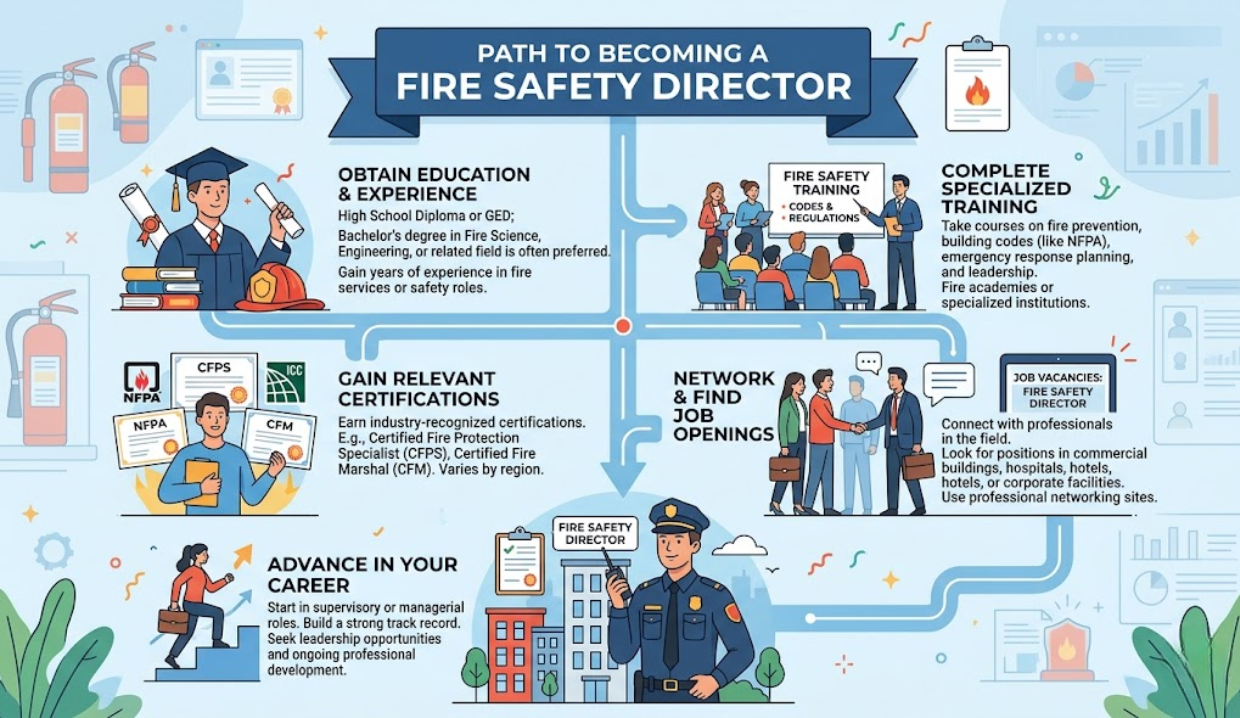
A fire in a high-rise building is not just an emergency—it is a fast-moving, high-risk situation where every second matters. In such environments, one role becomes central to safety coordination: the fire safety director. If you are exploring how to become a fire safety director, you are essentially looking at a career that combines technical fire knowledge, legal compliance, leadership, and real-time emergency decision-making.
This guide breaks everything down in a practical, structured way so you understand not only the certification path, but also the real responsibilities, systems knowledge, and career expectations behind the role.
What Is a Fire Safety Director?
A fire safety director is a trained and certified professional responsible for managing fire safety operations within large or high-occupancy buildings. In simple terms, they act as the “safety coordinator” during normal operations and the “command leader” during emergencies.
Definition (Featured Snippet Style):
A fire safety director is a certified safety professional responsible for managing fire prevention systems, coordinating evacuation procedures, ensuring building compliance with fire codes, and directing emergency response in large buildings such as high-rises, hotels, and commercial complexes.
This role is especially important in environments where building size and occupancy make self-evacuation complicated.
Why Fire Safety Directors Are Essential in Modern Buildings
Modern buildings rely heavily on integrated systems like alarms, sprinklers, smoke control systems, and emergency communication networks. However, technology alone is not enough.
A fire safety director ensures:
- Systems are functioning correctly under real conditions
- Occupants are properly trained for evacuation
- Emergency instructions are delivered clearly
- Coordination with fire departments is immediate and accurate
- Legal fire safety compliance is continuously maintained
Without this role, even the best safety systems can fail due to poor coordination.
Fire Safety Director Requirements
Becoming a fire safety director requires a combination of education, training, and certification. While exact requirements vary by region, major cities (like NYC) have strict licensing frameworks.
Education and Background
You typically need:
- High school diploma or equivalent (minimum baseline)
- Strong understanding of building systems or fire science (preferred)
- Background in security, facilities management, firefighting, or military service can be an advantage
Experience Expectations
Before certification, many candidates gain experience in:
- Building safety operations
- Emergency response coordination
- Security supervision
- Fire prevention assistance roles
Experience is important because the role demands real-world judgment, not just theoretical knowledge.
Step-by-Step: How to Become a Fire Safety Director
Step 1: Understand Local Certification Requirements
In many jurisdictions, you must obtain a Certificate of Fitness or equivalent licensing credential (for example, Certificate of Fitness fire safety director (FSD) in NYC).
Also read: What Does PASS Stand for in Fire Safety and Why It Matters?
Step 2: Complete Fire Safety Training
Training usually covers:
- Fire prevention principles
- Fire alarm systems operation
- Emergency evacuation procedures
- Building code compliance
- Life safety systems management
This stage builds your technical foundation.
Step 3: Learn Fire Code and Compliance Standards
A strong understanding of fire regulations is essential, including:
- NFPA fire safety standards compliance
- International Building Code (IBC) basics
- Local fire code enforcement guidelines
- Occupancy classification fire safety rules
This knowledge ensures you can legally operate within building safety regulations.
Step 4: Master Building Safety Systems
You must understand how critical systems work, including:
- Fire alarm control panels (FACP)
- Sprinkler systems (wet/dry systems)
- Smoke control systems
- Emergency lighting systems
- Elevator emergency recall systems
These systems are often the first line of defense in an emergency.
Step 5: Pass the Fire Safety Director Exam
The exam typically includes:
- Written knowledge test
- Scenario-based emergency response questions
- Practical system operation understanding
Common evaluation areas include:
- Emergency evacuation planning
- Fire drill coordination procedures
- Fire alarm system troubleshooting
- Incident response decision-making
Step 6: Obtain Certification and Maintain Compliance
After passing:
- You receive official certification or a license
- You must renew it periodically
- You may need continuing education or refresher training
Fire Safety Director Duties and Responsibilities
The role extends far beyond emergencies. Daily responsibilities are equally important.
Core Responsibilities Include:
- Conducting daily fire safety inspections
- Maintaining fire safety documentation and reporting
- Coordinating fire drills and training sessions
- Monitoring building life safety systems
- Ensuring compliance with fire codes
- Supervising fire wardens and staff
During Emergencies:
- Activating evacuation procedures
- Communicating instructions to occupants
- Coordinating with fire department responders
- Managing building-wide emergency announcements
- Monitoring smoke control systems and alarms
Fire Emergency Management Skills You Must Develop
A fire safety director is essentially an emergency operations leader. Key skills include:
Evacuation Planning
You must design evacuation strategies based on:
- Building layout
- Occupancy level
- Stairwell capacity
- Smoke movement behavior
Communication Under Pressure
Clear communication prevents panic. Directors often use:
- Public address systems
- Emergency announcement scripts
- Coordination with floor wardens
Incident Command Understanding
Knowledge of the Incident Command System (ICS) helps coordinate a structured emergency response with external fire services.
High-Rise Building Fire Safety Complexity
High-rise buildings present unique challenges:
- Evacuation takes significantly longer
- Elevator use is restricted or controlled
- Smoke movement can be unpredictable
- Occupants may require phased evacuation
This is why roles like fire safety director are legally required in many large buildings.
Fire Safety Director vs Fire Warden
| Role | Fire Safety Director | Fire Warden |
|---|---|---|
| Authority Level | High-level command | Floor-level support |
| Responsibility | Entire building | Specific zone/floor |
| Certification | Required | Often internal training |
| Decision Making | Strategic & legal | Operational assistance |
The fire safety director leads; fire wardens support execution.
Career Path and Salary Expectations
A fire safety director’s career can grow significantly over time.
Typical Career Progression:
- Fire safety assistant
- Fire safety officer
- Certified fire safety director
- Senior building safety manager
- Regional compliance supervisor
Industry Demand
High demand exists in:
- Commercial skyscrapers
- Luxury hotels
- Hospitals and healthcare facilities
- Industrial plants
Salary Factors
Earnings depend on:
- Building size
- Location
- Certification level
- Experience
Common Challenges and Real-World Mistakes
Many candidates underestimate the complexity of the role.
Frequent Issues Include:
- Miscommunication during evacuation
- Incorrect interpretation of fire codes
- Poor documentation of safety logs
- Failure to conduct proper fire drills
- Lack of familiarity with alarm systems
Some failures are not technical but psychological—handling pressure during emergencies is a major skill.
Advanced Insights Most Guides Ignore
Evacuation Decision Complexity
One of the hardest decisions is whether to:
- Evacuate immediately
- Delay evacuation (smoke spread control)
- Use phased evacuation strategies
Elevator Use During Fires
Fire safety directors must understand strict rules around elevator recall systems and when elevators are completely disabled.
Coordination Failures
In real incidents, breakdowns often occur between:
- Building staff
- Fire wardens
- External fire departments
Strong leadership prevents these gaps.
Fire Safety Director Daily Checklist (Practical Insight)
A typical daily workflow may include:
- Checking the fire alarm control panel status
- Reviewing system fault logs
- Ensuring exits are unobstructed
- Verifying emergency lighting
- Updating inspection reports
- Conducting staff briefings
Consistency is critical in preventing emergencies.
FAQS: How to become a fire safety director
You typically need certification, training in fire systems, and knowledge of fire codes, along with practical experience in building safety operations.
Yes, especially for those interested in emergency management, building safety, and structured operational leadership roles.
No. They do not extinguish fires; they coordinate evacuation and safety procedures while firefighters handle suppression.
High-rise buildings, large commercial complexes, hotels, and facilities with high occupancy often require one by law.
Conclusion
Becoming a fire safety director is not just about passing an exam—it is about mastering responsibility. The role combines technical system knowledge, legal compliance, leadership, and real-time decision-making under pressure.
If you are serious about this career path, focus on three core pillars:
- Deep understanding of fire safety systems
- Strong knowledge of fire codes and regulations
- Practical emergency coordination experience
With these foundations, you can move from training to certification and eventually into a critical leadership role that directly protects lives in high-risk environments.