
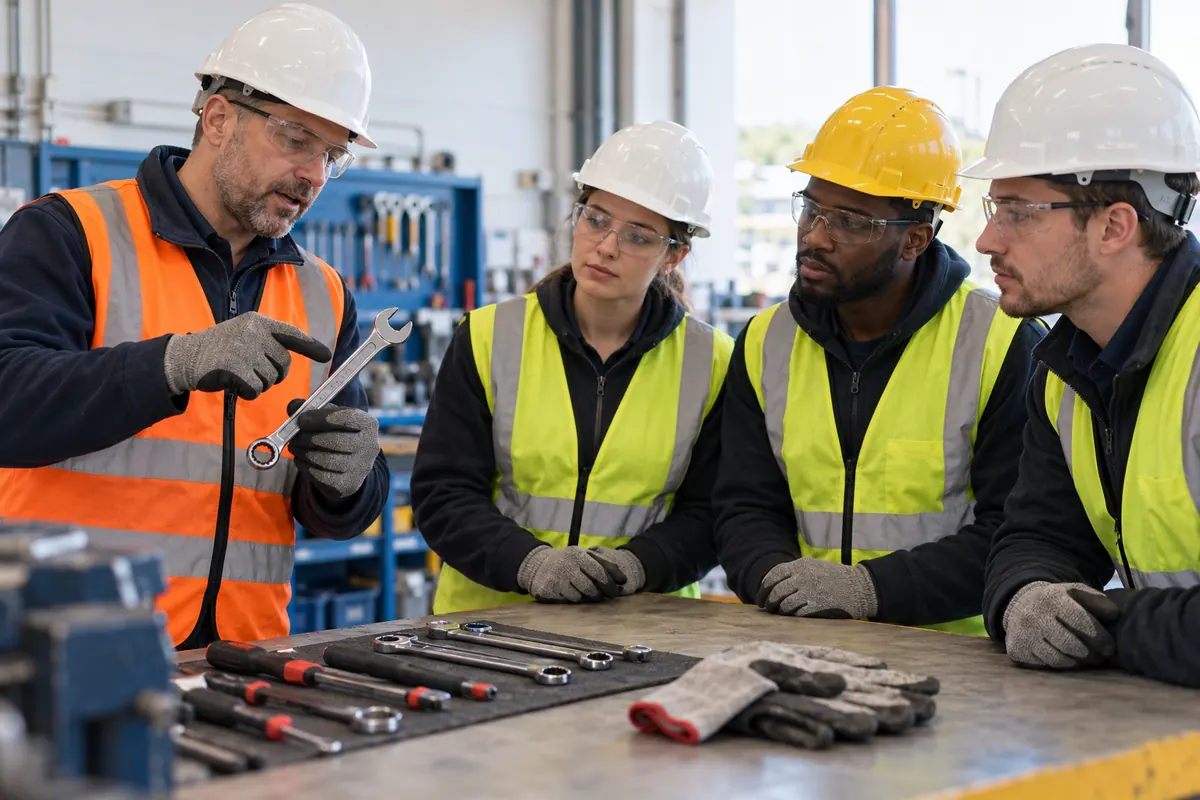
A hand injury prevention toolbox talk should examine where hands go during the real task. A glove choice matters, but it does not remove a pinch point, repair a damaged tool or replace a machine guard. Start with the operation and identify how contact can be prevented.
Prepare the briefing
Select a safe ground-level example using an unpowered tool or drawing. Do not demonstrate a trapping point with moving equipment. OSHA machine-guarding guidance describes injury potential from moving parts. Use the task assessment and equipment instructions to establish the controls for the actual work.
Presenter note: Read the script in a language the crew understands, add today’s task and controls, and pause for answers. The briefing supplements the assessed safe system of work.
Toolbox talk script
Before applying force, think about where your hand will go if the tool slips or the material moves. Keep hands away from the expected movement path and use the correct support, tool or handling aid. Do not use a finger to align a hole or feel a gap where parts can move together. If the method requires that exposure, stop and ask for a safer arrangement.
Check the tool is suitable and in good condition. Worn jaws, damaged handles or the wrong size can increase the chance of losing control. Do not add improvised extensions or use a tool for a purpose it was not designed for. Keep the work stable and make sure nearby people are clear before work starts.
Guards and energy-control arrangements must remain effective. Never reach through or bypass a guard, and do not assume a stopped machine cannot restart. Use the authorised isolation process for intervention. Wear the hand protection selected for the task, recognising that gloves can introduce an entanglement risk near some moving machinery. Follow the assessment rather than a blanket rule. Report cuts, defects and changes promptly.
Crew understanding questions
| Ask the crew | What to discuss |
|---|---|
| Where could the material move or close a gap? | Ask for actual pinch points in the planned task. |
| What prevents hand contact with the hazard? | Identify the support, handling aid, guard or other engineered arrangement. |
| What glove selection applies here? | Confirm the assessed protection and any entanglement limitation. |
Discuss a practical scenario
Illustrative discussion: a worker proposes holding a small component by hand while another tightens it. Ask how it will be supported if it rotates. Agree a suitable securing method before applying force, instead of relying on a tighter grip or heavier gloves.
Close the briefing with clear actions
Record unsuitable tools, missing supports or unclear isolation arrangements as actions. Explain and recheck any misunderstood control. A briefing does not make an unguarded machine ready for use.
Record the topic, task, date, presenter, attendance reference and outstanding actions. Use the toolbox talk feedback form to capture unclear points and recheck understanding. Keep competence evidence in the safety training matrix.
Common questions
Are gloves always the main control?
No. Control the hazard first and select protection for the actual task and equipment.
Does a stopped machine count as isolated?
No. Follow the authorised hazardous-energy control procedure and verification requirements.
Primary sources and applicability
Source jurisdictions are identified below. Confirm current Saudi requirements, the site assessment and applicable manufacturer instructions. No client or regulator approval of this example is claimed.
- OSHA: Machine guarding — United States guidance.