
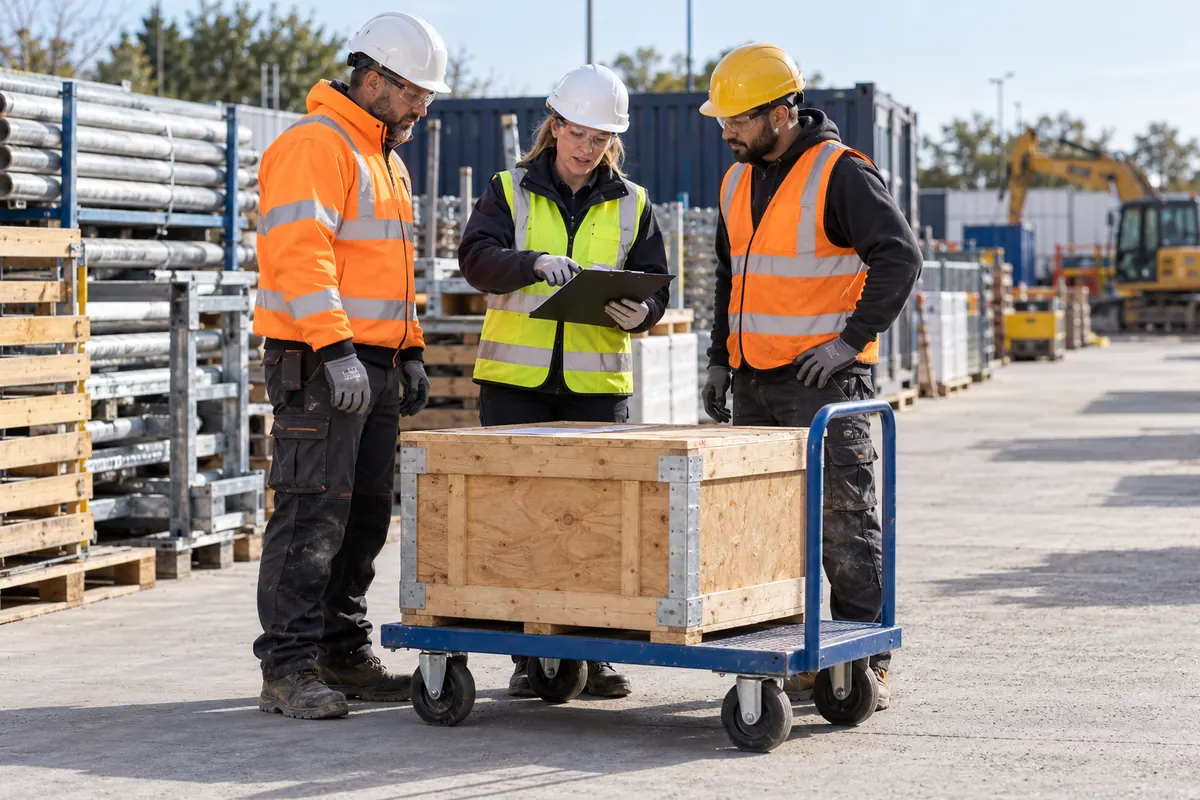
A manual handling toolbox talk should end with an agreed way to move today’s materials—not just a reminder to bend the knees. Discuss whether handling can be avoided, whether an aid suits the load and route, and what will stop the task. Use the briefing below with the actual assessment and workers’ input; it is not training or permission to attempt an uncertain lift.
Prepare one real task
Choose a delivery, relocation or installation activity the crew will actually perform. Check the load information, start and destination, access, frequency and suitable assistance. Deliver the talk in a safe area. Do not ask someone to demonstrate a heavy or unstable lift to make the session memorable.
In Great Britain, HSE’s approach is to avoid hazardous manual handling where reasonably practicable, assess unavoidable handling and reduce the risk. Its guidance does not set one universal legal lifting-weight limit. Other jurisdictions and tasks may impose additional requirements.
Read or adapt this crew script
“Before we move these materials, let us agree why the move is needed and whether we can change delivery or positioning so less handling is required. If we use a trolley or other aid, it must suit the load and the whole route, including the final placement. Wheels do not remove pushing, pulling, trapping or runaway-load risks.
Look at the shape, stability, grip and contents as well as the known weight. Do not trial-lift an unknown load to estimate whether it is safe. Check the assessment and get reliable information or competent help. A familiar package may be damaged, wet or differently loaded today.
Our destination must be ready before we begin. Check doors, changes in level, ground condition and the space to set the item down without trapping hands. Do not start a move that depends on finding a resting place halfway through.
If the planned aid, route, staffing or control is missing, stop and tell the supervisor. A second person is not an automatic solution: coordinated handling still needs a suitable load, space, agreed method and people able to carry it out. Nobody should feel obliged to continue through pain or loss of control.”
Ask the crew to show understanding
| Ask | Listen or look for |
|---|---|
| Can we avoid or reduce this move? | A practical delivery, storage or method option |
| What could change along the route? | Ground, doors, traffic, level changes and destination |
| What makes the load awkward? | Shape, stability, grip, contents and repetition |
| When will we stop? | Specific missing control or changed condition |
| Who resolves the problem? | Named site escalation route, not “be careful” |
Invite quieter workers to contribute and check language needs. The aim is shared understanding, not getting everyone to repeat a lifting slogan. Do not record a person as competent merely because they attended.
Discuss this fictional change
A delivery was planned onto a level hardstanding with a suitable handling aid. After rain, the final access is soft and uneven. Ask: does the aid still suit the route, can delivery or positioning change, and who must approve the revised arrangement? The acceptable response is to resolve the change before moving, not assume a team lift compensates for the ground.
Close with a short action record
| Record | Complete for today |
|---|---|
| Task and assessment | Actual move, location and current reference |
| Agreed method | Avoidance or suitable handling arrangement |
| Open issue | What must be resolved before work |
| Owner/recheck | Responsible person and verification |
| Crew feedback | Concern or practical improvement raised |
If the issue is unresolved, record the work restriction and communicate it at handover. Follow up on the action rather than keeping only a signed attendance sheet.
Keep this talk separate from other lifting work
For the broader method see hand-lifting guidance. Crane and rigging procedures concern a different operation. Competence-based training explains when briefing alone is insufficient.
Sources and scope
See HSE manual-handling guidance and CPWR’s lifting/carrying talk. CPWR includes an illustrative50-pound solo-lifting caution; it is not used here as a universally safe threshold. This original discussion script must be adapted to the assessed work and local requirements.