
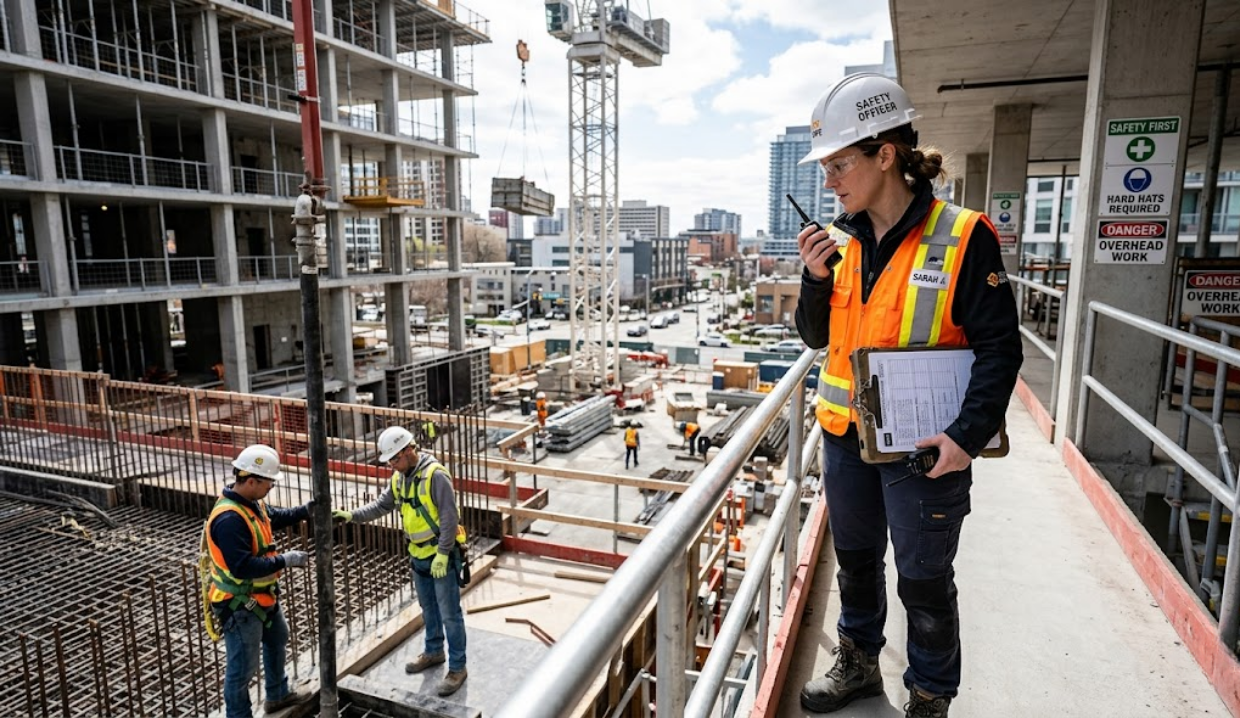
It was a routine morning on a mid-rise construction project. Workers were rushing to meet a tight deadline. Scaffolding was partially dismantled the night before, but no barricades were installed. Within minutes, a mason stepped into an unsecured edge and fell—resulting in a serious injury, work stoppage, and a regulatory investigation.
This wasn’t a failure of equipment. It was a failure of oversight.
A competent construction safety officer would have identified the hazard, enforced controls, and prevented the incident entirely.
What Is a Construction Safety Officer?
A construction safety officer is responsible for ensuring that all site activities comply with HSE standards, safety procedures, and regulatory requirements. Their role is not just advisory—it’s operational, preventive, and enforcement-driven.
They bridge the gap between management plans and real-world execution on-site.
Core Responsibilities
- Conducting hazard identification and risk assessments
- Monitoring compliance with safety procedures
- Ensuring proper use of PPE (Personal Protective Equipment)
- Leading safety inductions and toolbox talks
- Investigating incidents and near misses
- Coordinating safety audits and inspections
- Enforcing corrective actions
In high-risk industries like construction and oil & gas, their presence directly impacts incident prevention and operational continuity.
Key Duties in Daily Site Operations
1. Hazard Identification and Risk Assessment
A safety officer continuously scans the work environment for hazards:
- Working at height risks
- Electrical exposure
- Heavy equipment movement
- Excavation collapse hazards
Each hazard must be evaluated using a structured risk assessment process:
- Likelihood of occurrence
- Severity of consequences
- Control measures required
Example:
On a pipeline project, identifying unstable trench walls early can prevent fatal cave-ins.
2. Implementation of Safety Procedures
Policies alone don’t prevent accidents—execution does.
A construction safety officer ensures:
- Permit-to-work systems are followed
- Lockout/tagout procedures are applied
- Confined space entry protocols are enforced
- Lifting plans are approved and supervised
They verify—not assume—that procedures are followed correctly.
3. PPE Compliance and Monitoring
PPE is often the last line of defense. Safety officers ensure:
- Workers wear helmets, gloves, safety shoes, and harnesses where required
- PPE is in good condition and properly used
- Specialized PPE is available for high-risk tasks
Common issue: Workers wearing harnesses but not anchoring them properly.
Also read: What Are the Types of Warning Signs You Must Know
4. Site Inspections and Safety Audits
Routine inspections are non-negotiable.
A safety officer conducts:
- Daily walk-through inspections
- Weekly compliance audits
- Pre-task safety checks
They document:
- Unsafe acts
- Unsafe conditions
- Corrective actions
This creates accountability and traceability.
5. Incident Investigation and Reporting
When incidents occur, the role becomes critical.
A structured investigation includes:
- Root cause analysis
- Witness interviews
- Evidence collection
- Corrective action planning
The goal is not blame—it’s prevention of recurrence.
Step-by-Step: How a Safety Officer Manages Site Safety
Step 1: Pre-Work Planning
- Review method statements and risk assessments
- Identify high-risk activities
- Coordinate with supervisors
Step 2: Site Induction
- Introduce workers to hazards and controls
- Explain emergency procedures
- Ensure competency verification
Step 3: Active Monitoring
- Conduct frequent site patrols
- Observe worker behavior
- Intervene immediately when unsafe acts are identified
Step 4: Documentation
- Maintain inspection reports
- Track safety observations
- Record incidents and near misses
Step 5: Corrective Action Follow-Up
- Ensure hazards are resolved
- Verify compliance
- Escalate unresolved issues
Risks and Common Mistakes on Construction Sites
Even experienced teams make critical errors. A construction safety officer must recognize these patterns early.
1. Ignoring Minor Hazards
Small issues like loose cables or missing guardrails often lead to major incidents.
2. Poor Communication
Lack of coordination between contractors results in overlapping risks.
Example: Simultaneous hot work and flammable material storage.
3. Inadequate Supervision
Assuming workers understand safety procedures without verification leads to unsafe practices.
4. Documentation Without Action
Filling forms without implementing corrective actions creates a false sense of safety.
5. Time Pressure Over Safety
Deadlines often push teams to bypass safety protocols—this is where accidents happen.
Industry Best Practices for Construction Safety Officers
1. Proactive Safety Culture
Safety should be visible and consistent—not reactive.
- Encourage reporting of near misses
- Reward safe behavior
- Lead by example
2. Risk-Based Approach
Focus on high-risk activities:
- Working at height
- Lifting operations
- Confined spaces
Allocate resources where the risk is highest.
3. Continuous Training
Regular training ensures awareness stays high:
- Toolbox talks
- Emergency drills
- Equipment handling sessions
4. Strong Permit-to-Work System
Control hazardous tasks through structured permits:
- Hot work permits
- Excavation permits
- Electrical isolation permits
5. Effective Communication
Daily coordination meetings between teams reduce risk overlap.
Compliance and Safety Impact
A construction safety officer plays a direct role in:
Legal Compliance
Failure to comply with safety regulations can result in:
- Fines and penalties
- Project shutdowns
- Legal liability
Operational Efficiency
Safe sites are productive sites.
- Reduced downtime
- Fewer disruptions
- Improved worker morale
Audit Readiness
Well-documented safety practices ensure readiness for:
- Client audits
- Regulatory inspections
- Certification reviews
FAQS: Construction safety officer
Typically, a diploma or degree in safety, engineering, or a related field, along with recognized HSE training and site experience.
A safety officer focuses on on-site implementation, while a safety engineer designs systems and controls at a higher level.
Daily inspections are recommended, with more detailed audits conducted weekly or monthly depending on project size.
It identifies hazards before they cause harm, allowing preventive measures to be implemented effectively.
Falls from height, electrical risks, equipment accidents, and excavation collapses are among the most frequent.
Internal Linking Suggestions
To strengthen topical authority, link this article to:
- Risk assessment methodology in construction projects
- PPE requirements and compliance guidelines
- Incident investigation and root cause analysis
Conclusion
A construction safety officer is not just a compliance figure—they are a frontline risk manager. Their presence on-site determines whether hazards are controlled or ignored, whether procedures are followed or bypassed.
In high-risk environments, safety is not optional. It is operational discipline.
The difference between a safe project and a failed one often comes down to how effectively safety is managed on the ground.