
A scaffold inspection report form records who inspected a scaffold, which scaffold and where, when, what was found, whether work can safely go ahead, who was told, and what was done about it. Fill in one row each time a competent person inspects, sign it, and keep it. The free Word form on this page does exactly that.
How often you must inspect depends on the law that applies to you. In the US, OSHA requires a competent person to inspect a scaffold before each work shift and after any occurrence that could affect its structural integrity. In the UK, a working platform used for construction work from which a person could fall 2 meters or more must be inspected in position within the previous 7 days, and a written report made. Your company or client may require more.
Download the scaffold inspection report form
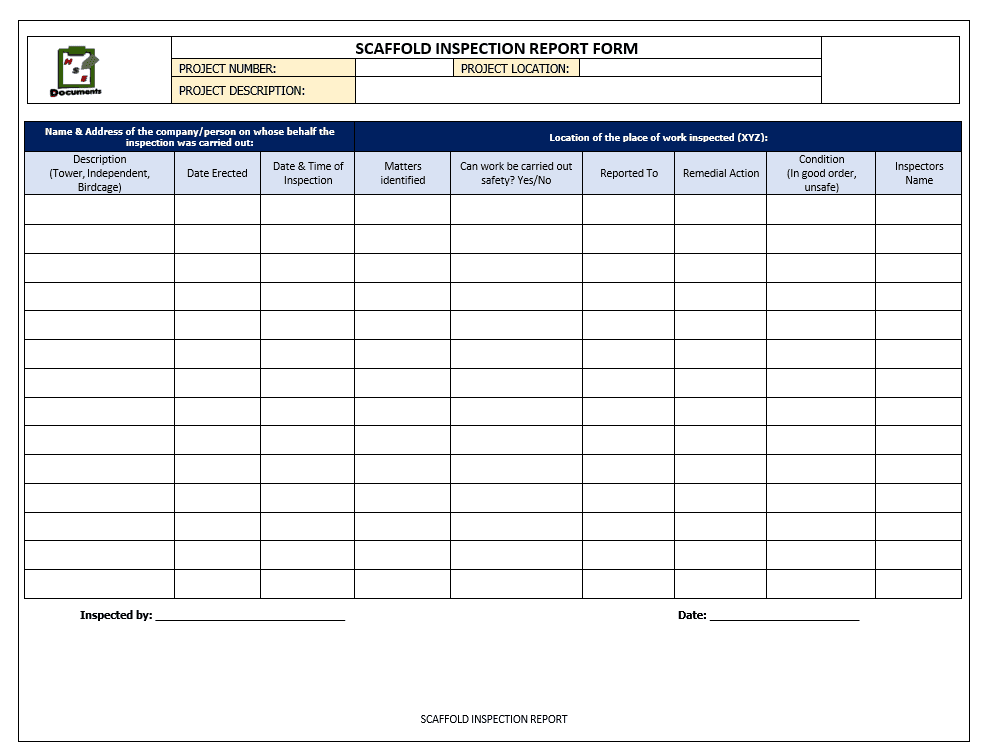
The image shows the form. The download below is the editable Word file attached to this page.
How to fill in the form
| Form field | What to write | Why it is there |
|---|---|---|
| Project number, location, description | The project, the site area and the job the scaffold serves. | Ties the report to a place and a job. |
| Name and address of the company or person on whose behalf the inspection was carried out | The scaffold owner or the contractor who asked for the inspection. | UK Schedule 7 asks for the name and address of the person the inspection was carried out for. |
| Location of the place of work inspected | The exact bay, elevation or grid reference. | Several scaffolds on a site can look alike. |
| Description (tower, independent, birdcage) | The scaffold type and a unique identifier if there is one. | Different types have different checks. |
| Date erected | When the scaffold was built. | Shows its age and any later alterations. |
| Date and time of inspection | Both, in full. | UK Schedule 7 asks for the date and time. |
| Matters identified | Every defect or concern, even small ones. | The report is a record of what the inspector actually found. |
| Can work be carried out safely? Yes or No | A clear answer. If no, the scaffold is not used. | Gives the crew a plain go or no-go. |
| Reported to | The person who was told, such as the supervisor. | Shows who knew and when. |
| Remedial action | What was done or must be done, and by whom. | UK Schedule 7 asks for action taken and further action considered necessary. |
| Condition (good order, unsafe) | One word summary of the scaffold’s state. | Fast to scan later. |
| Inspector’s name, inspected by, date | Name, signature and date. | Shows who is responsible. |
One gap to fix before you use it in the UK: Schedule 7 of the Work at Height Regulations 2005 asks for the name and position of the person making the report. The form has a name box but no position box, so add the inspector’s job title or role.
What the law says about inspection
| Where | When to inspect | What to record |
|---|---|---|
| US (OSHA 1926.451(f)(3)) | Before each work shift, and after any occurrence that could affect structural integrity. A competent person does it, for visible defects. | OSHA 1926.451 sets no written report format or retention period. Follow your employer, client and state rules. |
| UK (Work at Height Regulations 2005, regulation 12) | After installation, in position, before use. For a construction working platform with a fall of 2 meters or more, within the previous 7 days. Also after exceptional circumstances that could jeopardize safety. | A report with the Schedule 7 particulars before the end of the working period, a copy to the person who asked for it within 24 hours, kept on site until the work is complete and at an office for 3 months after. |
HSE guidance says inspection of a scaffold from which a person might fall 2 meters or more needs a report from a competent person on completion and at least weekly after that. It adds that a risk assessment may call for more frequent inspections, and that inspection may be needed after bad weather and always after any modification. A visible tag system is not a legal requirement in the UK, but HSE calls it a useful supplement to inspection reports.
Other countries and many companies set their own intervals. Saudi Aramco’s joint site inspection checklist, for example, asks whether the scaffold tag is completed correctly, signed and shows a valid inspection date (GI 2.100, Supplement 2.100-3, item 4.9). Scaffold erection is also listed there as an example of cold work. See the cold work permit checklist.
What the inspector checks
The list below comes from the OSHA scaffold rule, 29 CFR 1926.451. It is a prompt for the Matters identified column, not a full inspection manual. Metric values are OSHA’s own conversions.
| Check | What the OSHA text says |
|---|---|
| Foundation | Poles, legs and frames bear on base plates and mud sills or another firm foundation. Footings are level, sound, rigid and able to carry the loaded scaffold without settling. Unstable objects are not used ((c)(2)). |
| Plumb and braced | Uprights are plumb and braced to prevent swaying and displacement ((c)(3)). |
| Ties | A supported scaffold more than 4 times as high as its base width is restrained from tipping by guying, tying or bracing ((c)(1)). |
| Decking | Platforms are fully planked or decked, with no more than 1 inch (2.5 cm) between units and the uprights, except where a wider gap is shown to be necessary ((b)(1)). Platforms are at least 18 inches (46 cm) wide in most cases ((b)(2)). |
| Guardrails | Top rails 38 to 45 inches (0.97 to 1.2 m) above the platform on supported scaffolds placed in service since 1 January 2000, with midrails or equivalent, installed on all open sides and ends ((g)(4)). |
| Toeboards | At least 3.5 inches (9 cm) high where there is a danger of falling objects and the platform is more than 10 feet (3.1 m) above a lower level ((h)(4), (h)(2)(ii)). |
| Access | Where the platform is more than 2 feet (0.6 m) above or below the access point, a ladder, stair tower, ramp or similar is used. Cross braces are not used for access ((e)(1)). |
| Fall protection | Anyone on a scaffold more than 10 feet (3.1 m) above a lower level is protected from falling ((g)(1)). |
| Loading | Scaffolds and components are not loaded beyond their maximum intended loads or rated capacities ((f)(1)). |
| Damage | Any part damaged or weakened is repaired, replaced or removed from service at once ((f)(4)). |
| Surface condition | No work on scaffolds covered with snow, ice or other slippery material, except to remove it. Debris is not allowed to build up on platforms ((f)(8), (f)(13)). |
| Power lines | Minimum clearance to energized lines is kept, for example 10 feet (3.1 m) for uninsulated lines under 50 kV ((f)(6)). |
| Wind and storms | Work is prohibited in storms or high winds unless a competent person has decided it is safe and employees are protected by fall arrest or wind screens ((f)(12)). |
Who counts as a competent person
OSHA requires a competent person to inspect and also to supervise erection, moving, dismantling and alteration (1926.451(f)(3) and (f)(7)). The UK regulation defines inspection as a visual or more rigorous inspection by a competent person as appropriate for safety purposes, including any testing needed (regulation 12(10)). Competence here means training and experience for the type of scaffold, not a job title. HSE adds that scaffolds should only be designed, erected, altered and dismantled by competent people under a competent supervisor.
What to do when an inspection finds a fault
- Write the fault in Matters identified and answer No to Can work be carried out safely.
- Stop use of the scaffold or the affected area and tell the person in charge.
- Record who you told in Reported to.
- Have it repaired by competent people and record the Remedial action.
- Inspect again before anyone uses it, and record the new inspection on the next row.
Questions about scaffold inspection reports
How often must a scaffold be inspected?
In the US, before each work shift and after any occurrence that could affect structural integrity. In the UK, within the previous 7 days for a construction working platform with a fall of 2 meters or more, and after any exceptional event. Check your own country and your client’s rules.
Who can sign the report?
A competent person who carried out the inspection. The form needs their name and, for UK use, their position.
Is a scaffold tag the same as an inspection report?
No. A tag tells people on the spot that the scaffold has been inspected. The report is the record. HSE says tags are not a legal requirement in the UK but are a useful addition.
How long do I keep the report?
In the UK, on site until the work is finished and then at an office for 3 months. OSHA 1926.451 sets no period, so follow your employer, client and local rules.
Related reading: risk assessment for work at height and the cold work permit checklist.
Sources (checked 31 October 2026)
- OSHA 29 CFR 1926.451, Scaffolds: general requirements
- UK Work at Height Regulations 2005, regulation 12, Inspection of work equipment
- UK Work at Height Regulations 2005, Schedule 7, Particulars to be included in a report of inspection
- HSE, Scaffolding FAQ
- Saudi Aramco GI 2.100, Work Permit System (19 July 2020), Supplement 2.100-3 and definition 4.1 (internal document, no public link).
A template and general guidance. It does not replace the scaffold manufacturer’s instructions, a competent person’s judgment or the law that applies at your site.