
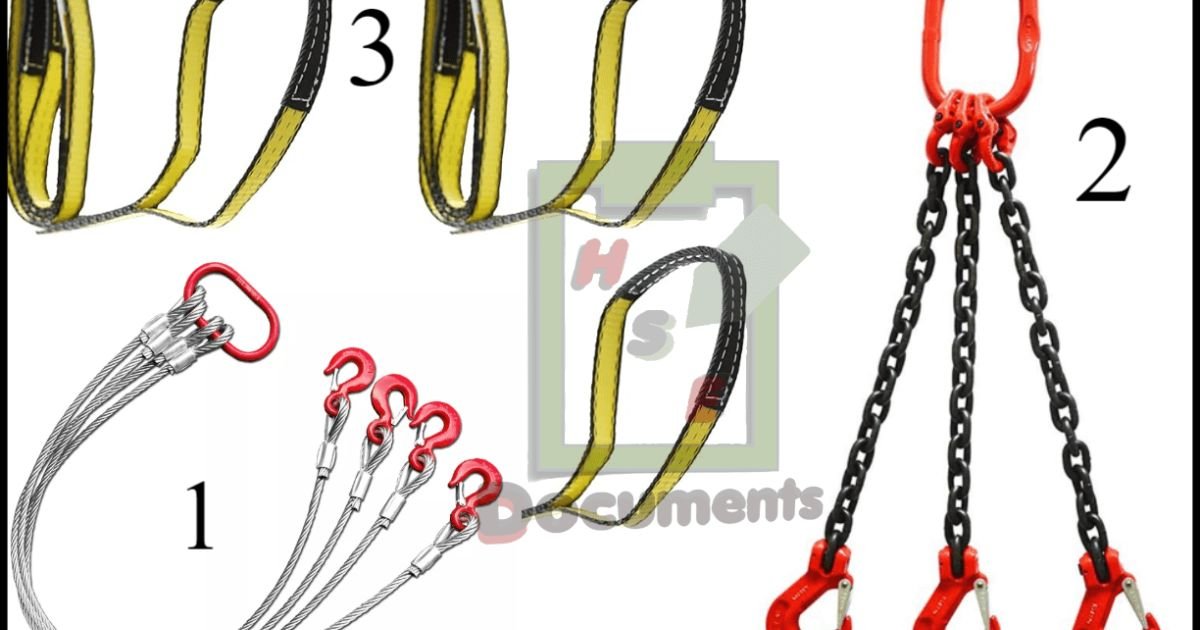
The three main types of lifting slings are wire rope, alloy steel chain and synthetic slings (web and round). OSHA’s sling standard, 29 CFR 1910.184, also covers metal mesh and natural or synthetic fiber rope. Choose the type from the load (weight, shape and center of gravity), the environment (heat, chemicals and abrasion), the surface of the load and the way the sling will be hitched. Then use it only within the rated capacity marked on its tag for that exact hitch and angle.
This page compares the types, shows how to choose, explains hitches and sling angles, and lists the inspection and removal rules. Sling capacities are set by the manufacturer for each hitch and angle, so use the tag on the sling and not a general rule. For the principle behind the tag, see working load limit (WLL).
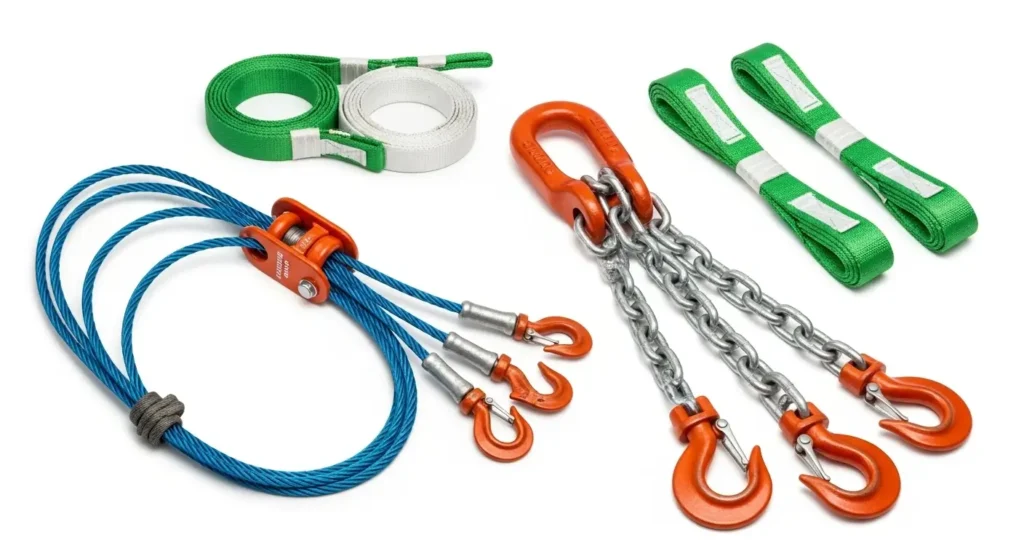
Sling types compared
| Type | Good for | Main strengths | Main limits |
|---|---|---|---|
| Wire rope | Rough, abrasive loads and hot materials | Strength, durability, abrasion resistance and the ability to conform to the load. OSHA notes wire rope slings can lift hot materials | Kinks, crushing, broken wires and corrosion end its life. Fiber-core is more flexible but less resistant to environmental damage |
| Alloy steel chain | Heavy, rugged loads and high heat | Rugged. The standard requires removal if the chain is heated above 1,000 °F and a reduced working-load limit above 600 °F | Link wear, defective welds, deformation, increase in length, and distorted or opened hooks. Avoid shock loading |
| Synthetic web | Finished, polished, painted or fragile surfaces | Soft and flexible, protects the load surface | Cuts, snags, burns, chemicals and heat. Sharp edges must be padded |
| Synthetic round | Irregular, cylindrical or delicate loads | Flexible and adapts to the shape | Same cut, heat and chemical limits as other synthetics; follow the manufacturer’s data |
| Metal mesh | Loads where the manufacturer recommends a mesh sling | For slings not coated with elastomers, the standard gives a temperature range of -20 to 550 °F without reducing the working load limit | Broken welds, loss of wire diameter from abrasion or corrosion, lost flexibility and distorted handles |
| Natural or synthetic fiber rope | Loads where a rope sling is suitable | Covered by the standard; follow the manufacturer’s data | Check the standard and the manufacturer’s limits for the rope type |
Where a table value, temperature or limit matters, take it from the sling’s tag and the manufacturer’s data. The figures above are from OSHA’s standard and guidance as checked on the date at the end of this page.
The main sling types in detail
Wire rope slings
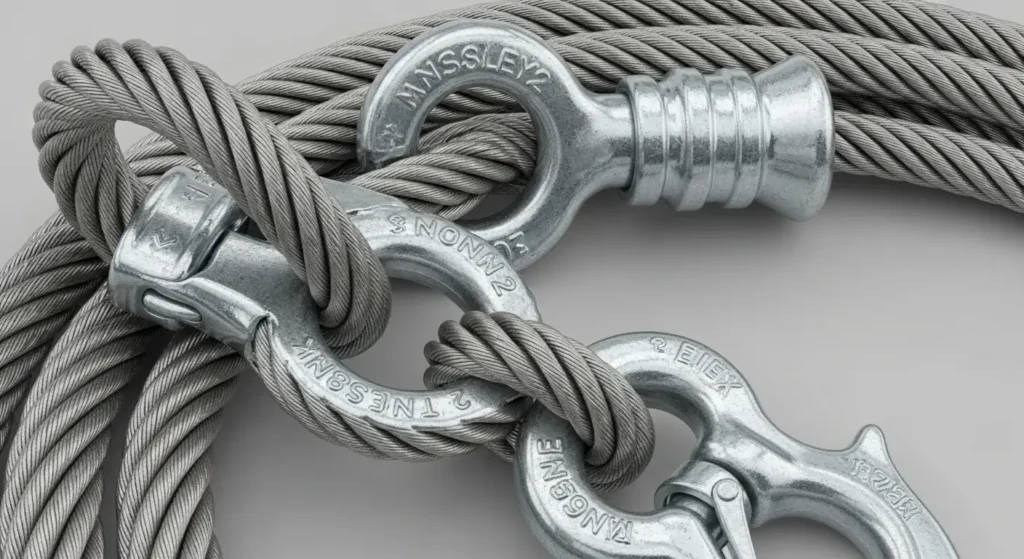
OSHA’s guidance explains why wire rope is common in slings: strength, durability, abrasion resistance and the ability to conform to the shape of the load. The rope has either an independent wire rope core (IWRC) or a fiber core. A fiber core is usually more flexible but less resistant to environmental damage, while a core made of wire rope strand tends to be stronger and more resistant to heat damage. When selecting a wire rope sling, OSHA lists four characteristics to weigh: strength, the ability to bend without distortion, the ability to withstand abrasive wear and the ability to withstand abuse.
Do not make a sling with knots, and do not use wire rope clips to make a sling except where the application rules out a prefabricated one and a qualified person has designed it. A sling made with wire rope clips must not be used in a choker hitch.
Alloy steel chain slings
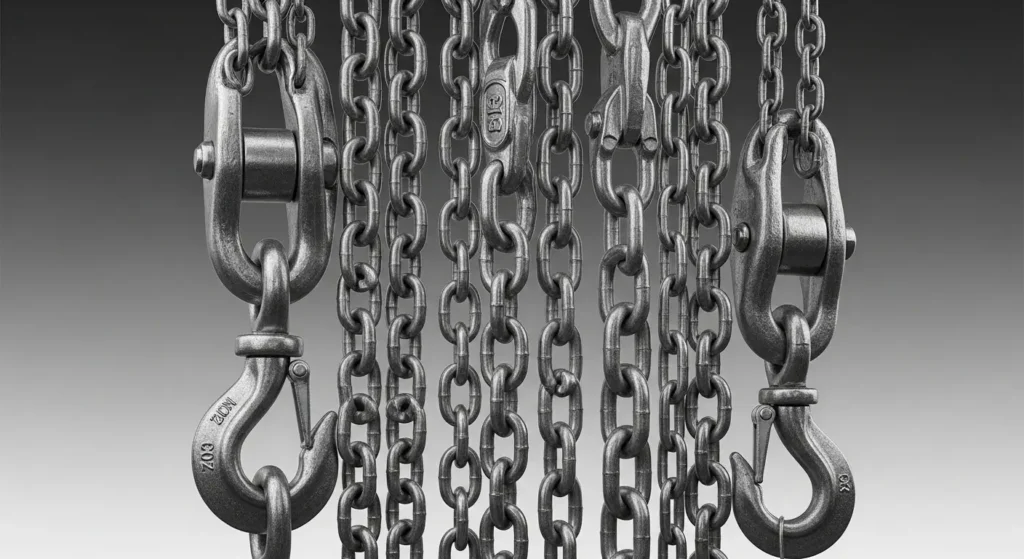
The standard requires alloy steel chain slings to carry permanently affixed, durable identification stating the size, grade, rated capacity and reach. Hooks, rings and other attachments must have a rated capacity at least equal to that of the chain, or the sling must not be used above the capacity of its weakest component. Makeshift links or fasteners made from bolts or rods must not be used. Each new, repaired or reconditioned chain sling must be proof tested by the manufacturer or an equivalent entity before use, and the employer keeps the proof test certificate.
Synthetic web and round slings
For synthetic web slings the standard requires each sling to be marked or coded to show the rated capacities for each type of hitch and the type of synthetic web material. Stitching is the only method allowed to attach end fittings and to form eyes. Fittings must have a minimum breaking strength equal to that of the sling and must be free of sharp edges that could damage the webbing. A repaired web sling must be proof tested at twice its rated capacity before it returns to service, and a temporary repair is not allowed. Round slings are not covered by their own paragraph in 1910.184, so follow the manufacturer’s data and your own risk assessment.
Metal mesh and fiber rope slings
Metal mesh slings must be permanently marked with the rated capacity for vertical, basket and choker hitch loadings. Repaired mesh slings must be repaired by a metal mesh sling manufacturer or equivalent entity and marked or recorded with the date, nature and person or organization that did the repair. Check the standard and the manufacturer’s data before using either type.
How to choose a sling
| Ask | Why it matters | Leans toward |
|---|---|---|
| How heavy is the load, and where is the center of gravity? | The sling and its hitch must be rated above the load on each leg | Capacity tag and the sling angle, not a guess |
| Is the surface finished, painted or fragile? | Hard slings can scratch or crush the surface | Synthetic web or round, with edge protection |
| Are there sharp edges or rough surfaces? | Cuts and abrasion are the common cause of sling failure | Wire rope, chain or mesh, or padded synthetic |
| How hot is the load or the area? | Each material has its own temperature limit | Chain or wire rope for heat; check the limit for synthetics |
| Are chemicals present? | Acids, alkalis and solvents damage different materials differently | Material matched to the chemical per the manufacturer |
| What hitch will you use? | Capacity changes with the hitch | Choose from the rated load for that hitch |
| Will the load shift or swing? | Shock loading can exceed the rating in an instant | Plan the lift and avoid shock loads |
Chemicals and temperature limits for synthetics
OSHA’s sling standard sets chemical and temperature limits for synthetic web slings. Nylon must not be used with acids or phenolics. Polyester and polypropylene must not be used with caustics. Polyester and nylon slings must not be used at temperatures above 180 °F, and polypropylene above 200 °F. Check the manufacturer’s data for the specific sling.
Rated capacity and identification
Every sling must carry identification. OSHA’s guidance says new wire rope slings are marked by the manufacturer with the rated load for the types of hitches and the angle those ratings are based on, the diameter or size and the name or trademark of the manufacturer. A sling with a missing or unreadable tag should be removed from service until it is replaced or re-identified by the manufacturer.
Rated loads depend on the material strength, the design factor, the type of hitch, the angle of loading, the diameter of curvature over which the sling is used and the fabrication efficiency. Never exceed the rated load for the actual configuration, and for multiple-leg slings never exceed the single-leg rating in any leg.
Hitches
| Hitch | How it works | Key points |
|---|---|---|
| Vertical | One leg straight from hook to load | Rated at the vertical capacity on the tag |
| Choker | Sling wraps the load and passes through its own eye | Capacity is lower than vertical. OSHA’s guidance gives the wire rope table values only where the angle of choke is 120 degrees or more. Put the choke point on the body of the sling, not on a fitting. Do not use slings made with wire rope clips as chokers |
| Basket | Sling passes under the load and both ends go to the hook | Balance the load and keep the legs above the center of gravity so it cannot slip |
| Bridle | Two, three or four legs to one hook | Share depends on the angle and on how evenly the load is balanced |
Sling angle and why it changes capacity
When legs are not vertical, the tension in each leg grows as the angle from the horizontal gets smaller. For a two-leg sling that shares the load equally, tension in each leg equals the load divided by 2 times the sine of the angle from horizontal. The tag capacity for an angle already allows for this; the point is that flat angles load the legs heavily.
| Angle from horizontal | Tension in each leg as a multiple of the vertical share | Each leg for a 4,000 lb load shared by two legs |
|---|---|---|
| 90 degrees (vertical) | 1.00 | 2,000 lb |
| 60 degrees | 1.155 | 2,309 lb |
| 45 degrees | 1.414 | 2,828 lb |
| 30 degrees | 2.000 | 4,000 lb |
The figures are calculated from the geometry and assume equal sharing between two legs; a real lift can load one leg more, and OSHA’s guidance requires an analysis by a qualified person for nonsymmetrical loads. OSHA’s guidance on wire rope slings also says not to use horizontal angles of less than 30 degrees unless the manufacturer or a qualified person recommends it. For a chart, see sling graph for safe lifting.
Inspection and removal from service
A sling must be inspected before use. Under 29 CFR 1910.184(d), each day before use the sling and all fastenings and attachments are inspected for damage or defects by a competent person designated by the employer. Periodic inspections are also required where service conditions warrant. For alloy steel chain slings the standard requires a thorough periodic inspection by a competent person at intervals of no more than once every 12 months, and the employer must keep a record of the most recent month in which each chain sling was thoroughly inspected. For wire rope slings, OSHA’s guidance says periodic inspections should be at intervals of no more than 12 months: yearly for normal service, monthly to quarterly for severe service. It notes that the sling standard does not require inspection records for wire rope, while the ASME standard does.
In Great Britain, a lifting accessory such as a sling must be thoroughly examined at least every 6 months, or in line with an examination scheme drawn up by a competent person, under the Lifting Operations and Lifting Equipment Regulations (LOLER) 1998. HSE says slings and chains still need a proper pre-use check.
Remove a wire rope sling for
- Broken wires: 10 randomly distributed broken wires in one rope lay, or 5 broken wires in one strand in one lay.
- Wear or scraping of one-third of the original diameter of the outside individual wires.
- Kinking, crushing, bird caging or any other damage to the rope structure.
- Heat damage.
- Severe corrosion of the rope or its end attachments.
- End attachments that are cracked, deformed or worn.
- Hooks opened more than 15 percent of the normal throat opening or twisted more than 10 degrees from the plane of the unbent hook.
- A missing or illegible identification marking, which the standard requires on wire rope slings.
Remove a chain sling for
- Wear, defective welds, deformation or an increase in length found at a thorough inspection.
- A chain size at any point of a link that is less than the minimum in the standard’s Table N-184-1.
- Cracked or deformed master links, coupling links or other components.
- Hooks that are cracked, opened more than 15 percent of the normal throat opening, or twisted more than 10 degrees from the plane of the unbent hook.
- Heating above 1,000 °F, which means permanent removal. Above 600 °F the working-load limit must be reduced as the manufacturer directs.
- Makeshift links or fasteners made from bolts or rods, which must not be used at all.
Remove a synthetic web sling for
- Acid or caustic burns.
- Melting or charring of any part of the sling surface.
- Snags, punctures, tears or cuts.
- Broken or worn stitches.
- Distortion of fittings.
- A missing or unreadable marking showing the rated capacities for each type of hitch.
Remove a damaged sling from service immediately. OSHA’s guidance says not to repair the wire rope itself: repairs are restricted to end attachments and fittings, must be done by the manufacturer or a qualified person, and a repaired sling must be marked to show who repaired it.
Safe use rules that apply to every sling
- Do not use a damaged or defective sling, and do not tie knots in a sling to shorten it.
- Pad sharp edges where the sling touches the load, with material strong enough to protect it.
- Do not shock load. Lift smoothly and avoid snatching or dropping.
- Keep hands, fingers and all parts of the body out from between the sling and the load, and between the sling and the hook.
- Never stand in line with a sling under tension, and never stand or pass under a suspended load.
- Do not pull a sling from under a load that is resting on it, and do not drag slings on the floor or over abrasive surfaces.
- Do not inspect a wire rope sling by running bare hands over it, as broken wires can puncture the skin.
- Store slings where they will not be damaged by mechanical damage, corrosion, moisture or extreme temperatures.
Plan the lift, not only the sling
The sling is one part of the lift. The lift plan should record the load weight, the rigging, the hitch and the angle. See lifting and rigging procedures, all about the lifting and rigging procedure and the mobile crane lifting plan. A signal person should use the rigging hand signals, and the work should be authorized with a lifting permit checklist. For risks in banking and slinging, see risk assessment for banking and slinging and risk assessment for heavy lifting with cranes. Wider crane context: crane safety and OSHA rules, crane safety hazards, types of mobile cranes and the crane safety toolbox talk. When lifting near electrical lines, see safe working distance from overhead power lines.
Common mistakes
- Choosing by habit, not by the load surface, heat and chemicals.
- Reading the vertical capacity and using it at a flat angle.
- Using a choker hitch with a rating from a vertical tag.
- No pre-use check, or a check by someone not competent to judge damage.
- Using a sling with a missing tag.
- Leaving slings on the ground where they get run over.
- Repairing a wire rope sling instead of removing it.
Questions about types of slings
What are the types of slings?
The three main types are wire rope, alloy steel chain and synthetic (web and round). OSHA’s standard also covers metal mesh and natural or synthetic fiber rope slings.
Which sling is best for a delicate or finished load?
A synthetic web or round sling, usually with edge protection, because it is soft and does not mark the surface. Check the chemical and temperature limits.
Which sling is best for hot loads?
Alloy steel chain and wire rope are the usual choices. OSHA notes wire rope slings can lift hot materials, and chain is removed if heated above 1,000 °F. Follow the manufacturer’s limits for the specific sling.
How often should slings be inspected?
Before each use, by a competent person under OSHA 1910.184. Chain slings also need a thorough periodic inspection at least every 12 months, and OSHA’s guidance gives the same maximum interval for wire rope slings. In Great Britain, lifting accessories are thoroughly examined at least every 6 months or under an examination scheme.
What is the 30 degree rule?
OSHA’s guidance on wire rope slings says not to use horizontal angles of less than 30 degrees except as recommended by the sling manufacturer or a qualified person, because the tension in each leg rises quickly at flat angles.
Related guides
- Daily tower crane inspection checklist
- Crane safety signs
- Crane assembly and disassembly director
- Crane accident causes: what investigations found
- Boom lift safe work procedure template
- SIMOPS checklist for construction
- How to become a crane operator
- Boom truck certification
- Incident investigation guide
- Health and safety training
Sources (checked 1 November 2026)
- OSHA 29 CFR 1910.184, Slings
- OSHA, Guidance on Safe Sling Use: Wire Rope Slings
- HSE (UK), Thorough examinations and inspections of lifting equipment
- The Lifting Operations and Lifting Equipment Regulations 1998, regulation 9
Temperatures, removal criteria and inspection intervals are from OSHA’s 1910.184 and its wire rope sling guidance as checked on the date above. Where the two differ, for example on the temperature limit for fiber-core wire rope, follow the manufacturer. The angle table is calculated from geometry, not taken from a sling chart. Always use the tag and the manufacturer’s data for the sling in your hand. For construction work, OSHA’s rigging equipment rule is 29 CFR 1926.251.